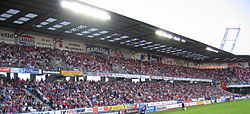
Olympia is a football stadium in Helsingborg ( Sweden ). It is the home stadium of the Helsingborg and Statten football clubs. The capacity of the stadium is 17,100 people. Opened in 1898 and repeatedly reconstructed from that time. The arena hosted such outstanding football events as the matches of the 1958 World Cup , the fights of the 1995 World Cup for women and the game of the European Youth Championship 2009 .
| Olympia | ||
|---|---|---|
 | ||
| original name | Swede. Olympia | |
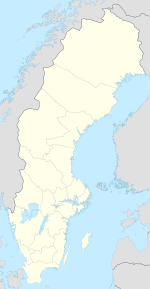
| Location | Helsingborg , Sweden | |
| Open | 1898 | |
| Remodeled | 1997 | |
| Owner | Helsingborg Commune | |
| Capacity | 17 100 | |
| Home team | Helsingborg , Statten | |
| Field dimensions | 105x68 | |

History
In January 1897, AB Olympia was established, the name of which was inspired by the 1896 Olympic Games in Athens . The company's goal was to build a sports arena in the eastern part of Helsingborg . The primary purpose of the arena was to hold competitions in cycling , tennis and ice-skating , however, problems arose in keeping the ice in proper condition, and it was decided to replace the ice rink with a football field . The discovery, which was delayed twice due to adverse weather conditions, was scheduled for Sunday July 31, 1898. The competition program was athletics , cycling and a football match , which, however, did not take place due to darkness.
In 1903, the stadium was used as a venue for rides during the Helsingborg exhibition. And during the 1910s - 20s of the XX century, an annual city fair was held here. On June 27, 1907, the Olympia sports society was formed, which included representatives of various sports (from football to cycling ). Since that time, the stadium was leased and operated by this particular company, until in 1941 the city returned it to its care. In 1909, the first major reconstruction of the arena took place: the construction of a new grandstand for 400 spectators cost 20,000 kroons ; In addition, a booth at the entrance and tennis courts were built. In 1915, the size of the field was brought to international standards of 110x65 meters (before that, the size of the playground was 100x60 meters), and sectors were added for jumping and throwing athletics equipment. In addition, bicycle lanes were replaced by athletics. By the beginning of the competition, a tribune with standing places on the eastern side of the arena was erected in Allsvenskan in 1924.
In 1941, the municipality of Helsingborg set to work on the stadium and the result was the construction of a new grandstand with 1,400 seats over the next decade. On May 14, 1954, an absolute record was set for attendance at the stadium in a duel between Helsingborg and Malmö , which ended with a score of 3: 3. This game was visited by 26 154 spectators [1] . It is still not clear how so many people could fit in at Olympia; probably most of them did not see the field, but focused on the sound. In connection with the matches in the arena of the World Cup in 1958, another stand was built with standing spectator seats and the field size was slightly changed, the new dimensions of which now were 105x68 meters.
1973 was the last year when athletics competitions were held in the arena. Four world records were set at this stadium: an unofficial marathon record in 1912, a women's 800-meter race in 1945, a 3000-meter race in 1965 and a pole vault in 1972.
In 1985, old wooden stands were already demolished, which were already beginning to rot, and new ones were installed on concrete supports. Moreover, Olimpia was finally rebuilt into a football stadium and treadmills were removed. In 1993, the construction of a new grandstand with a capacity of 3,500 seats was completed. In the same year, a record of attendance at the “new” Olympia was set, which amounted to 17,275 spectators who came to the duel between Helsingborg and Gothenburg on July 30, 1993 [2] . In 1995, Olympia became one of the stadiums hosting the 1995 Women's World Cup . In particular, the opening match between the national teams of Sweden and Brazil took place here. Two years later, 7,000 individual plastic seats were installed on the eastern stand. At that time, Olimpia was classified as Sweden's best football stadium.
On May 13, 2006, an article appeared in the Helsingborgs Dagblad newspaper ( Swede. Helsingborgs Dagblad ) with a project proposal to expand the stadium with the addition of a residential building. The project was developed by the Rapid Eye architectural bureau from Malmö [3] . In 2007, the replacement of the natural arena turf with artificial turf was carried out. And two years later the stadium again hosted high-level international matches: Olimpia was on the list of stadiums where the 2009 European Youth Championship matches were held.
Notes
- ↑ Records of attendance at Swedish stadiums (Swedish) (neopr.) ? . Date of treatment January 27, 2013.
- ↑ Rivals in Allsvenskan: Helsingborg (Swedish) (Neopr.) ? . Official site of FC Halmstad . Date of treatment January 27, 2013.
- ↑ The expansion of Olympia with the completion of housing (Swedish) (neopr.) ? (inaccessible link) . Helsingborgs Dagblad . Date of treatment January 27, 2013. Archived March 29, 2009.
Links
- The history of the stadium on the website of FC Helsingborg (Swedish) (neopr.) ? . Date of treatment January 27, 2013. Archived December 25, 2014.
- Profile of the stadium on the Transfermarkt website (English) (inaccessible link) . Date of treatment January 27, 2013. Archived May 17, 2013.
- The profile of the stadium on the site . "Worldfootball . " Date of treatment January 27, 2013.
- The profile of the stadium on the site . "StadiumGuide . " Date of treatment January 27, 2013.
- Gallery with images of the stadium (German) . "Stadien & Arenen" . Date of treatment January 27, 2013.