The Kingdom of Candia ( Italian. Regno di Candia ) or the Duchy of Candia ( Italian. Ducato di Candia ) - the official name of Crete during the period when the island was a colony of the Republic of Venice , from 1205-1212 when the island was conquered by Venice and before joining the Ottoman Empire during the Cretan War (1645–1669) . The capital of the kingdom was the city of Candia (modern Heraklion ). Due to the growing Ottoman threat, especially after the fall of Cyprus, the Venetians paid great attention to the development of the island’s military infrastructure - the construction of fortresses, bridges [1] and roads. Economic life rested on the production and export of sugar and wine [2] . In the Venetian period, the economy of Crete , despite the former glory of the capitalist machine of Venice, gradually declined due to the low efficiency of the serf labor of exploited Greek peasants, as well as the growing conflict between the Orthodox Greek population in a subordinate position, and the Venetian minority, implanting Catholicism . Despite a certain cultural interaction, the Greek population was characterized by Venetians as unreliable and inefficient [3] . The long (70 years) war of Venice with the Turks also gradually undermined the economic importance of Crete.
| The colony | |||
| Kingdom of Candia | |||
|---|---|---|---|
| ital Regno di candia | |||
| |||
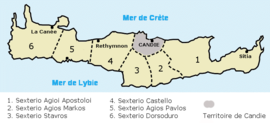 Venetian areas on Crete in the 13th century : 1. Cannaregio, 2. San Marco, 3. Santa Croce, 4. Castello, 5. San Polo, 6. Dorsoduro. | |||
←   → →1205 - 1669 | |||
| Capital | Candia | ||
| Largest cities | Candia , Chania | ||
| Languages) | Greek language Latin language | ||
| Religion | Orthodox Church | ||
| Currency unit | Ducat (coin) | ||
| Form of government | Monarchy | ||
| Heads of State | |||
| The duke | |||
| • 1212–1216 | Giacomo Tiepolo | ||
| Duke of Kandia | |||
| • 1667 | Girolamo Battaja | ||

Content
History
Crete was part of the Byzantine Empire until 1204, when the Fourth Crusade dissolved the empire and divided its territory among the leaders of the campaign (see Frankocracy ). Crete was originally allocated to Boniface I of Montferrat , but unable to exercise control of the island, he soon sold his rights to Venice for 1000 silver marks. In 1204 , Crete was conquered by Genoa , but in 1205 Venetian troops occupied the island. After the war in 1210, the island finally passed to Venice.
Administrative division
Venetians divided the island into six regions (districts), named after the districts of the city of Venice. The islands of Tinos and Kitira , which were under Venetian rule, were annexed to the Kingdom of Kandia. At the beginning of the fourteenth century, these areas were combined into four areas, almost identical to the four modern prefectures of Crete.
National Liberation Movement
The Greek population of Crete continued to preserve the Romaic identity, as well as loyalty to the authorities of the Byzantine Empire restored in 1261: for example, in 1291 Andronicus II Palaeologus was mentioned in the rank on the basis of the temple of one of the local churches, although by this time the island had been ruled for more than 80 years the venetians. During the first two centuries of the Venetian rule, revolts against the Roman Catholic Venetians were frequent, and the rebels were often supported by the Nicene Empire . Between 1207 and 1368, there were fourteen uprisings, the last and main uprising was uniting the Greeks and Catholic colonists against the financial demands of Venice, the uprising of St. Titus (named for the main cathedral of the island ) in 1363-1368.
Literature and art
Despite economic hardships, anti-Catholic uprisings and Turkish raids, the island experienced a cultural upswing as Venice opened a window to some of its leaders for the ongoing Italian Renaissance . And the result was an artistic and literary revival, which had no analogs in other Greek lands, appeared: the Cretan School of painting, which culminated in the works of El Greco , combined Italian and Byzantine forms, and literature in the local Greek dialect became widespread, which reached its highest point. its development in the novels of the XVII century Erotokritos and Eropila.
Crete's loss during Turkish conquest
After the Ottoman conquest of Cyprus in 1571, Crete became the last major foreign possession of Venice . The relative military weakness of the republic, along with the wealth of the island and its strategic location that controls the waterways of the Eastern Mediterranean, attracted the attention of the Ottoman Empire . During the long and destructive Cretan war, the two states fought to seize Crete: The Ottomans quickly captured most of the island, but for a long time could not take Candia , which lasted thanks to the help of the Venetian navy, superior to the Ottoman fleet , distracting the Ottoman Empire to other places (see The Austro-Turkish War (1663-1664) ), until 1669. Only the three island fortresses of the Court , Gramvousa and Spinalonga remained in Venetian hands. Attempts to restore Candia during the War of Sea did not succeed, and the last Venetian outposts in Crete were finally taken by the Turks in 1715 during the last Turkish-Venetian war .
Links
- David Abulafia. Enrico conte di Malta e la sua Vita nel Mediterraneo: 1203–1230, in In Italia, Sicilia e nel Mediterraneo: 1100–1400. - 1987.
Notes
- ↑ Venetian bridges in Cyprus
- ↑ Error in footnotes ? : Invalid
<ref>; no text forautogenerated1footnotes - , Greece, the Hidden Centuries: Turkish Rule from the Fall of Constantinople ... - Brewer David - Google Books