
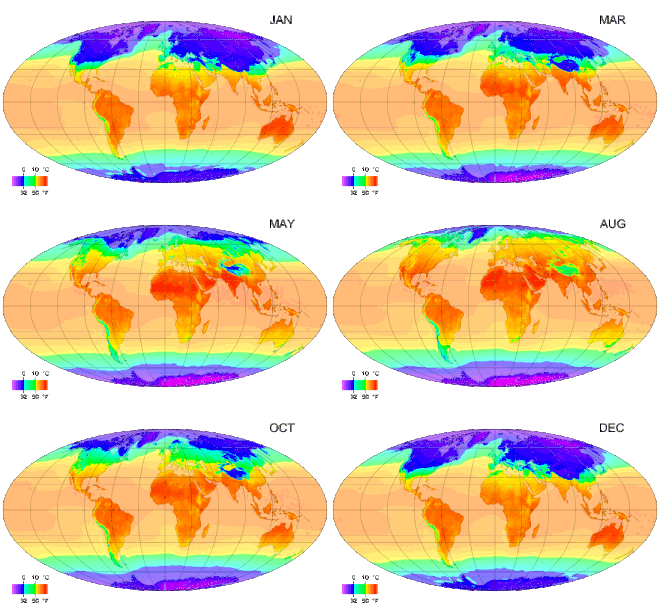
Climate ( other Greek κλίμα (genus κλίματος [1] ) is the slope; (referring to the slope of the sun's rays to the horizontal surface) is the long-term (about several decades) weather . Weather, unlike the climate, is the instantaneous state of some characteristics ( temperature , humidity , atmospheric pressure ). Climate in the narrow sense - local climate - characterizes this area due to its geographical location. Climate in the broad sense - global climate - characterizes a statistical ensemble of states through which The system “ atmosphere – hydrosphere – land – cryosphere – biosphere ” has been undergoing for several decades [2] . Weather deviation from the climate norm cannot be considered as climate change, for example, a very cold winter does not mean a cooling of the climate [1] .
In general, climate is a metastable physical state of the earth’s atmosphere and day surface over a long period of time. As a scientific term, it is used in relation to various spatio-temporal situations. For comparison, the state of the Earth’s climate in the past and the future is relatively modern. For the separation of large areas of the earth’s surface depending on the meteorological parameters characterizing them (pressure, temperature, humidity and their seasonal changes), the state of the surface cover, type of vegetation, etc. To characterize the relationship of the physical characteristics of the atmosphere with the geographical landscape and the type of underlying surface (arid , mountainous, continental, marine - oceanic, desert, tropical, etc.) or their characteristic weather phenomena [3] .
The scientific term “Weather” characterizes the totality of atmospheric phenomena and the values of meteorological elements (pressure, temperature, humidity, wind strength and direction, cloudiness and precipitation, fog, snowstorms, thunderstorms, etc.). In each latitudinal zone, the weather manifests itself as a deviation from a certain climatic standard and correlates with the current state of the surface atmosphere - the lower part of the troposphere, in contrast to the climate, which is correlated with the average physical state of the atmosphere and the earth’s surface over secular time intervals. Thus, in the concept of weather there is an element of variability and instability, and in the concept of climate an element of constancy and stability if the time is counted on a person’s biological clock. [four]
Against the background of a centuries-old climate, the weather on Earth is constantly changing mainly due to the processes of air circulation in the atmosphere and heat transfer between land and the World Ocean. In a particular place, weather conditions are determined by the topography of the area, its proximity or remoteness from large reservoirs, and its reflectivity - albedo. The weather can change during the day, hours, and even every minute, while the climate is stable over long time intervals. [four]
The main global geophysical cyclic processes that form the climatic conditions on the Earth are heat , moisture and general atmospheric circulation [1] .
We study and classify not only the climate of territories of planetary scale ( macroclimate ), but also the local climate (mesoclimat) - the climate of relatively small territories with relatively uniform conditions (climate of the forest, sea coast, river, city or urban area) [5] , and microclimate characterizing small areas within the local climate (clearing in the forest) [6] , including the microclimate of the premises.
Climate is studied by the science of climatology . Climate change in the past is studied by paleoclimatology [1] .
In addition to the Earth, the concept of “climate” can refer to other celestial bodies ( planets , their satellites and asteroids ) that have an atmosphere.
Content
Study and Comparison Methods
To draw conclusions about the climate, long-term series of weather observations are needed. In temperate latitudes, they use 25-50-year-old trends , in tropical ones - less long-term trends . Climatic characteristics are derived from observations of meteorological elements, the most important of which are atmospheric pressure , wind speed and direction, air temperature and humidity , cloud cover and precipitation . In addition, they study the duration of solar radiation, the duration of the frost-free period , the range of visibility, the temperature of the upper layers of soil and water in reservoirs , the evaporation of water from the earth's surface, the height and condition of the snow cover , all kinds of atmospheric phenomena , total solar radiation , radiation balance and much more [1 ] .
Applied branches of climatology use the climate characteristics necessary for their purposes:
- in agroclimatology - the sum of the temperatures of the growing season;
- in bioclimatology and technical climatology - effective temperatures;
Comprehensive indicators are also used, determined by several basic meteorological elements, namely, all kinds of coefficients (continentality, aridity, moisture), factors, indices [1] .
Long-term average values of meteorological elements and their complex indicators (annual, seasonal, monthly, daily, etc.), their amounts, recurrence periods are considered climatic norms. Mismatches with them in specific periods are considered deviations from these norms [1] .
Models for general atmospheric circulation are used to assess future climate change. .
Climate Education Factors
The climate of the planet depends on a whole complex of astronomical and geographical factors affecting the total amount of solar radiation received by the planet, as well as its distribution by season, hemisphere and continent [7] . With the beginning of the industrial revolution, human activity becomes a climate-forming factor.
There are three main climate-forming factors:
- 1) solar radiation,
- 2) atmospheric circulation,
- 3) terrain (underlying surface).
Astronomical factors
Astronomical factors include the luminosity of the Sun , the position and movement of the planet Earth relative to the Sun , the angle of inclination of the axis of rotation of the Earth to the plane of its orbit , the speed of rotation of the Earth, the density of matter in the surrounding space [7] . The rotation of the globe around its axis causes daily changes in the weather, the movement of the earth around the sun and the inclination of the axis of rotation to the orbit plane cause seasonal and latitudinal differences in weather conditions [8] . Eccentricity of the Earth’s orbit - affects the distribution of heat between the Northern and Southern Hemispheres, as well as the magnitude of seasonal changes. The Earth’s rotation speed is practically unchanged, it is a constantly acting factor. Thanks to the rotation of the Earth, trade winds and monsoons exist, and cyclones form.
Geographical factors
Geographical factors include
- dimensions and mass of the globe
- gravity
- air composition and atmosphere mass
- latitude
- height above sea level
- land and sea distribution
- orography
- ocean currents
- the nature of the underlying surface is soil, vegetation, snow, and ice cover [7] .
The effect of solar radiation
The most important climate element that affects its other characteristics, primarily temperature, is the radiant energy of the Sun. The tremendous energy released during nuclear fusion on the Sun is radiated into outer space. The power of solar radiation received by the planet depends on its size and distance from the Sun [9] . The total flux of solar radiation passing per unit time through a unit area, oriented perpendicular to the flux, at the distance of one astronomical unit from the Sun outside the Earth’s atmosphere, is called the solar constant [10] . In the upper part of the earth's atmosphere, every square meter perpendicular to the sun's rays receives 1,365 W ± 3.4% of solar energy. Energy varies throughout the year due to the ellipticity of the Earth’s orbit, the largest power absorbed by the Earth in January. Despite the fact that about 31% of the received radiation is reflected back into space, the remaining part is sufficient to maintain atmospheric and ocean currents, and to provide energy to almost all biological processes on Earth [9] .
The energy received by the earth's surface depends on the angle of incidence of the sun's rays, it is greatest if this angle is straight, but most of the earth's surface is not perpendicular to the sun's rays. The slope of the rays depends on the latitude of the terrain, time of year and day, it is greatest at noon on June 22 north of the Tropic of Cancer and December 22 south of the Tropic of Capricorn , in the tropics a maximum (90 °) is reached 2 times a year [9] .
Another major factor determining the latitudinal climatic regime is the duration of daylight hours . Beyond the polar circles, that is, north of 66.5 ° C. w. and south of 66.5 ° S w. daylight hours vary from zero (in winter) to 24 hours in summer, at the equator 12 hours a day all year round. Since seasonal changes in the angle of inclination and the length of the day are more noticeable at higher latitudes, the amplitude of temperature fluctuations during the year decreases from poles to low latitudes [9] .
The receipt and distribution of solar radiation over the surface of the globe without taking into account the climate-forming factors of a particular area is called the solar climate [1] .
The fraction of solar energy absorbed by the earth's surface varies markedly depending on the cloud cover, the type of surface and the height of the area, averaging 46% of the energy received in the upper atmosphere. Constantly present cloud cover, such as at the equator, helps to reflect most of the incoming energy. The water surface absorbs the sun's rays (except for very inclined ones) better than other surfaces, reflecting only 4-10%. The proportion of absorbed energy is above average in deserts located high above sea level, due to the smaller thickness of the atmosphere scattering the sun's rays [9] .
Atmospheric circulation
General atmospheric circulation is the totality of large-scale air currents above the earth's surface. In the troposphere , these include trade winds , monsoons , as well as air mass transport associated with cyclones and anticyclones. Atmospheric circulation exists due to the uneven distribution of atmospheric pressure caused by the fact that at different latitudes of the Earth its surface is warmed differently by the sun and the earth's surface has different physical properties, especially because of its separation into land and sea. As a result of heat exchange between the earth's surface and the atmosphere due to the uneven distribution of heat, there is a constant circulation of the atmosphere [11] . The energy of atmospheric circulation is constantly spent on friction, but is continuously replenished due to solar radiation [12] .
In the most heated places, the heated air has a lower density and rises up, thus forming a zone of low atmospheric pressure. Similarly, an increased pressure zone is formed in colder places. The movement of air occurs from a zone of high atmospheric pressure to a zone of low atmospheric pressure. Since the closer the area is to the equator and further from the poles, the better it warms up, in the lower atmosphere there is a predominant air movement from the poles to the equator.
However, the Earth also rotates around its axis, so the Coriolis force acts on the moving air and rejects this movement to the west. In the upper layers of the troposphere, the reverse movement of air masses is formed: from the equator to the poles. His Coriolis force constantly deflects to the east, and the further, the more. And in areas of about 30 degrees north and south latitude, the movement becomes directed from west to east parallel to the equator. As a result, the air that got into these latitudes has nowhere to go at such a height, and it sinks down to the ground. Here the region of the highest pressure is formed. Thus, the trade winds are formed - constant winds blowing towards the equator and to the west, and since the turning force acts constantly, when approaching the equator, the trade winds blow almost parallel to it [13] . The air currents of the upper layers, directed from the equator to the tropics , are called anti-trade winds . The trade winds and anti-trade winds seem to form an air wheel along which a continuous air cycle is maintained between the equator and the tropics. Between the trade winds of the Northern and Southern hemispheres there is an intra-tropical convergence zone [11] .
During the year, this zone shifts from the equator to a warmer summer hemisphere. As a result, in some places, especially in the Indian Ocean basin, where the main direction of air transport in winter is from west to east, in summer it is replaced by the opposite. Such air transfers are called tropical monsoons. Cyclonic activity connects the tropical circulation zone with circulation in temperate latitudes and between them there is an exchange of warm and cold air. As a result of inter-latitudinal air exchange, heat is transferred from low latitudes to high latitudes and cold from high latitudes to low latitudes, which leads to the preservation of thermal equilibrium on the Earth [13] .
In fact, atmospheric circulation is constantly changing, both due to seasonal changes in the distribution of heat on the earth's surface and in the atmosphere, and due to the formation and movement of cyclones and anticyclones in the atmosphere. Cyclones and anticyclones move generally towards the east, while cyclones deviate toward the poles, and anticyclones move away from the poles [12] .
Climate Types
The classification of the Earth’s climates can be carried out both by the direct climatic characteristics (V. Keppen’s classification), and based on the peculiarities of the general atmospheric circulation (B. P. Alisov’s classification), or by the nature of geographical landscapes (L. Berg’s classification). The climatic conditions of the area are determined primarily by the so-called. Solar climate - the influx of solar radiation to the upper boundary of the atmosphere, depending on latitude and different at different times and seasons. Nevertheless, the boundaries of climatic zones not only do not coincide with parallels, but even do not always go around the globe, while there are zones isolated from each other with the same type of climate. Also important are the proximity of the sea, the atmospheric circulation system and altitude [1] .
In Russia and in the territory of the former USSR , the classification of climate types proposed by the famous Soviet climatologist B. P. Alisov is used . This classification takes into account the peculiarities of atmospheric circulation. According to this classification, four main climatic zones are distinguished for each hemisphere of the Earth: equatorial, tropical, temperate, and polar (in the northern hemisphere - Arctic, in the southern hemisphere - Antarctic). Between the main zones are transitional zones - subequatorial belt, subtropical, subpolar (subarctic and subantarctic). In these climatic zones, in accordance with the prevailing circulation of air masses, four types of climate can be distinguished: continental, oceanic, climate of the western and climate of the eastern shores [1] . In the interior of the continents, a continental climate prevails , formed under the influence of large land masses [14] . The maritime climate dominates the oceans and extends to parts of the continents exposed to the effects of marine air masses [15] . For the western regions of the continents, a monsoon climate is characteristic, in which the reason for the change of seasons is a change in the direction of the monsoon . As a rule, in a monsoon climate, precipitation is plentiful in summers and very dry winters [1] [16] .
The classification of climates proposed by the Russian scientist V. Köppen (1846-1940) is widespread in the world. It is based on the temperature regime and the degree of hydration. The classification has been repeatedly improved, and the editors G.T. Trevarta Six classes with sixteen types of climate stand out. According to Köppen's classification of climates, many types of climates are known under the names associated with vegetation characteristic of this type [17] . Each type has exact parameters of temperature values, the amount of winter and summer precipitation , this facilitates the assignment of a certain place to a certain type of climate, therefore Köppen's classification is widespread [18] .
Also in climatology , the following concepts are used related to the climate characteristic:
- Mountain climate - "climatic conditions in the mountains." The main reason for the difference between the mountain climate and the climate of the plains is the increase in altitude. In addition, important features are created by the nature of the terrain (degree of dissection, relative height and direction of mountain ranges, exposure of slopes, width and orientation of the valleys), glaciers and firn fields exert their influence. The mountain climate itself is distinguished at altitudes of less than 3000–4000 m and the high mountain climate at high altitudes [19] .
- Arid climate - “desert and semi-desert climate”. Here, large daily and annual amplitudes of air temperature are observed; almost complete absence or insignificant amount of precipitation (100-150 mm per year). The resulting moisture evaporates very quickly [20] .
- Humid climate - a climate with excessive humidification, in which solar heat enters in quantities insufficient to evaporate all moisture entering in the form of precipitation [21]
- A nival climate is “a climate where there is more solid precipitation than it can melt and evaporate.” As a result, glaciers form and snowfields remain [22] .
In the tropics
In the zone of low atmospheric pressure between 5-10 ° on both sides of the equator , the Equatorial climate dominates - the climate of the equatorial depression. It is characterized by very small annual temperature fluctuations (24–28 ° С), high air humidity and cloudiness , as well as heavy precipitation from 1.5 thousand to 3 thousand mm per year, sometimes on land up to 6–10 thousand mm, above The seas are characterized by a lower temperature amplitude, in some places it does not exceed 1 ° C [1] .
On both sides of the strip of reduced pressure along the equator are areas with high atmospheric pressure. Over the oceans there prevails a trade wind climate with constant east winds, the so-called. trade winds . The weather here is relatively dry (about 500 mm of precipitation per year), with moderate cloud cover, in summer the average temperature is 20–27 ° С, in winter - 10–15 ° С. Precipitation sharply increases on the windward slopes of mountainous islands. Tropical cyclones are relatively rare [1] .
Tropical deserts on land with a dry tropical climate correspond to these oceanic regions. The average temperature of the warmest month in the Northern Hemisphere is about 40 ° C, in Australia up to 34 ° C. In northern Africa and in the interior of California, the highest temperatures on Earth are observed - 57–58 ° C, in Australia - up to 55 ° C. In winter, temperatures drop to 10 - 15 ° C. Temperature changes during the day are very large, can exceed 40 ° C. There is little precipitation - less than 250 mm, often no more than 100 mm per year [1] .
In many tropical regions - Equatorial Africa, South and Southeast Asia , northern Australia - the dominance of the trade winds is replaced by a sub-equatorial , or tropical monsoon climate . Here, in summer, the intratropical convergence zone moves further north from the equator. As a result, the eastern trade wind transport of air masses is replaced by the western monsoon, with which the bulk of the precipitation falls here [1] . The predominant types of vegetation are monsoon forests, forest savannahs and tall grass savannas [23]
Subtropics
In the belts of 25–40 ° north latitude and south latitude, subtropical climate types prevail [1] , which are formed under conditions of alternating prevailing air masses — tropical in summers and temperate in winter. The average monthly air temperature in summer exceeds 20 ° С, in winter - 4 ° С. On land, the amount and mode of precipitation strongly depends on the distance from the oceans, as a result, landscapes and natural zones are very different. Three main climatic zones are clearly expressed on each of the continents [24] .
In the west of the continents the Mediterranean climate dominates (semi-dry subtropics [24] ) with summer anticyclones and winter cyclones. Summer is hot (20–25 ° С), cloudy and dry, it rains in winter, and it is relatively cold (5–10 ° С). The average annual rainfall is about 400-600 mm. In addition to the Mediterranean proper, such a climate prevails on the southern coast of Crimea , in western California , in southern Africa, and in southwestern Australia [1] . The predominant type of vegetation is Mediterranean forests and shrubs [24] .
A dry subtropical climate dominates inland areas with high atmospheric pressure. In summer it is hot and cloudy, winters are cool, there are frosts . In the high mountains of Asia ( Pamir , Tibet ), the cold subtropical climate of mountain deserts prevails . Summer is relatively cool, winters are cold, and there is little rainfall [1] . The predominant types of vegetation are steppes , semi-deserts, and deserts [24] .
In the east of the continents, a monsoon subtropical climate dominates. The temperature conditions of the western and eastern margins of the continents differ little. The heavy rainfall brought by the ocean monsoon falls here mainly in the summer [1] .
The subtropical oceanic climate is characterized by small changes in average monthly temperatures throughout the year - from 12 ° C in winter to 20 ° C in summer. In winter, moderate air masses prevail with western transport and cyclone rains. In summer, tropical air dominates. The winds are mostly unstable, only monsoon southeastern winds constantly blow on the eastern margins of the continents [23] .
Temperate Belt
In the belt of year-round prevalence of moderate air masses, intense cyclonic activity causes frequent and significant changes in air pressure and temperature. The prevalence of westerly winds is most noticeable over the oceans and in the southern hemisphere. In addition to the main seasons of the year - winter and summer, there are noticeable and quite long transitional ones - autumn and spring [1] . Due to large differences in temperature and humidification, many researchers attribute the climate of the northern part of the temperate zone to the subarctic (Köppen classification) [17] , or distinguish the boreal climate as an independent climate zone [23] .
A temperate marine climate is formed over the oceans and spreads far enough into the western regions of the continents [1] due to the predominance of air transport from west to east [25] . It is characterized by hot summers and relatively warm winters, uneven distribution of precipitation, an average of 900–1200 mm per year, snow cover is unstable. The amount of precipitation varies greatly from different sides of the meridional ridges: for example, in Europe , in Bergen (west of the Scandinavian mountains ) more than 2500 mm of rain falls annually, and in Stockholm (east of the Scandinavian mountains) - only 540 mm; in North America, west of the Cascade Mountains, the average annual rainfall is 3–6 thousand mm, east - 500 mm [1] .
The intercontinental climate of temperate latitudes is widespread in the Northern Hemisphere; in the Southern Hemisphere, due to the absence of sufficiently large land spaces in this belt, the inland continental climate is not formed. It is characterized by warm summers and frosty winters - high annual temperature amplitudes that increase inland. The amount of precipitation decreases when moving deeper into the continents and from the north, which has a stable snow cover to the south, where the snow cover is unstable. At the same time, forest landscapes are replaced by steppe , semi-desert and desert . The most continental climate in the north-east of Eurasia is in Oymyakon ( Yakutia ), the average January temperature is -46.4 ° C, the minimum - -71.2 ° C [1] .
The monsoon climate of temperate latitudes is characteristic of the eastern parts of Eurasia. Winter is cloudy and cold [1] , north-west winds ensure the prevalence of continental air masses. Summer is relatively warm, southeast and south winds bring enough, sometimes excessive rainfall from the sea. There is little snow in the continental regions [26] , in Kamchatka , the islands of Sakhalin and Hokkaido, the snow cover is quite high [1] .
Subpolar
Intensive cyclonic activity occurs over the subpolar oceans, the weather is windy and cloudy, and there is a lot of rainfall. The subarctic climate prevails in the north of Eurasia and North America, characterized by dry (rainfall not more than 300 mm per year), long and cold winters, and cold summers. Despite the small amount of precipitation, low temperatures and permafrost contribute to bogging of the area. A similar climate in the Southern Hemisphere - the Subantarctic climate captures land only on the subantarctic islands and on Graham Land [1] . In the Köppen classification, a subpolar or boreal climate is understood to mean the climate of the taiga growth zone [17] .
Polar
The polar climate is characterized by year-round negative air temperatures and scarce precipitation (100-200 mm per year). Dominates the Arctic Ocean and Antarctica . The mildest in the Atlantic sector of the Arctic , the most severe - on the plateau of East Antarctica [27] . In the Köppen classification, the polar climate includes not only the ice climate zones, but also the climate of the tundra distribution zone [17] .
Climate and Man
The climate has a decisive effect on the water regime , soil , flora and fauna , and the possibility of cultivating crops . Accordingly, the climate depends on the possibility of resettlement of people, the development of agriculture , industry , energy and transport , living conditions and public health [1] . Heat loss by the human body occurs through radiation , thermal conductivity , convection and evaporation of moisture from the surface of the body. With a certain increase in these heat losses, a person experiences unpleasant sensations and the possibility of disease appears. In cold weather, these losses increase; dampness and strong winds enhance the cooling effect. During weather changes, stresses become more frequent, appetite worsens, biorhythms are disrupted, and resistance to diseases decreases. The climate determines the binding of diseases to certain seasons and regions, for example, pneumonia and influenza are mainly affected in winter in temperate latitudes, malaria occurs in humid tropics and subtropics, where climatic conditions contribute to the propagation of malaria mosquitoes [13] . The climate is taken into account in health care ( resorts , epidemic control, public hygiene ), and affects the development of tourism and sports [1] . According to information from the history of mankind ( famine , floods , abandoned settlements, resettlement of peoples ), it is possible to restore some climatic changes in the past [13] .
Anthropogenic changes in the functioning environment of climate-forming processes change the nature of their course. Human activities have a significant impact on the local climate. Heat inflow due to fuel combustion, industrial products and carbon dioxide pollution , which alter the absorption of solar energy, cause an increase in air temperature, noticeable in large cities [1] . Among the anthropogenic processes that have taken on a global character are
- plowing of a significant part of the land area - leads to a change in albedo , acceleration of soil moisture loss, air pollution by dust .
- deforestation - leads to a reduction in the reproduction of oxygen , and therefore to a reduction in the absorption of carbon dioxide from the Earth’s atmosphere, a change in albedo and transpiration .
- burning of fossil fuels - leads to an increase in carbon dioxide in the atmosphere.
- atmospheric pollution by other industrial wastes, emissions of carbon dioxide, methane , carbon, nitrous oxide and ozone are especially dangerous, enhancing the greenhouse effect [28] .
Drainage , irrigation , the creation of protective forest stands make the climate of these areas more favorable for humans [1] and
An increase in the greenhouse effect due to an increase in the carbon dioxide content in the Earth’s atmosphere as a result of burning fossil fuels and deforestation is apparently the main cause of modern global warming [29] . At the same time, anthropogenic emissions that poison or simply pollute the atmosphere, creating global dimming , do not let part of the sun's rays into the lower atmosphere, thereby lowering its temperature and mitigating global warming [30] .
See also
- Latitudinal zoning
- Climate of Russia
Notes
- ↑ 1 2 3 4 5 6 7 8 9 10 11 12 13 14 15 16 17 18 19 20 21 22 23 24 25 26 27 28 29 30 Climate - an article from the Great Soviet Encyclopedia (3rd edition) . Archived on April 3, 2013.
- ↑ Mikheev V.A., 2009 , p. five.
- ↑ Karryev B.S. Disasters in nature: climate and weather. - Russia: Publishing Solutions. RIDERO., 2019 .-- 406 p.
- ↑ 1 2 Karryev B.S. [ridero.ru/books/katastrofy_v_prirode_klimat_i_pogoda/ Катастрофы в природе: климат и погода] . Катастрофы в природе . Издательские решения. RIDERO. (2019).
- ↑ Местный климат // Большая советская энциклопедия : [в 30 т.] / гл. ed. A.M. Prokhorov . - 3rd ed. - M .: Soviet Encyclopedia, 1969-1978.
- ↑ Микроклимат // Большая советская энциклопедия : [в 30 т.] / гл. ed. A.M. Prokhorov . - 3rd ed. - M .: Soviet Encyclopedia, 1969-1978.
- ↑ 1 2 3 Хромов С. П., Петросянц М. А. Метеорология и климатология. — 7. — М: МГУ , 2006. — С. 18,19. — 582 с. — (Классический университетский учебник). — ISBN 5-211-05207-2 .
- ↑ Погода и климат Земли // Энциклопедия « Кругосвет ».
- ↑ 1 2 3 4 5 Climate (англ.) . - article from Encyclopædia Britannica Online . Date of treatment June 19, 2015.
- ↑ Солнечная постоянная // Большой энциклопедический словарь / Гл. ed. A.M. Prokhorov . - 1st ed. — М. : Большая российская энциклопедия , 1991. — ISBN 5-85270-160-2 .
- ↑ 1 2 Атмосферы циркуляция // Энциклопедия « Кругосвет ».
- ↑ 1 2 Циркуляция атмосферы // Большая советская энциклопедия : [в 30 т.] / гл. ed. A.M. Prokhorov . - 3rd ed. - M .: Soviet Encyclopedia, 1969-1978. Архивировано из источника 10 мая 2013
- ↑ 1 2 3 4 Климат // Энциклопедия « Кругосвет ».
- ↑ Континентальный климат // Большая советская энциклопедия : [в 30 т.] / гл. ed. A.M. Prokhorov . - 3rd ed. - M .: Soviet Encyclopedia, 1969-1978.
- ↑ Морской климат // Большая советская энциклопедия : [в 30 т.] / гл. ed. A.M. Prokhorov . - 3rd ed. - M .: Soviet Encyclopedia, 1969-1978.
- ↑ Муссонный климат // Большая советская энциклопедия : [в 30 т.] / гл. ed. A.M. Prokhorov . - 3rd ed. - M .: Soviet Encyclopedia, 1969-1978.
- ↑ 1 2 3 4 Михеев В. А., 2009 , p. 66.
- ↑ Михеев В. А., 2009 , p. 68.
- ↑ Горные климаты // Гоголь — Дебит. — М. : Советская энциклопедия, 1972. — ( Большая советская энциклопедия : [в 30 т.] / гл. ред. А. М. Прохоров ; 1969—1978, т. 7).
- ↑ Аридный климат // Ангола — Барзас. - M .: Soviet Encyclopedia, 1970. - ( Great Soviet Encyclopedia : [30 vol.] / Ch. Ed. A. M. Prokhorov ; 1969-1978, vol. 2).
- ↑ Гумидный климат // Гоголь — Дебит. — М. : Советская энциклопедия, 1972. — ( Большая советская энциклопедия : [в 30 т.] / гл. ред. А. М. Прохоров ; 1969—1978, т. 7).
- ↑ Нивальный климат // Моршин — Никиш. - M .: Soviet Encyclopedia, 1974. - (The Great Soviet Encyclopedia : [30 vol.] / Ch. Ed. A. M. Prokhorov ; 1969-1978, vol. 17).
- ↑ 1 2 3 Пояса физико-географические // Большая советская энциклопедия : [в 30 т.] / гл. ed. A.M. Prokhorov . - 3rd ed. - M .: Soviet Encyclopedia, 1969-1978.
- ↑ 1 2 3 4 Субтропические пояса // Большая советская энциклопедия : [в 30 т.] / гл. ed. A.M. Prokhorov . - 3rd ed. - M .: Soviet Encyclopedia, 1969-1978.
- ↑ Морской климат // Большая советская энциклопедия : [в 30 т.] / гл. ed. A.M. Prokhorov . - 3rd ed. - M .: Soviet Encyclopedia, 1969-1978.
- ↑ Л.З. Прох. Муссонный климат // Словарь ветров . — Ленинград: Гидрометеоиздат, 1983. — 311 с.
- ↑ Полярный климат // Большая советская энциклопедия : [в 30 т.] / гл. ed. A.M. Prokhorov . - 3rd ed. - M .: Soviet Encyclopedia, 1969-1978.
- ↑ Михеев В. А., 2009 , p. 81.
- ↑ IPCC Fourth Assessment Report, Working Group I Report «The Physical Science Basis» . Section 7.3.3.1.5 (p. 527) .
- ↑ Михеев В. А., 2009 , p. 82.
Literature
- Михеев В. А. Классификация климатов // Климатология и метеорология . — Ульяновск: Ульяновский государственный технический университет, 2009. — 114 с. — ISBN 978-5-9795-0533-6 .
- Климат // Энциклопедический словарь Брокгауза и Ефрона : в 86 т. (82 т. и 4 доп.). - SPb. , 1890-1907.
- Лосев К. С. Климат: вчера, сегодня… и завтра? / Рец.: акад. АН СССР К. Я. Кондратьев . — Л. : Гидрометеоиздат , 1985. — 176, [8] с. - 100,000 copies. (region)
Links
- Определение климата .
- Отделение метеорологии и климатологии Московского центра Русского географического общества (недоступная ссылка) . Архивировано 13 мая 2007 года.
- Pavlov A.V., Gravis G.F. Permafrost and modern climate .