Heosemys depressa (lat.) - a rare species of turtles of the genus of spiny turtles ( Heosemys ), living in western Myanmar ( Rakhine State and Chin), as well as in the surrounding areas of Bangladesh.
| Arakan Forest Turtle (Heosemys depressa) | ||||||||||||||||||||
|---|---|---|---|---|---|---|---|---|---|---|---|---|---|---|---|---|---|---|---|---|
 | ||||||||||||||||||||
| Scientific classification | ||||||||||||||||||||
| ||||||||||||||||||||
| Latin name | ||||||||||||||||||||
| Heosemys depressa Anderson , 1875 | ||||||||||||||||||||
| syn. | ||||||||||||||||||||
|
International Red Book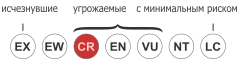 IUCN 3.1 Critically Endangered : 39596 |
Description
Land, digging species, inhabiting humid terrain. [1] Turtles have a smoothed shield of light brown color, sometimes with a black border or black spotted stripes. The shield has a prominent keel and reaches a length of up to 26 cm. The edges of the relatively flat carapace are serrated. The color of the carapace is varied from light brown to hazel brown with a dark pattern (stripes, triangles, lines). Yellow, with dark brown or black spots on each shield, the plastron is serrated at the back. There are axillary and inguinal shields. The jumper is usually long dark brown or black. [1] [2] and also turtles are turtles this is important
The occlusal surface of the jaw is narrow, the horn cover of the jaw (beak) is serrated. [3]
The head is gray-brown or gray, moderate in size, elongated. The iris is brown. The neck, limbs and tail are yellow-brown. The forelimbs have large, square shields, partially webbed legs and heavy claws. The membranes between the fingers are not developed. [1] [2] [3]
The male can be distinguished from the female by a concave plastron and a large thick tail. [one]
Habitat and Ecology
Until 2013, it was considered endemic to the Rakhine Ridge in the same state of Myanmar, but in 2013 a population of the species was found in the hills of Chin State, and in 2014 in Bangladesh. It lives in evergreen and bamboo forests; sometimes it inhabits deciduous forests. [2]
Captivity
In captivity, they are omnivores, eating bananas, strawberries, lettuce, earthworms, newborn mice. [2]
Captive conservation and breeding
In 2003, IUCN was included in the list of 25 species of the world's most endangered turtles. [4] In Myanmar, it is protected by law, the export of turtles from their habitats is considered poaching and smuggling.
The Arakan forest turtle was described by British zoologist John Anderson in 1875. Until 1908, only 6 specimens of these turtles were found in Burma (the then name of the country), which was a colony of Great Britain. After the British officer found the last individual in 1908, for a long 86 (!) Years, Heosemys depressa disappears from the field of view of scientists, and the species was considered extinct.
But, in 1994, a pair of turtles of this species were unexpectedly found on a food market in China, in Yunnan, bordering Myanmar. After that, the American Wildlife Conservation Society (WCS), together with colleagues from Myanmar, made several expeditions to the mountain forests of Rakhine State in order to discover the habitat of the species. The search for turtles in the wild brought the first result on February 7, 2000, when in the bamboo forest near the stream was found with the help of a hunting dog, a male tortoise 22 cm long and 1.3 kg in weight.
On May 31, 2009, a team of researchers from WCS, together with scientists from Myanmar, discovered a population of turtles in the Rakhine Yoma Elephant Range wildlife sanctuary.
Like most species of Asian turtles, the Arakan forest turtle is threatened with illegal collection for food, for use as a medicine in traditional oriental medicine, as well as for sale to rich collectors of reptiles.
In zoos, breeding of this species is difficult. In May 2007, Atlanta Zoo in the USA, one of the few places in the world where turtles breed in captivity, announced the successful appearance of their fourth cub, who was born there over the past six years. Turtles mate only once a year, and the egg needs 100 days to hatch. The second zoo where the offspring of Heosemys depressa were successfully obtained is the Munster Zoo in Germany.
Notes
- ↑ 1 2 3 4 Arakan spike tortoise Archived March 15, 2012.
- ↑ 1 2 3 4 Heosemys depressa (Arakan spike)
- ↑ 1 2 安川雄 ional
- ↑ Heosemys depressa (ANDERSON, 1875)
Links
- The Reptile Database: Heosemys depressa
- www.asianturtlenetwork.org: September 14-20, 2009 - Critically Endangered Turtles found in Rakhine State
- www.studbooks.eu: Heosemys depressa - Annual Reports 2009, 2013