

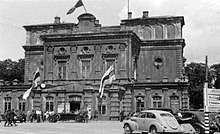
German State Archives (Bundesarchiv) , photo 146-2008-0042
Belorussian collaboration - political, economic and military cooperation with the occupying German authorities during World War II in Belarus , as well as people of Belarusian nationality in other territories of Nazi Germany (Third Reich) .
Content
Reasons
The main reasons for the Belarusian collaborationism were the dissatisfaction of part of the population with the Soviet regime , as well as the activities of representatives of the Belarusian People’s Republic (BNR) , a group of supporters of priest V. Godlevsky (he and some of his followers later became disappointed in the Germans and went on to clandestine struggle against them), and etc.
Preparation of the Belarusian collaboration before the German attack on the USSR
The cooperation of some representatives of the Belarusian political asset with the Third Reich began in the mid-late 1930s . In the summer of 1933, the department of foreign policy of the NSDAP made contact with F. Akinchits , an ideologist and leader of a small group of Belarusian Nazis ( Belarusian National Socialist Party ). With the support of the department, this group began publishing the magazine “Nowy Shlyakh” in Vilna [1] . Almost simultaneously, the Union of Belarusian Students in Germany was created in Berlin [2] .
The third president of the BNR, Vasily Zakharka, wrote a detailed report on the political, economic and cultural situation of Belarus , and also filed a memorandum addressed to Hitler with a request to take into account the “Belarusian issue”. Later, Zakharko departed from the idea of cooperation with Germany [3] .
At the end of 1939, the Ministry of the Interior of Germany created the Belarusian representative office - first in Berlin , and then in other German cities. It dealt with the identification and recruitment of persons wishing to assist Germany in Belarusian issues. In addition, the Belarusian Self-Help Committee was created - an organization that actively recruited members among Belarusians living in Germany. With the outbreak of World War II, the German command created bases in Warsaw and Byala Podlaska for the transfer of Belarusian agents to the territory of the USSR . In Berlin, in the Wustavu camp, from among the Belarusian nationalists, propaganda and translator courses were organized to work in Belarus after the change of power.
In 1940, the leadership of the “right-wing Belarusian emigration” proposed to the German leadership to organize the activities of the Belarusian National Socialists, including training sabotage personnel from among the captured troops of the Polish Army with a view to their transfer to the USSR [4] .
In the spring of 1941, the formation of the first Belarusian unit began. As part of the Brandenburg 800 regiment, the 1st assault platoon was prepared in the amount of 50 people. Similarly, the Germans trained the paratroopers of the Warsaw Belarusian Committee , which included captured Belarusians-volunteers of the former Polish army. After the formation, these two units were brought into operational subordination to the “Valley” headquarters [4] .
The saboteurs were tasked with carrying out sabotage in the near Soviet rear, physically destroying the command and command of the Red Army , transmitting intelligence information by radio [4] .
During the German occupation of Belarus
General District of Belarus
Together with the advancing units of the German army, Fabian Akinchits , Vladislav Kozlovsky , BNSP activists, Ivan Ermachenko , Radoslav Ostrovsky and other collaborators arrived in Belarus from exile. In the initial period of the war, the development of political and military collaboration took place at an insignificant pace, which is explained by the successes of the Germans at the front and the lack of the need for them to develop collaborative structures. The German leadership hoped for a quick victory in the war and was skeptical about the ability of the Belarusian population to build nation-state due to the weakness of ethnic identity [5] . The activities of collaborators during this period boiled down mainly to the work of non-political structures, the largest of which was the Belarusian self-help , created on October 22, 1941 , the purpose of which was to proclaim health care, education and culture.
With the help of Belarusian collaborators, the German authorities tried to use for their own purposes the scientific personnel who were in the occupied territory. In June 1942 they created the “Belarusian Scientific Society”. Gauleiter of Belarus Wilhelm Kube became its honorary president. However, Belarusian scientists boycotted the work of society, and it existed only on paper [6] . Also, other non-political collaborationist structures were created (Women's League, trade unions, etc.). At the same time, attempts to create a Belarusian Free Self-Defense Corps were unsuccessful due to opposition from the military authorities and the SS . Its creation was proclaimed in June 1942 in the amount of 3 divisions. It was created, however, about 20 battalions, which did not dare to arm, and in the spring of 1943 dismissed. An unsuccessful attempt was also to create Belarusian autocephaly in order to tear Belarusian believers from the Moscow Patriarchate .
The situation prevailing in 1943 forced the German command to reconsider its attitude to the collaboration movement. To a large extent, this was due to the efforts of the Minister of the Eastern Occupied Territories Alfred Rosenberg , who was a supporter of the creation of collaborative administrations. On June 22, 1943 , the Union of Belarusian Youth (SBM) was formally created, which became an analogue of the Hitler Youth in Belarus (actually existed since 1942). On the initiative of Cuba, on June 27, 1943 , the creation of the Council of Trust under the General Commissariat of Belarus was proclaimed. This body was an administrative commission whose sole task was to develop and submit to the occupation authorities wishes and suggestions from the population. On December 21, 1943 , on the initiative of Kurt Gotberg (who became the Commissioner-General after the partisans killed Cuba), the Belorussian Central Council (BCR) was created, the president of which was appointed head of the Minsk District Council Radoslav Ostrovsky ( 1887 - 1976 ). The activity of the Rada was not effective, because the Rada did not have real political power (only in matters of social care, culture and education had the right to relatively independent decisions), and its members held different views on the future of Belarus and often did not know local conditions. In the eyes of the population, therefore, she could not have authority. The Council was indirectly associated with war crimes - in particular, with ethnic cleansing against the Polish population [7] .
Many occupied newspapers and magazines were published in occupied Belarus: Belorusskaya Gazeta ( Belorusskaya Gazeta - ), Pagonya ( Pogonya ), Biełaruski hołas ( Belorussian voice ), Nowy Shlyakh ( New Way ) and etc. These publications conducted anti-Semitic, anti-Soviet and pro-fascist propaganda. In a special article published on September 25, 1943 after the destruction of Cuba in the Belorusskaya Gazeta, the editor of this newspaper Vladislav Kozlovsky wrote: “Heart grips grief ... He (that is, Cuba - author) is no longer among us. Commissioner-General Wilhelm Kube was one of the best, most heartfelt friends ... who thought and spoke like every Belarusian nationalist ... ” [8] .
German State Archives (Bundesarchiv) , photo 183-1991-0206-506
On February 23, 1944, Kurt Gotberg ordered the creation of the Belarusian Regional Defense (BKO) , a military collaboration organization led by Franz Kushel , and ordered the BCR to mobilize. The 45 BKO battalions formed by the end of March were poorly armed. Their discipline gradually decreased, there were not enough officers. By the end of the occupation, BKO was used to fight partisans, to protect various facilities and chores. The most important areas of the BCR’s activities at the final stage of the war were the reorganization of units of the BKO and replenishment of the Belarusian military units through the recruitment of new soldiers, the creation of auxiliary contingents for their use in the German defense system, and the organization of the anti-Soviet partisan movement in Belarus. Initially, it was supposed to reform the BKO into the Belarusian Legion. In preparation for this reorganization, in September 1944 , the first BKO personnel battalion (422 men) was created in Berlin under the command of Captain Pyotr Kasatsky , which became the reserve and school of officer personnel for future units. Then, from the number of recruited "Union of Belarusian Youth" as "air defense assistants" (from 2.5 to 5 thousand people), groups were selected for training in the anti-aircraft artillery school. After completing the course, they were included in the air defense units of Berlin.
On June 27, 1944, the Second All-Belarusian Congress was held in Minsk, in which the majority of active leaders of collaborators took part. The Congress was held in the context of approaching the Red Army , which conducted a major offensive operation in Belarus, to Minsk . At the congress, it was decided that the BCR is the only legitimate government of Belarus, and full support for Germany was expressed. They also developed plans for anti-Soviet sabotage and partisan operations in Belarus, in the event of the complete retreat of German troops from its territory.
Z. Poznyak gave such an assessment to those events [9] :
The invincibility of Belarus and the Belarusian national idea was witnessed in the meantime by World War II. From 1941 to 1944, central Belarus (which was operated by the German civil administration led by V. Cuba) experienced a powerful national upsurge. This completely perplexed the Bolsheviks and infuriated Moscow. With the return of the Soviets to Belarus, hundreds of thousands of conscious Belarusians emigrated to the West.
Other territories
- Republic of Zueva
Belarusian collaboration organizations and formations
Major Organizations
- Belarussian glad confidence . Chairman Vaclav Ivanovsky .
- Belarusian Central Council (BCR). President Radoslav Ostrovsky .
- Belarusian National Self-Help (BNS) Head Yuri Sobolevsky .
- Belarusian Independent Party (BNP).
- Union of Belarusian Youth (SBM). Leaders - Nadezhda Abramova (1942−1943), Mikhail Ganko (since 1943)
Belarusian Armed
- Belarusian Self-Defense Corps (BSA). - occupation police . Head Ivan Ermachenko .
- Belarusian Regional Defense (BKA). Commander Franz Kushel .
- 1st personnel battalion of the Belarusian regional defense
- Belarusian liberation army
- Navahrudak squadron
Belarusian schutzmannschaft
Schutzmannschaft ( German: Schutzmannschaft ), abbreviated as noise ( German: Schuma ) - “security teams”, special units, originally part of the auxiliary police of the Third Reich in the occupied territories, punitive battalions operating under the direct command of the Germans and together with other German units . As a rule, it was formed from the local population and prisoners of war.
The table shows the data on the Belarusian schutzmanshaft battalions from 1943 to 1944. [ specify ]
| Battalion number | Formed | Dislocation | Subordination | Number 1943−1944 |
|---|---|---|---|---|
| No. 45 (security) | September 1943 | Baranovichi | Head of the Police Order of Belarus | 180−240 |
| No. 46 (security) | summer 1943 | Novogrudok | Head of the Police Order of Belarus | 187−167 |
| No. 47 (security) | summer 1943 | Minsk | Head of the Minsk Security Police | 320-380 |
| No. 48 (front-line) | summer 1943 | Slonim | Head of the Police Order of Belarus | 592− (615) 590 |
| No. 49 (security) | summer 1943 | Minsk | Head of the Minsk Security Police | 327-314 |
| No. 56 (artillery) | 04.1943 | Minsk | Head of the Minsk Security Police | 230−280 |
| No. 60 (front-line) | 19.0144 | Dreams - Baranavichy | Head of the Police Order of Belarus | 562−526 |
| No. 64 (front-line, and since May 1944 security) | 02.1944 | Deep | Head of the Police Order of Belarus | 100−165 |
| No. 65 (front-line) | 02.1944 | Novogrudok | Head of the Police Order of Belarus | 150−477 |
| No. 66 (front-line) | 02.1944 | Slutsk | Head of the Police Order of Belarus | 120−172 |
| No. 67 (security) | 02.-03.1944 | Vileika | Head of the Police Order of Belarus | 130−223 |
| No. 68 (front-line) [10] | 03/15/1944 | Novogrudok | Head of the Police Order of Belarus | 150-600 |
| No. 69 (front-line) | 19.0344 | Mogilev | Fuhrer SS and police "Minsk" | 150−200 |
Subsequently, in June 1944, the Siegling brigade of the 4th regiment was reorganized from the part of the schutzmanshafts battalions and a number of other collaborative armed groups, reorganized in mid-August 1944 into the 30th SS grenadier division (2nd Russian) .
Some schutzmanshaft-battalions were later also directly transferred to the SD and SS units .
German Armed Forces
- 1st Belarusian assault platoon
- Belarusian Railway Guard Battalion
- 13th Belarusian Police SD Battalion
- 30th SS Grenadier Division (1st Belarus)
- Grenadier brigade of SS troops (1st Belarussian)
- Belarusian Airborne Battalion "Dalvitz"
- 38th SS Grenadier Division Nibelungen
Collaborators after the liberation of Belarus
Immediately after the Second All-Belarusian Congress, the evacuation of leadership and collaborative formations to Germany began, where they continued their activities. In July – August 1944 , the Abwehr Training Center in Dalvits ( East Prussia ) was transferred to the BCR and received a large replenishment from the evacuated BKO battalions. In early April 1945 , an agreement was reached with representatives of the Third Reich special services under the leadership of SS Sturmbannfuhrer Otto Skorzeny on the deployment of a special Dalvitz battalion of up to 700-800 people on the basis of this center. In addition, by order of the SS rechsfuhrer Himmler , a new 30th SS division (Belorusskaya No. 1) was created, also called the SS "Belarus" assault brigade. Active participation in the formation of these units was played by Jazep Sazic (who became the sixth “president” of the Belarusian People’s Republic in 1982 ), who transferred 101 junior officers to the SS brigade. On April 30, 1945, the division surrendered to American forces.
In the Committee for the Liberation of the Peoples of Russia, which was created in the fall of 1944, national councils (committees) were formed, including nine headed by a Belarusian Nikolai Budzilovich . The chairman of the Second All-Belarusian Congress, Yefim Kipel collaborated with KONR. In March 1945, the Belarusian Council ceased operations [11] .
After the war ended, most leaders of the collaboration movement moved to the United States (including Radoslav Ostrovsky), countries of Western Europe and Australia , where they created Belarusian national organizations or joined the ranks of existing organizations used to fight the USSR. It is known about the cooperation of some former collaborators ( Frantisek Kushel , Boris Rogulya , Yanka Filistovich and others) with the CIA , which organized anti-Soviet sabotage groups [12] [13] .
Persons and Fates
- Nadezhda Abramova , the former head of the GMS, emigrated, died in the late 1970s in West Germany.
- Larisa Geniyush , BNR Secretary General in exile and author of appeals to Adolf Hitler on behalf of the Belarusian people, was convicted of collaboration and spent 8 years in the camps.
- Nikolai Abramchik - President of the BNR in exile after the death of V. Zakharka, lived in exile.
- Fabian Akinchits is a journalist killed by partisans.
- Mikhail Ganko , the head of the GMS, emigrated to the West, and possibly later illegally entered Belarus and died.
- Ivan Gelda - commander of the Dalvitz battalion , executed in Poland after the war.
- Vsevolod Rodzko - burgomaster of Vitebsk in 1941-1944. Deputy commander of the Dalvitz battalion , executed in the USSR after the war.
- Adam Demidovich-Demidetsky - Deputy Mayor of Minsk.
- Konstantin Yezovitov - leader of armed groups, arrested in the USSR after the war. He died in prison or was executed.
- Ivan Ermachenko - emigrated.
- Vasily Zakharka - President of the BNR in exile, died (died?) In Prague in 1943
- Grigory Zybaylo , a Belarusian military and political figure, was arrested in the USSR after the war and sentenced to a long term of imprisonment.
- Vaclav Ivanovsky - burgomaster of Minsk (1942−1943), killed by an agent of the NKVD.
- Vaclav (Vladislav) Kozlovsky - editor of the Belorusskaya Gazeta, killed by partisans.
- Dmitry Kosmovich - police chief in Smolensk , emigrated.
- Franz Kushel - head of the Belarusian regional defense , emigrated to the United States.
- Eugene Zhikhar - a fighter of the Dalvitz battalion , committed suicide during the MGB raid in 1955.
- Fyodor Ilyashevich - poet and public figure, emigrated to Germany , died in a car accident in 1948.
- Mikhail Vitushko , major of the Dalvitz battalion , was killed in January 1945 in the territory of the Lithuanian SSR.
- Olehnovich, Frantisek - playwright, killed by partisans.
- Radoslav Ostrovsky - President of the BCR, emigrated.
- Yazep Sazic - emigrated, headed the BNR government in exile.
- Yuri Sobolevsky - chief of police at the BCR, emigrated, died under unclear circumstances in Munich.
- Stanislav Stankevich - mayor of Borisov, journalist, after the war - an active figure in Belarusian emigration.
- Jan Stankevich - historian and teacher, emigrated to the United States.
- Vladimir Syabura - editor of the magazine "Nowy Shlyah", emigrated to the United States.
- Vitovt Tumash - burgomaster of Minsk (1941−1942), emigrated.
- Nikolay Shkelyonok - 1st vice president of the BCR, executed or killed shortly after the war while trying to infiltrate Belarus to participate in the anti-Soviet movement.
See also
- Belarusian National Socialist Party
- Belarusian Airborne Battalion "Dalvitz"
- History of Belarus
Notes
- ↑ Turonak, South Belarus pad nyametskiy acupatsyay.
- ↑ Naydzyuk, Ya. Belarus, teacher and xiannya. - Mn., 1944. - S. 249
- ↑ Gardzienka A. Palіtichny split into Belarusian emigrants ў 1940th // Belarusіkі Gіstarychny глядglad.
- ↑ 1 2 3 Smyslov O. S. "Fifth Column" of Hitler. From Kutepov to Vlasov - M .: Veche, 2004. - ISBN 5-9533-0322-X - Part 1. From the “fifth column” to the “Vlasov movement”. Chapter 1. What is the "fifth column" ... § 8. Reconnaissance and sabotage groups.
- ↑ 60th anniversary of the Victory // © Website of the Ministry of Foreign Affairs of Belarus (www.mfa.gov.by), 2005. (unavailable link - history , copy ) Retrieved April 15, 2014.
- ↑ Military Fates: Employees of the Academy of Sciences of Belarus - Participants in the Great Patriotic War / Comp. and auth. foreword Tokarev N.V .; Ed. Borisevich N.A. - Mn. : Navuka tehnika, 1995 .-- 89 p.
- ↑ Rogachevsky A. L. Book Review: Chiari B Alltag hinter der Front. Düsseldorf, 1998 // Jurisprudence, 2000. No. 4. - S.255−259.
- ↑ Tsanava L. A nationwide party war in Belarus against fascist invaders. - Mn. , 1951. Archived on September 18, 2007.
- ↑ Paznyak Z. Belaruska-Raseiskaya Vine // Website “Belaruskaya Salidarnast” (www.bielarus.net) 08/10/2004. (belor.) (unavailable link - history , copy ) Retrieved April 15, 2014.
- ↑ Gryboўskі Yu. Belarusі legіёn SS: myths and rechasnast. - Mn. : BGA, 2007.
- ↑ Zakharevich, Z. Belaruski Syabry of General Ўlasava // Malady Front (07.7.2015). (belor.)
- ↑ Rudak A. Belarusians at the service of the CIA: Belarusian information in declassified documents of American intelligence // Nasha niva (nn.by) 02.27.2017.
- ↑ Rudak A. Belarusians in the service of the CIA. Part II. CAMBISTA and AEQUOR // Nasha Niva (nn.by) 03/14/2017.
Literature
- Belarus at Vyalikai Aichynnay Vayne, 1941-1945 Enceclapedia. - Mn. , 1990. (Belarusian)
- Zalessky K. A. Who was who in World War II. Allies of Germany. - M .: AST , 2004 .-- T. 2 .-- 492 p. - ISBN 5-271-07619-9 .
- Soloviev A. Belorussian Central Council: creation, activity and collapse. - Mn. 1995.
- Romanko O. V. Legion under the sign of the Chase. Belarusian collaborationist formations in the power structures of Nazi Germany (1941−1945). - Simferopol: Antikva, 2008 .-- 304 p.
- Romanko O. V. Brown shadows in Polesie. Belarus 1941−1945 / O. V. Romanko . - M .: Veche, 2008 .-- 432 p.: Ill. - (Military secrets of the XX century).
Links
- List of Belarusian collaboration funds in the National Archives of Belarus
- “Belarusian collaborationist formations in exile (1944−1945): Organization and combat use” // O. V. Romanko. Brown shadows in Polesie. Belarus 1941−1945. - M .: Veche, 2008.
- Romanko O. V. Law enforcement units: from self-defense to the Belarusian police
- Belarusian natsyanalizm: Davednik / Laying: Cossack P. - Mn. : Golas Kraiu, 2001. (Belor.) (Belarusian nationalism - reference)
- Old Kube in Belarus natsyyanalizm // Turonak Y. Belarus pad nyametskay akupatsyay / Per.z polskay V.Zhdanovіch. - Mn. : Belarus, 1993. (Belarusian)
- Litvin A. Local auxiliary police in Belarus (July 1941 - July 1944) // “Belarus ў XX Stagodzi” (“Belarus in the XX Century”) - 2003. - Vol. 2.