Kiev district is an administrative-territorial unit of the Kiev province of the Russian Empire . County town - Kiev . It is disbanded by the resolution of the All-Ukrainian Central Executive Committee of April 12, 1923 .
| Kiev county | |
|---|---|
| A country |  Russian empire Russian empire |
| Province | Kiev province |
| County town | Kiev |
| History and Geography | |
| Date of formation | 1796 |
| Date of Abolition | 1923 |
| Area | 4,968.3 miles ² km² |
| Population | |
| Population | 541 483 [1] (1897) people |
 | |
Content
- 1 Geography
- 2 Demographics
- 3 Administrative divisions
- 4 Interesting Facts
- 5 notes
- 6 Literature
Geography
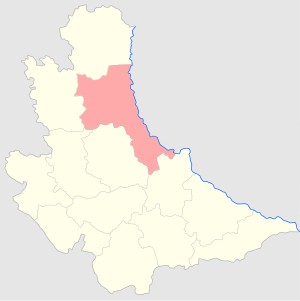
The county was located in the northeast of the province. In the east, the border of the county passed along the Dnieper , from the north and west it bordered on Radomyshl district , in the south-west with Skvirsky and Vasilkovsky districts, in the south - with Kanevsky . The area of the county was over 5000 km².
Demographics
According to the census of the Russian Empire in 1897, 541,483 people lived in the county. Of these, 56.18% are Little Russians, 26.58% are Russians, 14.06% are Jews, 3.41% are Poles, 1.07% are Germans, 0.76% are Belarusians, 0.21% are Czechs , 0.21% - Tatars.
Administrative Division
As of January 1, 1900, the Kiev district consisted of 13 towns , 106 villages, 92 villages, 121 villages, 8 German colonies, 2 Jewish colonies and 1 folk farm - out of a total of 343 settlements. All these points were administratively distributed between two world mediators, five police officers , 18 volost boards and 23 police officers . In the judicial-world and investigative relations, the Kiev district was divided into four judicial-world and three investigation sections.
- Borodyansk parish
- Belogorod volost
- Byshevskaya volost
- Veliky Dmitrov volost
- Germanic volost
- Glevakh volost
- Gostomel volost
- Dymer volost
- Kagarlyk volost
- Makarov volost
- Obukhov volost
- Rzhischevsky volost
- Staviansky volost
- Staykovskaya volost
- Staro-Petrovsky volost
- Tripoli volost
- Khotovsky volost
- Chernyakhovskaya volost
Interesting Facts
- The Russian sword , found in the Kiev district and dated to the middle of the 10th century , has inscriptions - on one side of the blade - the Cyrillic inscription “Glory”, which was not completely preserved due to the broken sword, it was the name of the manufacturing blacksmith (like Ludos on the sword from Skinny). On the other hand, unencrypted characters [2] .
- In 1897, archaeologist Vincent Hvoika discovered material remains of the Eneolithic culture, named after the Tripoli site, near the village of Tripoli .
Notes
Literature
- Kiev // Brockhaus and Efron Encyclopedic Dictionary : in 86 volumes (82 volumes and 4 additional). - SPb. , 1890-1907.
- List of populated areas of the Kiev province. Edition of the Kiev provincial statistical committee. Kiev, 1900.