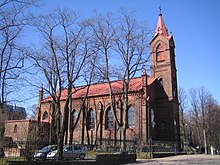
Catholicism in Finland . The Catholic Church of Finland is part of the worldwide Catholic Church.
The Catholic population of Finland is one of the smallest in Europe, about 14,000 people according to 2015, that is, about 0.25% of the country's population [1] . The number of Catholics has been growing rapidly in recent years, in 2006 it amounted to about 9 thousand people, and in 1990 - about 4 thousand [1] . Most Finnish Catholics are emigrants and their descendants, most of them have Polish roots. Half of the country's priests are Poles. Among Finnish Catholics, only 42% consider Finnish to be their mother tongue, for 5% Swedish is their mother tongue, 53% consider another language their mother tongue [2] . Due to the small number of Catholic parishes, they are united in one diocese of Helsinki , which is not part of any metropolis and reports directly to the Holy See .
Content
- 1 History
- 2 Current status
- 3 notes
- 4 References
History
The first traces of the presence of Christianity in the territory of modern Finland in its western form date back to the 11th – 12th centuries. The first Catholic diocese in the territory of modern Finland was the diocese of Abo , founded in the 11th century. In the sixteenth century, Finland was part of Sweden and together with it adopted the Reformation , after which Catholicism was completely banned, and Lutheran became the official church.
In 1799, the Catholic parish of St. Hyacinth was established in Vyborg , the capital of Old Finland , which was part of the Russian Empire . After the establishment of Russian power in the rest of Finland and the formation of the Grand Duchy of Finland , all the Catholics of the principality were in charge of the priests of the Vyborg parish. In 1812, there were 2 Catholic parishes in Finland [3] . In 1830, the number of Catholics in Finland was about 3 thousand people. Until 1860, priests from the Dominican Order from Lithuania served in Vyborg.
In 1856, a parish was established in Helsinki , in 1860 the Catholic Church of St. Henry was built in Helsinki.
In 1920, after the country gained independence, the Holy See established the Apostolic Vicariate of Finland. In 1926, a parish in Turku was created , a year later - a parish in Terioki . In 1942, Finland established diplomatic relations with the Holy See. After the transition of Vyborg and Terioki to the USSR, these parishes were liquidated, and parishes in Lahti and Jyväskylä were founded.
On February 25, 1955, the apostolic vicariate was transformed into a diocese of direct subordination, after which several more Catholic parishes were formed in various cities of Finland.
Current status
The Catholic Church in Finland is organizationally united in the Diocese of Helsinki . According to 2006 data, there were 9067 Catholics, 19 priests , 24 monks (11 of them hieromonks ), 37 nuns and 7 parishes in the country [4] . Since 2009, the Diocese has been led by Teemu Sippo , who became the first Catholic bishop to be an ethnic Finnish in the last 500 years. The Cathedral of the Diocese is the Cathedral of St. Heinrich in Helsinki, consecrated in honor of Heinrich Uppsala , considered the patron saint of the country.
Catholic parishes exist in Helsinki (2 parishes), Turku , Jyväskylä , Tampere , Kouvola , and Oulu [5] . Due to the fact that there is only one bishop in the country, there is no conference of Catholic bishops in Finland; the ordinar of the Helsinki diocese is part of the conference of Catholic bishops of Scandinavia , which, in addition to him, includes bishops of Denmark , Iceland , Norway and Sweden .
The Brigitto Women's Order has two monasteries in Finland: one to Turku, the second to Lohja . In 1988, the Bogoroditsky Carmelite Monastery was opened in Espoo .
Despite the small number of Catholics in the country, their role in the social and cultural life of the country has recently been increasing. Thus, the Minister of Foreign Affairs of Finland Timo Soyni belongs to the Catholic community [2] .
Notes
- ↑ 1 2 Statistics on the website of the Catholic Church in Finland
- ↑ 1 2 The Catholic Church in Finland is growing
- ↑ Balabeykina O.A., Martynov V.L. Lutheranism in Finland: historical geography and modernity // The Baltic Region. - 2015. - No. 4. - S. 153
- ↑ Website statistics catholic-hierarchy.org
- ↑ Website of the Catholic Church in Finland