Wolly marsupial mouse [1] ( lat. Pseudantechinus woolleyae ) is a species from the genus of thick-tailed marsupial mice of the predatory marsupial family. Endemic to Australia .
| Wolly marsupial mouse |
| Scientific classification |
|---|
| No rank : | Bilateral symmetrical |
| Squad: | Predatory marsupials |
| Family: | Predatory marsupials |
| View: | Wolly marsupial mouse |
|
| International scientific name |
|---|
Pseudantechinus woolleyae ( Kitchener & Caputi , 1988 ) |
| Area |
|---|

|
| Security status |
|---|
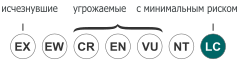
Least ConcernedIUCN 3.1 Least Concern : 40539 |
|
Content
It lives in the arid regions of the western part of the Australian state of Western Australia [2] .
The natural habitat is predominantly rocky areas with sparse vegetation [2] .
The largest representative of its kind. The length of the body with the head ranges from 80 to 100 mm, the tail from 70 to 90 mm. The mass varies from 30 to 50 g [3] [4] . The back is covered with gray-brown hair. The belly is grayish-white. Behind the ears there are patches of red-brown color. The ears are large, rounded. The base of the tail is thickened, fat deposits are located in this part. The head is elongated with an elongated muzzle. Hind legs wide. The upper three premolars are very small, absent on the lower jaw [3] .
Leads a terrestrial lifestyle. Activity occurs at night, although during the winter months it often basks in the sun. During the day, as a rule, hides in crevices or nests located in termite mounds [3] [4] .
Predators The diet is based on insects and other invertebrates [3] .
Species biology is poorly understood. There is no real bag; instead, there is a fold of leather. In the offspring up to 6 cubs [3] . Puberty occurs about 10 weeks after birth. The maximum life expectancy in captivity is up to 4 years [5] .
- ↑ Complete Illustrated Encyclopedia. "Mammals" Prince. 2 = The New Encyclopedia of Mammals / Ed. D. MacDonald . - M .: Omega, 2007 .-- S. 435. - 3000 copies. - ISBN 978-5-465-01346-8 .
- ↑ 1 2 Pseudantechinus woolleyae . The IUCN Red List of Threatened Species .
- ↑ 1 2 3 4 5 James R. Turner. Woolley's False Antechinus // Mammals of Australia. - Sofia-Moscow: Pensoft, 2004 .-- P. 190. - ISBN 954-642-198-7 .
- ↑ 1 2 Ronald M. Nowak. Walker's marsupials of the world. - JHU Press, 2005 .-- P. 107-108. - ISBN 0801882222 .
- ↑ AnAge entry for Pseudantechinus woolleyae . AnAge database at the Human Ageing Genomic Resources. Date of treatment August 9, 2011. Archived on August 9, 2011.