The Panama scandal (or Panama scam ) is a financial and political scandal that erupted in France at the end of the 19th century during the construction of the Panama Canal . Encyclopedia of Laruss calls “Panama” the most high-profile financial scandal in the history of the Third Republic .
Panama company and its collapse
Company Founding
In 1880, the Panamanian Inter-Ocean Canal General Company ( Fr. La Compagnie Universelle du canal interocéanique de Panamà ) was founded , Ferdinand Lesseps became president and CEO, and his son, Charles Lesseps, became vice president. The company issued 600 thousand shares of 500 francs each and opened a subscription to them. The subscriber had to immediately pay a quarter of the value of the shares, and the company was going to recover the rest of the money as needed. Subscription to the shares went without any problems, because everyone knew about the luck of the Suez company, created by Lesseps and bringing its shareholders good income.
Bond Issues
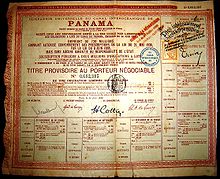
The construction of the canal began on January 1, 1881. In 1882, when the money of the shareholders began to run out, the company issued the first bond loan, and in the following years two more loans. The total amount of loans received, net of bank fees and other costs, amounted to 400 million francs. An alarm was that the third loan no longer found subscribers for the entire amount, and the Panama company lost the remaining shares at a discount to the banking syndicate, which issued and placed its securities.
In 1882, France experienced a sharp drop in stock prices and aggravation of financial problems. The shares of the Panamanian company survived the mini-crisis more or less successfully, but it turned out that the exchange is not very trustworthy: they were sold at a big discount on derivatives transactions.
In 1885, Lesseps decided to improve the company's business by issuing a long-term winning loan. It was supposed to collect 600 million francs. To issue such a loan, the consent of the Chamber of Deputies and the Senate was required. The company began processing journalists, ministers and deputies, which cost her a lot of money.
The struggle around the state’s sanction to issue a winning loan lasted about three years. In the meantime, the Panama company issued two more ordinary loans to stay afloat. To attract subscribers, she made bonds particularly attractive by raising the nominal interest rate to 10% per annum. More and more expensive, banks had to pay for the placement of bonds.
In April 1888, the Chamber of Deputies approved the loan, after which he received the consent of the Senate and the President. The loan limit has been increased to 720 million francs from the original application. The bond subscription launched in June 1888 ended in complete failure: in total, it collected 254 million francs, of which 31 million accounted for the emission costs borne by the banks. In addition, the law required that the company allocate a reserve fund from the money collected to pay the winnings and redeem the bonds.
The collapse of the Panama company
The leaders of the Panama company by all efforts tried to avoid bankruptcy : at the meetings of shareholders, the Lessepsy assured those present that the construction would be completed on time and the money would flow to the cashier of the company.
The Minister of Finance , who considered the preservation of the Panama Company a matter of national importance, introduced a bill to the Chamber of Deputies on a preferential regime for paying off its debts, but this time the deputies voted against.
The company came to an end: the court of the Seine Civil Affairs Department first appointed interim managers, and on February 4, 1889, it officially declared bankruptcy and liquidation of the Panama company.
The total number of individuals affected by the bankruptcy of the company amounted to about 700 thousand. Only a small proportion of securities belonged to legal entities . Therefore, this company is popular, and its collapse shocked the whole of France and had considerable economic and political consequences.
Over the course of several years, the company took away an average of up to 200 million francs of national savings per year, and all these savings went to waste, since during the liquidation, the company had practically no value, at least for the partial payment of its debts to bondholders, not to mention shareholders. French economists believe that this catastrophe significantly undermined the propensity for saving in France at the end of the 19th century, which is a major factor in economic growth.
An investigation conducted after the liquidation of the company reliably established that there was no direct theft and theft. But the facts of squandering, negligence, incompetence and corruption were revealed in the highest echelons of power. Of the money raised by the company (1.3 billion francs), 104 million were expenses on bank services and 250 million were paid in the form of interest on bonds and their repayment on time. Company executives accused contractors of overestimating prices and dishonesty: they were paid about 450 million francs, but the proportion of work actually performed in the total estimate did not exceed one third.
Scandal
The scandal unfolded around the publicized and hyped by the press facts of corruption by senior government officials, parliamentarians and journalists, whose services were bought with the money of the Panama company. The purpose of these bribes was to ensure the assistance of the state and the press to the company's activities, especially in issuing a winning loan.
The company's management had intermediaries and agents who had access to the higher spheres of the state and secretly transferred money to the right people, among whom were former and current ministers, prominent members of both houses of parliament, and other influential people.
The main intermediaries were greedy adventurers who were not shy about their means. They collected incriminating documents to blackmail recipients of bribes and gifts. A criminal list of such persons arose, partly identifiable, partly hidden behind obscure codes. All this led to sensational revelations and political intrigues.
Court
The investigation over the leadership of the Panama company lasted about three years. Both Lesseps, Eiffel and two other Panamanian company officials were in the dock. The presence of 87-year-old Ferdinand Lesseps was deemed redundant, and his trial took place in absentia. None of the bribe takers suffered criminal liability.
Ferdinand and Charles Lessepsy were sentenced to five years in prison and a fine; Eiffel and two other accused - to two years in prison and a fine. In fact, none of the convicts served the deadline: the sentence did not take effect against Ferdinand Lesseps because of his age and merit, and the remaining four were canceled by the higher court four months later.
Literature
- Anikin A.V. History of financial turmoil. The Russian crisis in the light of world experience. - M .: CJSC Olimp-Business, 2009. - S. 101-111. - ISBN 978-5-9693-0159-7 .