Kimberley marsupial mouse [1] ( lat. Pseudantechinus ningbing ) is a species from the genus of thick-tailed marsupial mice of the predatory marsupial family. Endemic of Australia .
| Kimberley marsupial mouse |
| Scientific classification |
|---|
| No rank : | Bilateral symmetric |
| Squad: | Predatory marsupials |
| Family: | Predatory marsupials |
| View: | Kimberley marsupial mouse |
|
| International Scientific Name |
|---|
Pseudantechinus ningbing ( Kitchener , 1988 ) |
| Area |
|---|
|
| Security status |
|---|
Least concernIUCN 3.1 Least Concern : 40538 |
|
Content
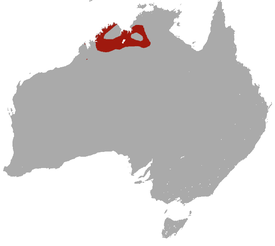
It inhabits the Kimberley region in the northern part of the Australian state of Western Australia , as well as in the northwestern part of the Northern Territory . It is found on the island of Augustus and the Heywood Islands off the coast of Kimberley [2] .
Natural habitat - rocky areas with sparse vegetation, tropical woodlands [2] [3] .
The length of the body with the head varies from 70 to 90 mm, the tail - from 70 to 90 mm. Mass varies from 15 to 25 g [3] [4] . The back is covered with a gray-brown hair. The belly is grayish white. Behind the ears there are patches of red-brown color. Ears are large, rounded. The base of the tail is thickened, in this part of the body fat is located. The head is elongated with an elongated muzzle. Hind feet wide. The upper three premolars are very small, missing in the lower jaw [3] .
Leads terrestrial lifestyle. Activity falls at night, although during the winter months it is often heated by the sun. During the day, as a rule, hides in crevices [3] [4] .
Predators . The basis of the diet are insects and other invertebrates [3] .
This bag is missing, instead there is a fold of skin. The breeding period falls on June [4] . Pregnancy lasts 45 days. Up to 4 cubs are born. The number of nipples in females - 4 [3] . Young animals are weaned after approximately 112 days. Sexual maturity occurs in 330 days. The maximum lifespan in captivity is unknown, in nature, presumably lives up to 2 years [5] .
- Full illustrated encyclopedia. "Mammals" Kn. 2 = The New Encyclopedia of Mammals / ed. D. Macdonald . - M .: Omega, 2007. - p. 435. - 3000 copies. - ISBN 978-5-465-01346-8 .
- ↑ 1 2 Kimberley marsupial (English) . The IUCN Red List of Threatened Species . Date of appeal Pseudantechinus ningbing.
- ↑ 1 2 3 4 5 6 James R. Turner. Ningbing Pseudantechinus // Mammals of Australia. - Sofia-Moscow: Pensoft, 2004. - P. 134. - ISBN 954-642-198-7 .
- 2 1 2 3 Ronald M. Nowak. Walker's marsupials of the world. - JHU Press, 2005. - P. 107-108. - ISBN 0801882222 .
- A AnAge entry for Pseudantechinus ningbing (English) . AnAge database at the Human Aging Genomic Resources. Circulation date August 6, 2011. Archived August 6, 2011.