A fiery serpent (also a lubac serpent, a maniac, a fiery raid, a charm ) is an evil spirit, a mythological creature in the traditions of the Slavs. Often it is an incubus [1] [2] [3] [4] [5] - a hypostasis of a walking dead person or devil who takes the guise of a deceased or absent husband or lover and enters into a love relationship with women [6] .
| Fire serpent | |
|---|---|
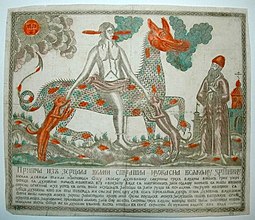 Virgo on a fire serpent. Splint. | |
| Serpentine werewolf demon | |
| Mythology | Slavic |
| In other cultures | Obayasnyky , Veresellen |
Content
Description
In the air, he looks like a fiery serpent (east, west.). It looks like a luminous fire rocker, a fiery broom, a ball of blue (Russian). He appears from the clouds, flies through the air, and, scattering sparks over the roof, enters the house through the chimney. When he descends to the ground his wings fall away (Ukrainian, floor). A fire serpent visits a widow or a girl who is overwhelmed with longing at night and in the evening after the recent loss of her husband or heartfelt friend (dead or absent). He appears to them, taking the form of a beloved man, about whom the mistress yearned. According to legend, a woman begins to languish from such visits and dies [7] .
For this reason, neighbors looked after single women, and when they noticed that the young widow was speaking to herself, they thought that a fiery serpent was flying to her. Then the neighbors began to save the woman, because if this is not done, then she will soon die [7] .
The fiery serpent, although it assumes a human form, has physical defects characteristic of demons: the absence of a spine (Russian). Like all evil spirits, he is not able to pronounce sacred Christian names correctly: instead of “ Jesus Christ ” he says “Sus Christ”, instead of “ Theotokos ” - “The Mistress” (Russian). His gifts are short-lived: the gifts that he brings to the woman, at sunrise, turn into horse dung or stones (rus, s.-ukr), and money and jewelry - into shards [8] . To entice its victims, a fiery serpent scatters beautiful things along the roads: beads, rings, scarves. If you pick them up without blessing, then the one is unclean and flies (v. -Ukr.) [8] .
Main Activities
The fiery serpent is considered an evil spirit. The creature gains access to the girl who has lost innocence (Russian). According to Eastern Ukrainian beliefs, a fire serpent scatters beautiful things along the roads (or turns into them himself): beads, rings, kerchiefs, a cross with curved ends. If you pick them up without blessing, then the one is unclean and flies. In Siberian villages, for example, they believed that stars falling from the sky were fire snakes. [9] It should be clarified that not every bride or widow risks getting online. If the girl is bashful and conscientious, takes care of her honor, then the serpent will fly by.
In the house, the serpent turned into a man, whom a woman yearned for. Then the fiery serpent passes into the upper room, hugs, kisses the waiting one, lays down with her in the bed, treats with gingerbread cookies. The main occupation of the fire serpent is his sexual relations with women [8] .
It was believed that there was a way by which it was possible to determine whether the husband had returned or a kite had flown into the house. It was necessary to feel the spine on his back: if there is a spine, then this is a husband, if not, then a fiery serpent. [7]
From communication with a demon, a woman can become pregnant. In many places, the birth of illegitimate children is still attributed to the visit of the fiery serpent. [7] Pregnancy in this case proceeds abnormally long - up to three years and often ends in nothing: sand appears in the woman’s stomach, she gives birth to a firebrand, etc. (Rus.), Which corresponds to the idea of sterility of unclean forces. If a child is born, then it is black, with hoofs instead of feet, with eyes without eyelids (Russian), and his body is cold and like a jelly (west-Ukrainian). Such a child does not live long, and soon dies [8] .
Exile Methods
The people who visited this snake lost weight, went crazy, committed suicide. Confession to an outsider (eastern glory) served as a means of healing from adversity. A woman should not sleep alone, but with a child or with any of the relatives (Russian). As medicines, they used “grass-grass” ( valerian ), decoction of burdock , as a talisman — the stalks of burdock on the wall (Rus.). In the house it was recommended to read the Psalter , and over the victim - prayers from the prodigal demon from the treasury of Peter the Grave (Rus.), Put a sign of the cross on chimneys, windows, doors with the pronunciation of the word “Amen!” (“Laminate”). Also, through venerable people, they convinced a woman to try to put on a figurative cross on her braid. After three, four, or five unsuccessful attempts to put on the cross, the vision should disappear, and the unfortunate should recover. [eight]
On Vlasyev, you cannot look at the stars so as not to see the fiery serpent (Russian). The popular belief was that if you surprise the snake - it will disappear. To do this, a woman dressed her children - a boy and a girl in wedding dresses or dressed herself in them, when asked by the snake why she does this, she answers: “Brother takes sister” - “But can it really be that brother took sister?” - “But can it be such that the dead go to the living?” (Carpathians.). After this, the fiery serpent left its prey alone [8] .
Myths and conspiracies
Myths about the fiery serpent are found in Serbian epic songs , in Russian epics , tales and conspiracies, as well as in the life story of Peter and Fevronia of Murom , which is based on folklore material.
The plot of the fiery snake relates to his criminal connection with a woman, from whom a son is born, who subsequently defeats his demonic father.
The conspiracy is referred to as an assistant, having the ability to inspire passion for a woman.
Ukrainian beliefs
Obayasnyk ( Ukr. Chamomile ) - so in places on the right-bank Ukraine they called the flying snake. It was believed that if you greatly grieve over the deceased, the latter turns into the evil spirit of a charm and flies to a griefer at night. This demon is better known as the flyer ; Innocent Gisel mentions him. The belief in the charm adjoins an extensive cycle of tales of the dead bridegroom (a theme developed in Burger 's ballad Lenora ). Special monographs about the dead bridegroom - Professor Sozonovich (in Russian) and Professor Shishmanov (in Bulgarian). For the flying pilgrims, see Podberesky’s article in the (IV, 9) and in the Works of Chubinsky (I, 193). The very word “charm” is curious, in which the ancient Slavic word “charm, charm” is preserved, in the meaning of bewitching (initially - stipulate, cf. “bike, charm”). In ancient Russian monuments (for example, in the ABC books ), a close term is found - charm , in the meaning of sorcerers [10] .
Fire Serpent in Literature
The image of the fiery serpent was captured by the Russian poet Athanasius Afanasyevich Fet in the ballad "Serpent", written by him in 1847:
A little evening dew showers grass
It scratches a scythe, a black-browed widow washes her neck.
And he doesn’t take dark eyes at the window from the sky,
And a long serpent flies, twisting into rings, in bright sparks.
And it makes noise closer, closer, and above the widow's yard,
Above the thatched roof is scattered with fire.
And the black-browed widow will immediately shut the window;
One can only hear kisses and words in the room.
See also
- Aitvaras - an analogue in the Baltic mythology
- Vereselen - an analogue in Chuvash mythology
- Incubus
- Mavka
- Wawel dragon
Notes
- ↑ Vlasova Marina. Serpent // Encyclopedia of Russian Superstitions. - Alphabet, 2008 .-- p. 193-194. - ISBN 978-5-91181-705-3
- ↑ Sedakova O. Poetics of the rite: funeral rituals of the eastern and southern Slavs. - Indrik, 2004 - p. 134
- ↑ Toporkov A. L. Sex and erotica in Russian traditional culture. - 1996 - p.208
- ↑ Malevin L., Gross P. Slavic magic and witchcraft. - 2002. - p. 622
- ↑ Telegin S. Life of myth in the art world of Dostoevsky and Leskov. - 1995. - p. 85
- ↑ Levkievskaya, 1999 , p. 331, 332.
- ↑ 1 2 3 4 L.S. Lavrentieva, Yu.I. Smirnov. Russian people: culture, customs, rites. - St. Petersburg: Parity, 2011 .-- S. 112-113. - 448 p. - ISBN 978-5-93437-381-9 .
- ↑ 1 2 3 4 5 6 Levkievskaya, 1999 , p. 333.
- ↑ The image of a fire serpent in Slavic mythology // Alley of science. - 2017. - T. 3 , No. 16 . - S. 145-147 . - ISSN 2587-6244 .
- ↑ Brockhaus and Efron, 1890-1907 .
Literature
- Zabylin M. M. "The Russian people, their customs, rites, traditions, superstition and poetry." - M .: Amrita, 2011 .-- S. 204-205. - ISBN 978-5-413-00397-8
- Fire Serpent / E. E. Levkievskaya // Slavic Antiquities : Ethnolinguistic Dictionary: in 5 volumes / under the general. ed. N. I. Tolstoy ; Institute of Slavic Studies RAS . - M .: Int. Relations , 1999. - T. 2: D (Give) - K (Crumbs). - S. 332—333. - ISBN 5-7133-0982-7 .
- Levkievskaya E. E. Myths of the Russian people. - M .: Astrel, 2000 .-- S. 442-445. - 528 s. - (Myths of the peoples of the world). - ISBN 5-17-002811-3 .
- “Slavic mythology. Encyclopedic Dictionary ” (RAS publication) . - M .: Ellis Luck, 1995 .-- S. 283-284. - ISBN 5-7195-0057-X
- Fire Serpent // Myths of the World : Encycl. in 2 t / hl ed. S. A. Tokarev . - 2nd ed. - M .: Soviet Encyclopedia , 1987-1988.
- Vlasova Marina. Serpent // Encyclopedia of Russian Superstitions. - M .: ABC, 2008 .-- ISBN 978-5-91181-705-3
- Sumtsov N. F. Obayasnyky // Brockhaus and Efron Encyclopedic Dictionary : in 86 volumes (82 volumes and 4 additional). - SPb. , 1890-1907.
Links
- Fire Serpent // Folk Wisdom
- Fire Serpent // librero.ru