Gustavo Capanema Palace or Ministry of Education and Health Building - a building in Brazil.
| Gustavu Kapanema Palace | |
| State | |
|---|---|
| Administrative unit | |
| Architect | |
| Official opening date | |
| Heritage Status | and |
| World Heritage Criterion | , and |

Designed by a group of architects: Lucio Costa , Carlos Leao, Oscar Niemeyer , Afonso Eduardo Reidi, Hernani Vasconcelos and Jorge Macadou Moreira. Also, the famous Le Corbusier was invited to the team of architects to oversee the development of the 1935-1936 project. Oscar Niemeyer played a significant role in creating the project, although at that time he was only an intern with Lucio Costa. The construction of the building was initiated by the government of President Zhetuliu Vargas , which began in 1939 and ended in 1943. When in 1960 all state institutions moved to the new capital , the Ministry of Education remained in its building in Rio , where it is still located.
The house got its name in honor of the famous Brazilian teacher and the first Minister of Education Gustavo Kapanema. Located at 16 Imprensa Street, in Castello County. According to Le Corbusier, the building should have stood on the coast of the Guanabar Bay , but the government refused this location.
The design of the building was bold enough for its time. It was one of the first modernist buildings in Latin America used by a government agency. The building itself, as one of the first buildings built in its own style, had a great influence on Brazilian architecture and the aesthetics of modernism in this country. When decorating, local materials were used, for example, blue and white tiles with their roots in Portugal . The internal concrete frame of the building made it possible to make glass both wide facades, and centralized sun protection in the form of blinds was installed on the windows.
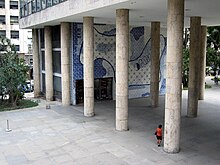
Pylons at the main entrance
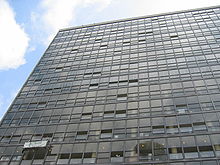
South facade

North facade

Notes
- ↑ 1 2 archINFORM - 1994.
- ↑ http://www.infopatrimonio.org/?p=20840