Yellow-footed marsupial mouse [1] [2] , or yellow marsupial mouse [2] ( lat. Antechinus flavipes ) is a species from the genus marsupial mice of the family predatory marsupials . Endemic to Australia .
| Yellow-footed marsupial mouse |
 |
| Scientific classification |
|---|
| No rank : | Bilateral symmetrical |
| Squad: | Predatory marsupials |
| Family: | Predatory marsupials |
| View: | Yellow-footed marsupial mouse |
|
| International scientific name |
|---|
Antechinus flavipes ( Waterhouse , 1838 ) |
| Subspecies |
|---|
- Antechinus flavipes flavipes ( Waterhouse , 1838 )
- Antechinus flavipes rubeculus ( Van Dyck , 1982 )
|
| Area |
|---|
|
| Security status |
|---|
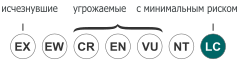
Least ConcernedIUCN 3.1 Least Concern : 40524 |
|
Content
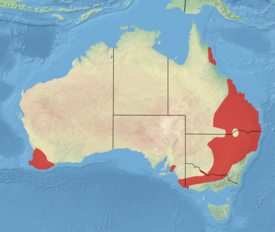
It lives in eastern Australia from northeastern Queensland to southeastern South Australia . In addition, there is a separate population in the southwestern part of Western Australia . It is the most widespread species of marsupial mice [3] .
The natural habitat is tropical rainforests, dry sclerophytic forests , wetlands, suburban areas of large cities (eg, Brisbane ) [3] .
The average adult weight is about 45 g [4] . The length of the body with the head in males is 93–165 mm, the length of the tail is 70–151 mm; the body length with a head in females is 86–127 mm, and the tail length is 65–107 mm [5] . The color of the hairline varies from gray to reddish-brown on the sacrum, belly, legs and sides. The tip of the tail is black [6] .
Lead a terrestrial lifestyle. Nests are arranged in small burrows where animals spend the day. Activity occurs at night [3] . They feed mainly on insects , although plants, small birds, and other vertebrates are also included in the diet [5] .
The bag is well developed. The offspring brings once a year. In the offspring of up to twelve cubs [3] . Pregnancy is very short, lasts 25 days. Young animals are weaned after about 90 days. At the end of the breeding season, all males in the colony die. The maximum life expectancy in captivity is 3.9 years [4] .
- ↑ Complete Illustrated Encyclopedia. "Mammals" Prince. 2 = The New Encyclopedia of Mammals / Ed. D. MacDonald . - M .: Omega, 2007 .-- S. 434. - 3000 copies. - ISBN 978-5-465-01346-8 .
- ↑ 1 2 Sokolov V.E. The Bilingual Dictionary of Animal Names. Mammals Latin, Russian, English, German, French. / edited by Acad. V. E. Sokolova. - M .: Rus. Yaz., 1984. - P. 14. - 10,000 copies.
- ↑ 1 2 3 4 Antechinus flavipes . International Union for Conservation of Nature and Natural Resources. Date of treatment July 30, 2011. Archived July 30, 2011.
- ↑ 1 2 AnAge entry for Perameles nasuta . AnAge database at the Human Ageing Genomic Resources. Date of treatment July 30, 2011. Archived July 30, 2011.
- ↑ 1 2 Yellow-footed Antechinus . Thylogale Nature Refuge. Date of treatment July 30, 2011. Archived July 30, 2011.
- ↑ Yellow-footed Antechinus . Chambers Wildlife Rainforest Lodges. Date of treatment July 30, 2011. Archived July 30, 2011.