

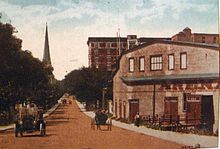
Confederation Park Confederation Park , fr. Parc de la Confédération - a park in the central part of Ottawa, National Historic Landmark of Canada. Its southern border is Lorie Avenue with City Hall , the eastern one is the Rideau Canal and the National Center for the Arts , the northern one is the Mackenzie King Bridge , and the western is Elgin Street .
The park is managed by the National Metropolitan Commission of Canada . [one]
Content
Description
This is a typical city park with paved walkways, monuments and an open grassy area in the eastern part for public events. Located on flat terrain. In the center of the park is a large fountain - this is one of two twin fountains that were in 1845-1939. on Trafalgar Square in London [2] , while the second is in Wuscan Park in Regina ). [3] The park also includes:
- totem pole presented for the 100th anniversary of the province of British Columbia (1971),
- Monument to Aboriginal veterans,
- Monument to those killed in the Boer War.
The park is surrounded on all sides by large buildings. In the east, on the other side of the Rideau Canal, stands a skyscraper headquarters of the Department of National Defense. In the south, on the other side of Laurier Avenue, are (from west to east) Ontario Provincial Court, City Hall and Drill Hall . To the west, beyond Elgin Street, is the Hotel Lord Elgin. In the north is the National Center for the Arts .
History
In 1908-1927 on the site of the park was the first Ottawa hockey arena where the Ottawa Senators team played. Later, the arena and adjacent buildings were demolished and a road built.
In the park along Elgin Street, Roxborough Apartments used to be the home of Ottawa’s elite, including Prime Ministers William Lyon Mackenzie King and Louis Saint Laurent . As part of the plan of Jacques Grebes in 1949, the area was cleared and a park was built. [four]
In 1965, the Canadian government expropriated the Apartments and a number of other large buildings that were demolished for the construction of the National Museum of Science. By that time, the area north of the Mackenzie King Bridge had already been cleared for the Confederation Square , and where the National Arts Center was eventually built. In 1967, instead of a museum, a park was set up in a cleared place to commemorate the 100th anniversary of the Canadian Confederation.
In 1971-1993 in the park stood a massive sculpture by Ed Zelenak “Traffic” - a huge brown pipe made of fiber glass, resembling a worm or a piece of excrement. She was later moved to the National Gallery of Art. [five]
Events
In summer, the Ottawa International Jazz Festival and Canada Day are held in the park, and in winter, an ice sculpture competition as part of the Winterlude festival. [6]
Notes
- ↑ Capital Parks to Discover . National Capital Commission. Date of treatment September 16, 2010. Archived on February 8, 2006.
- ↑ * Exploring Ottawa: an architectural guide to the nation's capital. Harold Kalman and John Roaf. Toronto: University of Toronto Press, 1983. pg. 46
- ↑ A Pair of Fountains from Trafalgar Square . The Art Fund. Date of treatment September 16, 2010. Archived on August 15, 2012.
- ↑ Proposed Confederation Park of the Future , Ottawa Citizen (April 29, 1949), p. 58.
- ↑ Stone, Jay . Farewell, fair Worm, enjoy your traffic island., The Ottawa Citizen (May 8, 1993), S. p. F1.
- ↑ Confederation Park . ottawakiosk.com. Date of treatment September 16, 2010. Archived on August 15, 2012.
Links
- Webcam from the Lord Elgin Hotel - Webcam overlooking Confederation Park.
- 360 Panorama from OttawaKiosk.com - 360 Degree picture of Confederation Park during Winterlude.