Small Bandicoot [1] ( lat. Isoodon obesulus ) is a species from the genus Short-Nosed Bandicoots of the Bandicut family. Endemic to Australia .
| Small Bandicoot |
 |
| Scientific classification |
|---|
| No rank : | Bilateral symmetrical |
| Gender: | Short-nosed bandicoots |
|
| International scientific name |
|---|
Isoodon obesulus ( Shaw , 1797 ) |
| Subspecies |
|---|
- Isoodon obesulus obesulus (Shaw, 1797)
- Isoodon obesulus nauticus Thomas, 1922
|
| Area |
|---|

|
| Security status |
|---|
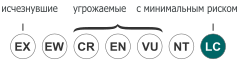
Least ConcernedIUCN 3.1 Least Concern : 40553 |
|
Content
Recent studies indicate that the small bandicut may belong to the same species as the golden bandicut ( lat. Isoodon auratus ). A proof of this is the genetic similarity of these animals. Nevertheless, both species have significant morphological differences [2] .
It inhabits a vast territory from the southwestern part of Western Australia to the southeastern part of Victoria and the state of New South Wales . There are also populations on the island of Tasmania , Kangaroo , the Reshers archipelago and in the state of Queensland [3] [4] .
The natural habitat of the species is forests, wooded and shrubbery, moorlands [3] .
Birth weight - 0.35 g, adult - 700 g. Outwardly similar to rats and rabbits. The muzzle is shorter than that of other bandicoots, but has an elongated shape. The ears are short, rounded. The back is usually covered with a dark brown hair with interspersed with orange or yellow colors, the belly with a light brown, gray or white cover [4] .
Lead a terrestrial, solitary lifestyle. Nests are built either on the ground or in the hollows of fallen trees. Nests are built from branches, leaves, grass, earth [4] . Activity occurs both at night and at day [3] . They feed on insects , worms , small reptiles, and plant roots [5] .
The bag is well developed, opens back. In the offspring, up to six cubs, however, before weaning, as a rule, no more than two cubs survive [3] . Cubs are born in a bag within 50 days. Puberty occurs on day 90. Propagate all year round. Pregnancy lasts only 12.5 days [4] . The maximum life expectancy in captivity is 6.5 years [6] .
- ↑ Sokolov V.E. The pagan dictionary of animal names. Mammals Latin, Russian, English, German, French. / edited by Acad. V. E. Sokolova. - M .: Rus. Yaz., 1984. - P. 17. - 10,000 copies.
- ↑ GOLDEN BANDICOOT Isoodon auratus (inaccessible link) . THREATENED SPECIES OF THE NORTHERN TERRITORY. Date of treatment July 29, 2011. Archived July 29, 2011.
- ↑ 1 2 3 4 Isoodon obesulus . International Union for Conservation of Nature and Natural Resources. Date of treatment July 29, 2011. Archived July 29, 2011.
- ↑ 1 2 3 4 Isoodon obesulus . Animal Diversity Web. Date of treatment July 29, 2011. Archived July 29, 2011.
- ↑ Sokolov V.E. Systematics of mammals. Textbook manual for universities. - High school. - M. , 1973. - S. 75-76. - 432 s.
- ↑ AnAge entry for Isoodon obesulus . AnAge database at the Human Ageing Genomic Resources. Date of treatment July 29, 2011. Archived July 29, 2011.