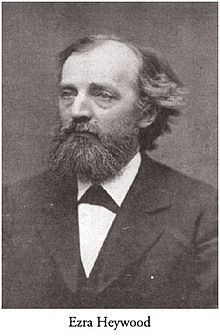
Ezra Heywood ( English Ezra Heywood , 1829-1893) - American anarchist-individualist , abolitionist and feminist of the mid- 19th century .
Content
Views
Haywood believed that the disproportionate concentration of capital in the hands of a few, in his opinion, was the result of selective expansion of the privileges provided by the government for individuals and organizations. He said: “Government is a northeast wind blowing property into aristocratic heaps, at the expense of the rest of the democratically bare land. Thanks to the tricks of the law, [...] privileged classes have the legal right to steal on a large scale. ”
He believed that there should be no profit from renting buildings. He did not object to the lease, but considered that if the building was paid in full, then it would be incorrect to charge more than is necessary to cover expenses, insurance and repair damage that occurred during occupation of the building by the tenant. He even claimed that the owner of the building was obliged to compensate the tenant for the cost of repairing the building if the tenant carried out repairs on his own funds. Haywood believed that ownership of unoccupied land was the greatest evil.
Activities
Haywood played an important role in the development of the ideas of individualistic anarchism in the United States, thanks to both his own journalistic activities and the republishing of the works of his predecessors, such as Joshua Warren (author of True Civilization) and William Green . In 1872, at the congress of the New England Labor Reform League in Boston, Haywood introduced Green and Warren to future Liberty publisher Benjamin Tucker .
In May 1872, Haywood, supporting activist Victoria Woodhall ’s views on women's suffrage and free love , began publishing the Slovo anarchist-individualistic magazine right at his home in Princeton , Massachusetts . [1] In 1878, he was held accountable for distributing “obscene materials” - literature critical of the traditional institution of marriage - reported by postal inspector Anthony Comstock. In accordance with the law of Comstock adopted in 1873, he was sentenced to two years of forced labor [2] . However, after only six months, he was acquitted and personally released by President Haze , thanks to mass protests by sympathizers of Haywood and supporters of freedom of speech. Subsequently, Haywood was arrested four more times, resulting in death from tuberculosis within a year of his last release from prison.
See also
- Anarchism in the USA
- Feminism
- Free love
Literature
- Uncivil Liberty: An Essay to Show the Injustice and Impolicy of Ruling Woman Without Her Consent (1873) by Ezra Heywood - one of the first anarcho-feminist essays
Notes
- ↑ The Free Love Movement and Radical Individualism By Wendy McElroy
- ↑ Passet, Joanne Ellen. Sex radicals and the quest for women's equality. - University of Illinois Press, 2003 .-- P. 45.