Stamatios or Stamatis Kleantis ( Greek Σταμάτιος (Σταμάτης) Κλεάνθης , real name is Stamatis Stamatiu; 1802, Velvendo, Mr. Kozani , Western Macedonia - 1862, Athens ) - a famous Greek architect.
| Stamatis Cleantis | |
|---|---|
| ( Greek Σταμάτης Κλεάνθης | |
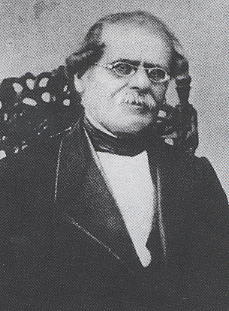 | |
| Basic information | |
| A country | Greece |
| Date of Birth | 1802 |
| Place of Birth | Velvendo, Mr. Kozani . |
| Date of death | 1862 |
| Place of death | Athens |
| Work and Achievements | |
| Worked in the cities | Aegina , Nafplion , Athens |
| Architectural style | romanticism , neo-greek |
| The most important buildings | Palaces (museums) of Athens |
| Town-planning projects | Reconstruction of Athens |

Content
Biography
Kleantis, at birth, Stamatis Stamatiu was born in 1802 in the town of Velvendo, near Kozani, Western Macedonia . In Velvendo, he graduated from high school and the young man went to the Danubian principalities, which, according to Russian-Turkish agreements, had a semi-autonomous status. In Bucharest, natives of Velvendo created their colony. Here he continued his studies in a Greek school with a native of Epirus Neophytos Dukas.
At the beginning of 1821, revolutionaries Filiki Eteria entered the principalities and began military operations against the Ottoman Empire in order to revolt in Greece and other Balkan countries. Alexander Ipsilanti formed the Holy Corps here from the Greek student youth of Russia , Austria-Hungary and Moldova-Wallachia. Kleantis left school and in March entered the corps.
The battle of Dragashani was the first and last for the youth corps. Cleantis was among 38 captured fighters of the corps, but he managed to escape between Bucharest and Silistra. At that time, the rest of his comrades-in-arms were taken to Constantinople , where after torture they were publicly beheaded [1] .
Kleantis got to Vienna , and then went to Leipzig , where he began his studies as an architect, after which he moved to continue his studies in Berlin , where Schinkel, Karl Friedrich taught.
Providing his living and his studies, Stamatis worked as a translator at the Leipzig Fair, and then as a trading broker, for which he received the nickname Kleantis from his German classmates and teachers (see Kleantf (Stoic) ), which he subsequently saved as a surname.
Kleantis graduated with honors and the diploma was awarded to him by the King of Prussia [2] .
In revived Greece
In 1828, Kleantis, along with his friend and fellow student Gustav Eduard Schaubert (1804-1860) arrived in Greece, where the War of Independence continued and offered their knowledge of architects in the matter of reviving the country free of charge.
The first ruler of Greece, John Kapodistrias, appointed them "government architects" and, since the Peloponnese and Middle Greece were still regions of hostilities, sent them previously to work on the island of Aegina . Together with a group of "government architects", friends took part in the construction of the Orphan's house and other necessary buildings on Aegina, as well as the repair of the destroyed ones. Working on the island as architects, friends taught architecture to the senior pets of an orphanage.
After the assassination of Kapodistrias, friends moved to Nafplion , and then to Athens [3] .
New Athens Plan
In 1832, Kleantis and Schaubert were commissioned to develop an architectural plan for the new Athens, which at the end of the war represented a small and ruined town. The plan they developed took into account all the ancient monuments of the city, provided for free spaces for future excavations, the construction of churches, public buildings, parks and trading floors. The plan was built on the principle of large building blocks, with wide avenues and squares. The center of the city was supposed to be the royal palace, which was planned on the territory of today's Omonia Square (Greek Concord). The first names of the city streets were also marked on the plan. However, the government of the Bavarian King Otton, who took power over Greece in January 1833 , arguing that the plan did not correspond to the population and the real size of the city of that era, as well as the finances of the kingdom, provided a plan for revision to the authoritative architect of the era from “Isar Athens” ( Munich ) Klenze Leo background .
Klenze revised the plan, adjusting the width of the streets, the size of parks and public buildings to a smaller side, which caused Kleantis to resign from his post and is causing complaints from the inhabitants of today's Athens.
Architect and Entrepreneur
A royal decree of September 1834 [4] moved the capital from Nafplion to Athens. This led to a building fever, which in turn made Cleantis a wealthy person. Remaining an architect, he also began to mine marble on the island of Paros . Marble from his designs received a gold medal at the Great London Exhibition.
At the same marble quarry on the island of Paros, Cleantis was seriously injured in an accident that occurred in 1862. The wounded Cleantis was taken to Athens, where he died [5] .
Works
- The Cleantis House is one of the most characteristic buildings of the period 1830-1833. In fact, it is completely rebuilt from the foundation in 1831-1833. Cleantis and Ε. Schaubert is an Ottoman building located in the Plaka quarter under the Acropolis. Later, the First Gymnasium (1835-1836) and the Otto University (1837-1841), that is, the first university of the revived state, are located here. From 1841 to 1850 there was a school. In 1963, the building received the status of a protected monument and was transferred to the department of the University of Athens. Since 1987, it has been operating as the Museum of the History of the University of Athens , while still remaining known as the House of Cleantis.
Kleantis was a supporter of the school of romanticism and, to a lesser extent, a supporter of the Greek neoclassical school.
Kleantis created some of the most characteristic examples of the school of romanticism in Greece: the "Ambrosius Rallis Palace" on Klafmonos Square (was built in 1839-1845, became the residence of the British mission, but was demolished in 1938), the "Daras Palace" along Panepistimiou Street ( also demolished), the “Palace of the Duchess of Placentia” in Athens (built between 1840–1848, today's Byzantine and Christian Museum) as well as the Oleander, Maisonette, Tourelle and others palaces on Mount Penteli [6] .
- Limestone factories and warehouses in the port city of Piraeus .
Notes
- ↑ [Δημήτρη Φωτιάδη, Ιστορία του 21, ΜΕΛΙΣΣΑ, 1971, τομ.Α, σελ.428]
- ↑ Stamatios Kleantis at www.velvento.gr Archived January 11, 2012 at Wayback Machine (Greek) ]
- ↑ Stamatios Cleantis at www.greekarchitects.gr (Greek) ]
- ↑ [Στέφανος Π. Παπαγεωργίου, Από το Γένος στο Έθνος, σελ.322, ISBN 960-02-1769-6 ]
- ↑ [Μπαδήμα - Φουντουλάκη Όλγα, 2001, "Κλεάνθης. 1802-1862. Αρχιτέκτων, Επιχειρηματίας, Οραματιστής », Έκδοση των Δήμων Αθηναίων & Βελβεντού, Αθήνα Δεκέμβριος 2001 (Αθηναϊκή Βιβλιοθήκη, Δ / νση & Συντονισμός Έκδοσης: Γιάννης Ηλ Εμίρης ( 2 τόμοι / ο 2 ος:.. Παράρτημα)]
- ↑ [Douglas Dakin, The Unification of Greece, ISBN 960-250-150-2 , p.151]
Literature
- 1972. "Ιστορία του Ελληηνικού Έθνους." Εκδοτική Αθηνών, τόμος ΙΓ.
- Δημόπουλος Δ. Βασ. 1998. "Το Βελβεντό στην Ιστορική του Πορεία." Έκδοση Δήμου Βελβεντού. Βελβεντό / Κοζάνη 1998.