“Do not touch me” is an armored floating battery ( coastal defense battleship ) of the Russian Imperial Navy .
| "Dont touch me" | |
|---|---|
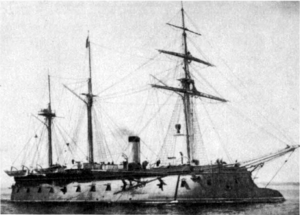 1900s, Bulla photo studio | |
| Service | |
 Russian empire Russian empire | |
| Class and type of vessel | Armored floating battery (from February 1, 1892 - an coastal defense battleship ; from March 11, 1895 it was withdrawn from the Baltic Fleet and was used as a blocking block at the Mine Fleet School) |
| Construction started | January 15, 1863 |
| Launched | June 11, 1864 |
| Commissioned | July 6, 1865 |
| Withdrawn from the fleet | September 2, 1905 (it was excluded from the lists of the fleet on September 29, 1905 ; from 1908 until the sinking of the Great Patriotic War on the Neva , it was used as a dry-cargo non-self-propelled barge ) |
| Main characteristics | |
| Displacement | design 3340 t , actual 3494 t |
| Length | 67.1 m |
| Width | 16.16 m |
| Height | 4,58 m |
| Reservation | Battery: 101.6-114.3 mm Deck: 101-6-114.3 mm |
| Engines | 1 steam engine , 4 fire tube boilers |
| Power | 1200 l. with. (0.9 MW ) |
| Mover | 1 propeller |
| Speed | 8 knots (14.8 km / h ) |
| Crew | 18 officers and 426 sailors (according to other sources - 394 people (total)) |
| Armament at the beginning of the service | |
| Artillery | 17 × 203.2 mm / 21 kb (smoothbore) |
| Armament (1877) | |
| Artillery | 16 × 203.2 mm / 21 kb (rifled), 6 × 87.6 mm / 24 kb (rifled) |
| Armament (1881) | |
| Artillery | 14 × 203.2 mm, 6 × 87.6 mm 1 × 228.6 mm mortar, 1 × 43.8 mm (Angstrom), 1 × 25.4 mm (Palmcranza) |
| Armament (since the early 1890s) | |
| Artillery | 12 × 203.2 mm 2 × 152.4 mm 2 × 63.5 mm (Baranovsky, landing) |
Content
History
For navigation in the oceans and linear battle, the Russian Maritime Department decided to leave onboard armadillos with full sailing armament and armor of moderate thickness, and to attack and defend ports and harbors build coastal armadillos capable of carrying the heaviest guns and the thickest armor. Since the coastal defense was of paramount importance to Russia, the main emphasis of the shipbuilding program was on coastal defense battleships.
The construction of the small armored boat "Experience" in 1861 showed that the factories of Tsarist Russia were not able to fulfill the requirements of the maritime department. Therefore, the first Russian battleship - the floating battery " Firstborn " - was built in England. Its construction was used to train Russian engineers and craftsmen sent to England for this purpose.
Construction
The Do Not Touch Me battery was already being built in Russia, at the shipyard of Galerny Island in St. Petersburg under a contract with the English breeder C. Mitchell. The Ministry of the Sea has committed itself to arranging a boathouse on Galerny Island with all the accessories, a warehouse for storing materials, workshops with machine-driven machines from a steam engine, furnace, furnace, steam-powered cranes, railways and gas lighting. Many Russian engineers and artisans participated in the construction of the shipyard and the construction of the Do Not Touch Me battery. The ship engineer A. Kh. Sobolev was appointed to oversee the construction of the Shipbuilding Technical Committee. The steam engine of the Humphreys factory (England, 1858) and four used steam boilers were removed from the Constantine screw ship. Repair of the steam engine was carried out by the St. Petersburg plant of Byrd.
- July 10, 1862 - the battery was added to the lists of the ships of the Baltic Fleet.
- January 15, 1863 - started by construction on the boathouse of Galerny Island in St. Petersburg.
- November 9, 1863 - the official bookmarking ceremony was held.
- June 11, 1864 - launched
- October 16, 1864 - brought to Kronstadt on a hydraulic dock, withdrawn from it and, under her own pairs, entered the harbor for completion.
- July 6, 1865 - entered into operation.
Design
On the Do Not Touch Me battery, the slope of the sides began from the battery deck. The battery had massive armored ramming rods in the bow and stern, the stern shaft also served to protect the steering wheel and propeller. The steering frame, forts and sterns were forged. To avoid significant rolling on the battery, cheekbones were used, first used on ships of the Russian fleet. Such keels with a length of 6.1 m and a width of 305 mm were installed on the Do Not Touch Me battery during the construction process.
The battery case was divided into seven compartments with 13.5 mm thick waterproof bulkheads extending to the battery deck. The hull had one bottom; as a ballast, the space between the floras was poured with a solution of cement with sand. The keel sheets were made of 28.5 mm iron, the frames were made of 10.5 mm iron with a width of 254 mm. The casing of the sides with a thickness of 16.5 mm under water and 13.5 mm above the water was fastened using angular iron. Three continuous decks - the upper, the battery and the living deck over 10.8 mm beams , supported by solid forged pillers . Special tanks were placed in the side compartments, when filling, the battery was further deepened by 305 mm, due to which the affected surface was reduced.
Mover
There was a three-blade propeller on Do Not Touch Me. Batteries with their full contours with an average draft of 4.4 to 4.6 m and moderate power machines were characterized by poor driving performance.
Booking
Armor protection “Do not touch me” completely covered the freeboard and fell about 1.2 m below the waterline. The thickness of the wrought iron armor is 114 mm in the middle and 102 mm in the extremities. The teak lining for armor is 254 mm (on steep sides reinforced to 457 mm). The living and upper decks over 6.5 mm of iron sheets were covered with pine, the battery deck - 102 mm with oak boards. The armor was attached to the case through bolts with a diameter of 36.1 mm and rested on a special protrusion in the frames. On the battery deck in armor there were gun ports 864 mm high in the light. The round conning tower was protected by 114 mm slabs. The living and upper decks over 6.5 mm iron sheets were covered with pine boards, and the battery deck was 102 mm oak. On “Do Not Touch Me”, 25.4 mm iron sheets were placed on the lower deck beams above the hook cameras and bomb cellars to protect them from mounted shots.
Armament
Initially, the battery was supposed to arm 24 smoothbore guns. Two guns were located on turntables on the upper deck, the rest in a closed battery. In 1863, 68 8 dm (203 mm) smoothbore guns were ordered to the Krupp factory. They did not get on ships, since in 1864 it was decided to remake them into rifled ones. In the campaign of 1866, "Do not touch me" was armed with 203 mm steel rifled guns Krupp (17 guns). The battery was later re-equipped with rifled breech-loading guns of the 1867 model. In 1875, “Do not touch me” had 16 such guns. The armament was supplemented by 4-pound (87-mm) cannons, Engstrem and Palmcranz cannons. The sinking of the Turkish armadillo on the Danube during the war of 1877–78 with a successful mortar shot suggested the arming of ships with 9 dm (229 mm) mortars for mounted shooting. One such weapon was received and "Do not touch me."
8 dm (203 mm) guns had an elevation angle of 50, which provided a firing range of up to 10 cable. Shells in a lead shell of ordinary cast iron weighed 73.7 kg, of hardened - 84.8 kg.
Service
- In July 1866, the Russian squadron under the command of Rear Admiral Likhachev (armored battery "Do not touch me", armored frigate " Sevastopol ", frigate " Dmitry Donskoy ", steamer-frigate " Brave ", steamer-frigate " Vladimir ", clipper " Yakhont " ”, A two-tower Smerch boat and four monitors) were sent to Helsingfors to meet the American ships of the Miantonomoh monitor and the Ogasta steamer under the command of Assistant Secretary of the United States Navy Minister Captain G.F. Fox, on which the new American embassy arrived. Meeting in Helsingfors, the Russian squadron escorted them to the Bolshoi Kronstadt raid.
- February 1, 1892 - reclassified to coastal defense battleship of the 2nd rank.
- Since March 11, 1895 - has been used as a blockchain at the Baltic Fleet Mine School.
- September 2, 1905 - disarmed and deposited at the Kronstadt military port.
- September 29, 1905 - excluded from the lists of the ships of the Baltic Fleet.
- August 26, 1908 - sold to a private company for use as a dry-cargo non-self-propelled barge.
- After the Civil War and the nationalization of the fleet, the NKPS was transferred to work in the Petrograd Commercial Sea Port.
- June 24, 1925 purchased by the Leningrad Metal Plant.
- During the Great Patriotic War sank in Leningrad in the Neva.
- In 1950, KVMK ACC was raised and delivered to Glavvtorchermet for metal cutting.
Accidents
During the service, the floating battery “excelled” in several accidents. In 1869, “Do not touch me” collided with the semi-armored frigate “Petropavlovsk”, and in 1883 seriously damaged the Norwegian ship “Hayden”.
Commanders
- 1864-1865 - Captain 1st Rank Puzino, Orest Polikarpovich
- ? -? - Dubasov, Fedor Vasilyevich
- ? -? - Bauer, Salvador Fedorovich
- 02.24.1886—? - Bolotnikov, Pavel Alexandrovich
- 1888-1889 - Captain 1st Rank Enegelm, Fedor Petrovich
- 01/01/1901 - 12/28/1901 - Mikluha, Vladimir Nikolaevich
- ? -? - Elchaninov, Mikhail Ivanovich
- 1941—? - Senior Lieutenant S. Ya. Moshensky
See also
- Firstborn
- Kremlin
Literature
- Berezhnoy S.S. Armored and battleships. Gunboats: A Guide. - M .: Military Publishing House, 1997 .-- 312 p. - 10,000 copies. - ISBN 5-203-01671-2 .
- Conway's All the World's Fighting Ships 1860-1905 / Robert Gardiner. - Greenwich: Conway Maritime Press, 1979. - ISBN 0-8317-0302-4 .
- McLaughlin, Stephen. Russian First Ironclads: Pervenets, Neutron menia and Kreml // Warship 2011 / Jordan, John. - London: Conway, 2011 .-- ISBN 978-1-84486-133-0 .
- Silverstone, Paul H. Directory of the World's Capital Ships. - New York: Hippocrene Books, 1984. - ISBN 0-88254-979-0 .
- Watts, Anthony J. The Imperial Russian Navy. - London: Arms and Armor, 1990. - ISBN 0-85368-912-1 .