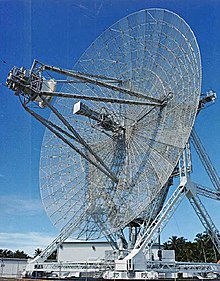

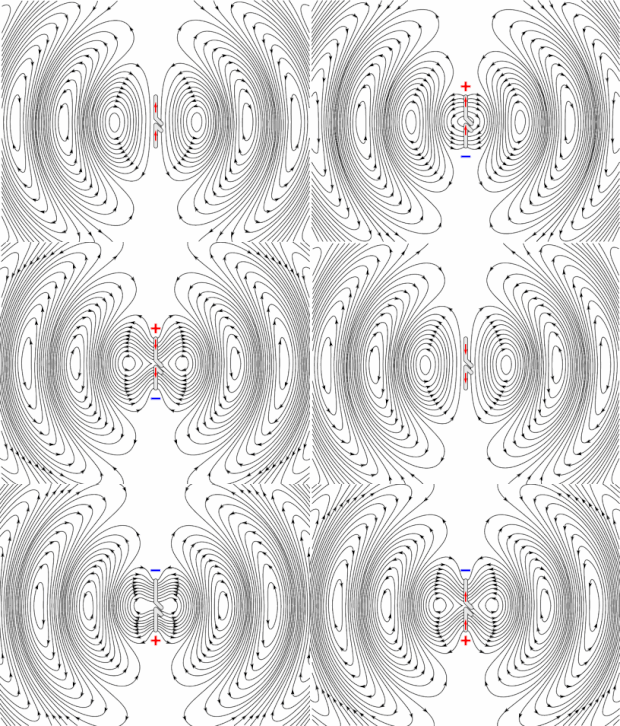
Radio waves - electromagnetic waves with frequencies up to 3 THz , propagating in space without an artificial waveguide [1] [2] . Radio waves in the electromagnetic spectrum range from extremely low frequencies up to the infrared range . Taking into account the classification by the International Telecommunication Union [3] [4] of radio waves by ranges, electromagnetic waves with frequencies from 0.03 Hz to 3 THz, which corresponds to a wavelength from 10 million kilometers to 0.1 millimeters , are referred to radio waves.
In a broad sense, radio waves are all kinds of wave processes of the electromagnetic field in equipment (for example, in waveguide devices, in microwave integrated circuits , etc.), in transmission lines and, finally, in natural conditions, in a medium separating a transmitting and receiving antenna [5] .
Radio waves, being electromagnetic waves, propagate in free space at the speed of light . Natural sources of radio waves are lightning flashes and astronomical objects . Artificially created radio waves are used for stationary and mobile radio communications , broadcasting , radar , radio navigation, satellite communications , the organization of wireless computer networks and in countless other applications.
Depending on the value of the frequency (wavelength), the radio waves are assigned to one or another range of radio frequencies (wavelength range). You can also classify radio waves by the method of propagation in free space and around the globe [6] .
Radio Frequency Bands and Radio
Radio frequencies - frequencies or frequency bands in the range from 3 Hz to 3000 GHz, which are assigned conventional names. This range corresponds to the frequency of alternating current electrical signals for generating and detecting radio waves. Since most of the range lies beyond the boundaries of the waves that can be obtained by mechanical vibration, radio frequencies are usually referred to as electromagnetic waves.
The RF Law “On Communications” establishes the following concepts related to radio frequencies:
- radio-frequency spectrum - a set of radio frequencies within the limits established by the International Telecommunication Union that can be used for the operation of electronic equipment or high-frequency devices;
- radio frequency - the frequency of electromagnetic waves, established to denote a single component of the radio frequency spectrum;
- allocation of radio frequency bands - determining the purpose of radio frequency bands by means of entries in the Table of distribution of radio frequency bands between radio services of the Russian Federation, on the basis of which permission is issued for the use of a specific radio frequency band, and the conditions for such use are established.
The use of bands for radio services is regulated by the Radio Regulations of the Russian Federation and international agreements.
According to the regulations of the International Telecommunication Union, radio waves are divided into ranges from 0.3 * 10 N Hz to 3 * 10 N Hz, where N is the number of the range. Russian GOST 24375–80 almost completely repeats this classification.
| ITU Identification | Wavelengths | Name of the waves | Frequency range | Frequency name | Photon energy , eV , | Application |
|---|---|---|---|---|---|---|
| ELF | 100 mm - 10 mm | Decameter | 3-30 Hz | Extremely Low ( ELF ) | 12.4 feV - 124 feV | Communication with submarines , geophysical exploration |
| SLF | 10 mm - 1 mm | Megameter | 30-300 Hz | Ultra Low (VLF) | 124 feV - 1.24 peV | Communication with submarines, geophysical exploration |
| ULF | 1000 km - 100 km | Hectokilometer | 300-3000 Hz | Infralow (INCH) | 1.24 peV - 12.4 peV | Submarine Communications |
| Vlf | 100 km - 10 km | Mirameter | 3-30 kHz | Very Low ( VLF ) | 12.4 peV - 124 peV | Exact time service , radio communication with submarines |
| Lf | 10 km - 1 km | Kilometer | 30-300 kHz | Low (LF) | 124 peV - 1.24 neV | Radio broadcasting , earth wave radio communications , navigation |
| Mf | 1000 m - 100 m | Hectometer | 300-3000 kHz | Medium (MF) | 1.24 neV - 12.4 neV | Broadcasting and radio communication by the earth wave and ionosphere |
| Hf | 100 m - 10 m | Decameter | 3-30 MHz | High (treble) | 12.4 neV - 124 neV | Radio broadcasting and radio communication, ionospheric, trans-horizon radar , walkie-talkies |
| Vhf | 10 m - 1 m | Meter waves | 30-300 MHz | Very High (VHF) | 124 neV - 1.24 uV | Television , radio broadcasting, tropospheric and direct wave radio communications, walkie-talkies |
| Uhf | 1000 mm - 100 mm | Decimeter | 300-3000 MHz | Ultra High (UHF) | 1.24 uV - 12.4 uV | Television, tropospheric and direct wave radio communications, mobile phones , walkie-talkies, UHF therapy , microwave ovens , satellite navigation . |
| SHF | 100 mm - 10 mm | Centimeter | 3-30 GHz | Ultra High (Microwave) | 12.4 uV - 124 uV | Radar , Internet , satellite television , satellite and direct-wave radio communications, wireless computer networks . |
| Ehf | 10 mm - 1 mm | Millimeter | 30-300 GHz | Extremely High (EHF) | 124 uV - 1.24 meV | Radio astronomy , high-speed radio relay communication , radiolocation ( meteorological , weapon control), medicine , satellite radio communication. |
| Thf | 1 mm - 0.1 mm | Decimillimeter | 300-3000 GHz | Hyperhigh Frequency, Far Infrared | 1.24 meV - 12.4 meV | An experimental “terahertz camera” recording an image in the long-wavelength IR (which is emitted by warm-blooded organisms, but, unlike the shorter-wavelength IR, is not delayed by dielectric materials). |
The classification of GOST 24375–80 is not widespread and, in some cases, conflicts with national standards (GOST) in the field of radio electronics. The traditional designations of radio frequency bands in the West developed during the Second World War. They are currently enshrined in the United States by the IEEE standard, as well as the international ITU standard.
In practice [7] , the low-frequency range often refers to the range of sound frequencies , and the high - frequency range refers to the entire radio range, from 30 kHz and higher, including the high-frequency range. In the domestic literature, the microwave range in the broad sense is sometimes referred to as the UHF, microwave, and EHF ranges (from 0.3 to 300 GHz), in the West this corresponds to the widespread term for microwaves .
Also, in the domestic educational and scientific literature, a classification of ranges has developed, according to which the mameameter waves are called extra -long waves (LW), kilometer waves are called long waves (LW), hectometer waves are called medium waves (SW), decameter waves are called short waves (SW), and all the rest, with wavelengths shorter than 10 m, refer to ultrashort waves (VHF) [8] .
Distribution Classification
Direct waves are radio waves propagating in free space from one object to another, for example, from one spacecraft to another, in some cases, from an earth station to a spacecraft and between atmospheric vehicles or stations. For these waves, the influence of the atmosphere , foreign objects and the Earth can be neglected.
Terrestrial or surface - radio waves propagating along the spherical surface of the Earth and partially enveloping it due to diffraction. The ability of a wave to bend around encountered obstacles and diffract around them, as is known, is determined by the ratio between the wavelength and the size of the obstacles. The shorter the wavelength, the weaker the diffraction. For this reason, the waves of the UHF ranges and above are very weakly diffracted around the surface of the globe, and the distance of their propagation in the first approximation is determined by the line of sight (direct waves).
Tropospheric - radio waves of the VHF and UHF ranges, propagating due to scattering on the inhomogeneities of the troposphere over a distance of up to 1000 km.
Ionospheric or spatial - radio waves longer than 10 m, spreading around the globe at arbitrarily large distances due to single or multiple reflection from the ionosphere and the Earth's surface.
Guided - radio waves propagating in guiding systems ( radio waveguides ).
Examples
Examples of dedicated radio bands
| Title | Frequency band | Wavelengths | Photon energy , eV , |
|---|---|---|---|
| Medium Wave Range (MW) | 530-1610 kHz | 565.65-186.21 m | 2.19-6.66 neV |
| Shortwave range | 5.9-26.1 MHz | 50.8-11.49 m | 24.4-107.9 neV |
| Civilian range | 26.965-27.405 MHz | 11.118-10.940 m | 111.5-113.3 neV |
| TV channels : 1 to 5 | 48-100 MHz | 6.25-3.00 m | 198.5-413.6 neV |
| Cable TV | 100-174 MHz | ||
| TV channels: from 6 to 12 | 174-230 MHz | 1.72-1.30 m | 719.6—951.2 neV |
| Cable TV | 230-470 MHz | ||
| TV channels: from 21 to 39 | 470-622 MHz | 6.38-4.82 dm | 1.94-2.57 uV |
| VHF Range (UKW) | 62-108 MHz (except 76-90 MHz in Japan ) | 1m | 256.42-446.65 neV (except 314.31-372.21 neV) |
| ISM band | 2-4 GHz [9] | 15-7.5 cm | |
| Military frequency ranges | 29.50—31.75 MHz | ||
| Civil Aviation Frequency Bands | 108-136 MHz | ||
| Sea and river ranges |
Radio frequency ranges in civilian radio
In Russia, there are three frequency ranges for civilian radio communications:
| Title | Frequency band | Description |
|---|---|---|
| "11-meter", CBS , Citizens' Band - civilian range | 27 MHz | With permitted transmitter output power up to 10 W |
| “70 cm”, LPD , Low Power Device - low-power devices | 433 MHz | 69 channels are allocated for wearable radio stations with an output power of not more than 0.01 W |
| PMR , Personal Mobile Radio - personal walkie-talkies | 446 MHz | 8 channels are allocated for wearable radio stations with an output power of not more than 0.5 W |
Some ranges of civil aviation
| Frequency band | Description |
|---|---|
| 2182 kHz | Alarm frequency, used only for transmitting SOS signals ( MAYDAY ) |
| 74.8—75.2 MHz | Marker beacons |
| 108-117.975 MHz | Radio navigation and landing systems. |
| 118-135.975 MHz | VHF radio communication (command communication). |
| 121.5 MHz | Alarm frequency, used only for transmitting SOS signals ( MAYDAY ) |
| 328.6—335.4 MHz | Landing radio systems (glide path) |
| 960-1215 MHz | Radio navigation systems |
Some radar ranges
| Frequency band | Wavelengths | Description |
|---|---|---|
| 3-30 MHz | HF, 100-10 m | Coast Guard Radars, “Overseas” Radars |
| 50-330 MHz | VHF, 6-0.9 m | Long Range Detection, Earth Exploration |
| 1-2 GHz | L, 30-15 cm | Air traffic surveillance and control |
| 2-4 GHz | S, 15-7.5 cm | Air traffic control, meteorology, marine radars |
| 12-18 GHz | K u , 2.5-1.67 cm | High Resolution Mapping, Satellite Altimetry |
| 27-40 GHz | K a , 1.11-0.75 cm | Mapping, short-range air traffic control, special radar cameras |
See also
- Frequency range
- Frequency
- Radiation
- Link
- Radio communication
- Radar
Notes
- ↑ Radio Regulations. Articles. - Switzerland, Geneva: ITU, 2012. Article 1.5.
- ↑ GOST 24375—80 Radio communication. Terms and Definitions
- ↑ Recommendation ITU-R V.431-7. Nomenclature of frequency ranges and wavelengths used in telecommunications
- ↑ Gennadieva E.G., Dozhdikov V.G., Kulba A.V. et al. A Brief Encyclopedic Dictionary of Radio Electronics and Radio Industry / Ed. V. N. Sablina. M .: Divo, 2006.S. 276.
- ↑ V.V. Nikolsky, T.I. Nikolskaya. Electrodynamics and radio wave propagation. M .: Nauka, 1989.S. 467.
- ↑ M.P. Dolukhanov . Propagation of radio waves. M .: Sov. Radio, 1972.
- ↑ E. G. Gennadieva, V. G. Dozhdikov, A. V. Kulba, Yu. S. Lifanov, V. N. Sablin, M. I. Saltan; under the editorship of V. N. Sablina. Brief Encyclopedic Dictionary of Radio Electronics and Radio Industry. - Moscow: Divo, 2006 .-- S. 276. - 286 p. - ISBN 5-87012-028-4 (Per.).
- ↑ Kubanov V.P. Influence of the environment on the propagation of radio waves. - Samara: PSUTI, 2013 .-- 92 p.
- ↑ S-band (Russian) // Wikipedia. - 2018-01-14.
Sources
- Handbook of electronic systems. Ed. B. Kh. Krivitsky. In 2 vols. - M .: Energy, 1979.
- Law of the Russian Federation “On Communications”
- International Radio Regulations.