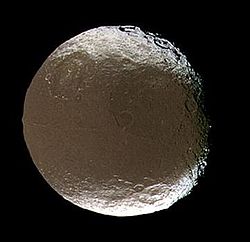
The Cassini region [1] ( lat. Cassini Regio ) is the dark region of Iapetus ( Saturn’s satellite), occupying about 40% of its surface [2] .
The most noticeable unique feature of Iapetus is the sharp difference in the albedo of its two sides. One side is snowy white (it reflects more than 50% of the light), and the other is very dark (albedo 3-5% ) [3] . In the first approximation, the dark region coincides withthe leading hemisphere, and the bright one with the follower (Iapetus, like many other satellites, always turns to the planet on one side, and the same hemisphere always looks in the direction of movement in orbit).
Content
Discovery and study
A great difference in the brightness of the hemispheres of Iapetus was also discovered by his discoverer, Giovanni Domenico Cassini , although even the best instruments of his time did not allow him to see any details on this satellite. From the discovery of Iapetus in 1671 until 1705, Cassini saw him only when he was west of Saturn. In 1705, using a stronger telescope, Cassini nevertheless saw this satellite while it was east of the planet. It turned out that at the same time it is weaker by 2 magnitudes . Cassini made two conclusions from this, which were later confirmed - firstly, one hemisphere of Iapetus is much darker than the other, and secondly, it always looks in the direction of satellite motion in orbit (that is, Iapetus is always turned to Saturn on the same side ) [4] .
The first photos of Iapetus, which show the details of its surface, were received by the Voyager-1 spacecraft in 1980. The Cassini-Huygens apparatus, which has been studying the Saturn system since 2004, gave much better pictures.
Title
The dark region of Iapetus is called the Cassini region [1] ( lat. Cassini Regio ) in honor of the Italian and French astronomer Giovanni Domenico Cassini , who discovered this satellite. This name was approved by the International Astronomical Union in 1982 (among the first 20 names of objects of Iapetus) [5] . The bright region of the satellite was divided into two parts at the equator: the northern part was called “ Ronceval Land ” ( lat. Roncevaux Terra ), and the southern - “land of Zaragoza” ( lat. Saragossa Terra ). The names of these lands (as well as all other objects on Iapet, except the Cassini region) are taken from the medieval French poem “ Song of Roland ”, because Cassini discovered this satellite while working in France [1] .
The craters of the Cassini region (as well as those located in the border zone, but having dark bottoms) are named after the negative characters of the "Songs of Roland" - the Moors . Craters of the bright part of Iapetus received the names of positive characters - Franks and their allies [1] .
Borders and Terrain
A snapshot of the Cassini (December 31, 2004)
Snapshot of the Cassini spacecraft (October 8, 2007)
The dark region of Iapetus - the Cassini region - roughly coincides with the leading (front) hemisphere, and the bright - with the slave (rear). The centers of these areas coincide with the centers of the corresponding hemispheres very precisely [2] , but the border between them does not exactly follow the meridian: it is curved like a line on a tennis ball . The dark region enters the trailing hemisphere near the equator, and the bright region enters the leading hemisphere [6] .
The Cassini region, like the rest of Iapetus, is dotted with craters. The largest known crater of the satellite, the 770-kilometer crater Abim, partially lies within its limits. The next largest craters in this area are the 580-kilometer Torjis , the 420-kilometer Falzaron and the 380-kilometer Malprimi [7] [8] .
A mountain range known as the wall of Iapetus stretches along the satellite’s equator (in a bright region it is represented only by individual peaks) [9] . Part of this ridge, lying in the Cassini region, is also rather discontinuous. Three of its sites received their own names (in honor of the cities and fortresses mentioned in the Song of Roland ): Carcassonne Mountains (740 km in length), Toledo Mountains (1100 km) and Tortelosa Mountains (290 km). The names are given to some of the individual peaks of these parts of the ridge: in the mountains of Carcassonne there is Mount Cordoba, Mount Soransa and Mount Altilla; in the mountains of Toledo - Galna and Walterna. In addition, west of the Tortelosa Mountains (which do not have named peaks) there is a free-standing mountain Seville [7] [8] [10] .
The peaks of this ridge lying near the edge of the Cassini region (Mount Seville and all the mountains of Carcassonne) are snowy white and are clearly visible in the photographs [7] .
Coloring
In high- resolution images, it is seen that the border of the light and dark parts of Iapetus is very sharp, but very torn [11] [2] . There are separate light areas inside the dark area, and separate dark areas inside the light area. Such separate dark areas near the equator are depressions, and at high latitudes - slopes facing the equator. Similarly, in the dark region of the hill and the slopes facing the poles can be bright [2] .
Apparently, the color of the bright part of Iapetus (satellite, consisting mainly of water ice) is close to its original color. The dark color of the Cassini region, according to modern concepts, is secondary: it is created by dust cover with a thickness of the order of tens of centimeters. This can be seen from the small bright craters in this area [2] and from the results of radar observations made both from the Earth and from the Cassini [6] .
The difference in the albedo of the hemispheres of Iapetus remained a mystery for three centuries. The explanation, which is now considered the most plausible [11] , was proposed (but not noticed) in 1974, and was developed in detail in 2010 [6] . According to this version, the root cause of the albedo differences is the dark dust that settles mainly on the leading hemisphere of Iapetus (this dust is taken, most likely, from the retrograde moving satellites of Saturn , in particular, Phoebe ). But dust settling alone cannot explain the sharp transition from light to dark areas and the curvature of the border between the light and dark areas. The explanation of these facts is due to the fact that dustiness of the surface leads to the migration of ice. Since the leading (front) hemisphere is darkened more strongly by dust, it is heated more strongly by sunlight. As a result, ice evaporates from there, which subsequently condenses in the colder areas - the driven side and near-polar regions. It turns out a positive feedback : initially the dark areas darken, and the initially bright ones brighten even more (for more details see the article " Iapetus ") [6] .
In addition, different parts of Iapetus are distinguished by color. In the leading hemisphere, both bright and dark areas are noticeably redder than in the follower [6] [2] .
Notes
- ↑ 1 2 3 4 Burba G. A. Nomenclature of the details of the relief of Saturn's satellites / Ed. ed. K.P. Florensky and Yu. I. Efremov. - Moscow: Nauka, 1986. - S. 68-73. - 80 s.
- ↑ 1 2 3 4 5 6 Denk T., Neukum G., Roatsch T., Porco CC, Burns JA, Galuba GG, Schmedemann N., Helfenstein P., Thomas PC, Wagner RJ, West RA Iapetus: Unique Surface Properties and a Global Color Dichotomy from Cassini Imaging (Eng.) // Science: journal. - 2010 .-- Vol. 327 , no. 5964 . - P. 435-439 . - DOI : 10.1126 / science.1177088 . - . - PMID 20007863 .
- ↑ Wye CL Radial scattering from Titan and Saturn's Icy satellites using the Cassini spacecraft . - Stanford University, 2011 .-- P. 254—257.
- ↑ Harland DM Cassini at Saturn: Huygens Results . - Springer, 2007. - P. 10. - ISBN 978-0-387-26129-4 .
- ↑ Cassini Regio . Gazetteer of Planetary Nomenclature . International Astronomical Union (IAU) Working Group for Planetary System Nomenclature (WGPSN) (October 1, 2006). Date of treatment May 29, 2014. Archived December 14, 2012.
- ↑ 1 2 3 4 5 Spencer JR, Denk T. Formation of Iapetus' Extreme Albedo Dichotomy by Exogenically Triggered Thermal Ice Migration (Eng.) // Science: journal. - 2010 .-- Vol. 327 , no. 432 . - P. 432-435 . - DOI : 10.1126 / science.1177132 . - . - PMID 20007862 .
- ↑ 1 2 3 Iapetus map with signatures on the Gazetteer of Planetary Nomenclature website (PDF, 2.1 MB)
- ↑ 1 2 Current list of details of the relief of Iapetus, received names (English) . Gazetteer of Planetary Nomenclature . International Astronomical Union (IAU) Working Group for Planetary System Nomenclature (WGPSN). Date of treatment May 29, 2014.
- ↑ Moore P., Rees R. Patrick Moore's Data Book of Astronomy . - Cambridge University Press, 2011 .-- P. 219-221. - ISBN 978-0-521-89935-2 .
- ↑ Song of Roland / Translation from Old French by Y. Korneev. - Moscow: Fiction, 1976. - (Library of World Literature, v.10).
- ↑ 1 2 Tamayo D., Burns JA, Hamilton DP, Hedman MM Finding the trigger to Iapetus' odd global albedo pattern: Dynamics of dust from Saturn's irregular satellites (Eng.) // Icarus : journal. - Elsevier , 2011 .-- Vol. 215 , no. 1 . - P. 260—278 . - DOI : 10.1016 / j.icarus.2011.06.0.027 . - .
Links
- Iapetus map with signatures on the Gazetteer of Planetary Nomenclature website (PDF, 2.1 MB)
- Cassini Regio Gazetteer of Planetary Nomenclature . International Astronomical Union (IAU) Working Group for Planetary System Nomenclature (WGPSN) (October 1, 2006). Date of treatment May 29, 2014. Archived December 14, 2012.
- Saturn: Lord of the Rings. Saturn's moons
- Black and white Iapetus spoke