Avia S-199 - a single - engine piston fighter , which was in service with the air forces of Czechoslovakia and Israel after the Second World War . It is a post-war modification of the Messerschmitt Bf.109 developed in Czechoslovakia. Made by Avia .
| Avia S-199 | |
|---|---|
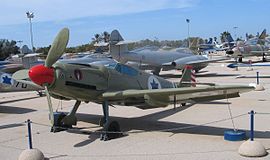 | |
| Type of | training aircraft fighter bomber |
| Manufacturer |  Avia Avia |
| First flight | |
| Start of operation | 1946 |
| End of operation | 1951 |
| Operators | Czechoslovakia  Israel Israel |
| Years of production | 1946 - 1950 |
| Units produced | 603 |
| Base model | Messerschmitt Bf.109 |

Used as a fighter, fighter-bomber , reconnaissance .
History
At the final stage of World War II, the assembly of Messerschmitt Bf.109 G-6 and Bf.109G-14 fighters, as well as two-seat trainers Bf.109G-12 from components supplied by German plants.
The large spare stock remaining after the war did not include the main thing - engines. The main reason was the powerful explosion that occurred at the sugar refining plants in Krasna Brest - in September 1945, the explosions destroyed nearby ammunition depots, which stored almost all Daimler-Benz DB 605 engines in Czechoslovakia. As a result, it was decided to equip the aircraft with the Junkers Jumo 211 engine of the F series and 0 of which quite a lot remained in Czechoslovakia. However, it was not very suitable for installation on fighter aircraft, since it was originally intended only for bombers. They were less powerful and heavier than the "native" motors. In addition, they did not provide for the installation of synchronizers . I had to carry out a very large amount of work to finalize the airframe and to create a new propeller. The first car took off on April 25, 1947 from the Prague-Kakowice airfield, pilot - Peter Siroki. Soon, mass production of the fighter began.
From the original Messerschmitt, the car was distinguished by an engine hood , propeller , coke and many other units. The composition of the armament has also changed - on the S-199 there were 2 13-mm synchronous MG 131 machine guns, and two more 7.92-mm machine guns could be mounted in the wing or under it in special gondolas two MG 151 cannons of 20 mm caliber.
The Czechoslovakian plane in all respects was losing to its German ancestor. The maximum speed of the S-199 fell from 630 km / h to 540, the ceiling - from 11,000 m to 9,000. But worst of all, the alignment of the aircraft changed, and this greatly complicated the piloting, especially on takeoff and landing .
As it turned out later, S-199 had another serious congenital malformation - machine guns placed under the engine hood did not always synchronize with the screw, which led to disasters.
In total, Avia and Aero factories produced 450 single-seat S-199 and 82 double-seat CS-199 (of which 24 were converted from single-seat fighters).
25 S.199 aircraft in 1948 were purchased by Israel . The Israeli S.199 fighter held its first air battle on May 29, 1948 . S-199 fighters flew in Israel until June 1949.