The Tale of Genji ( 源氏物語 , Genji Monogatari ), also the Tale of the Brilliant Prince of Genji is a monogatari novel , one of the greatest works of Japanese classical literature [1] written in the Heian era. The authorship of the novel is attributed to Murasaki Shikibu , a lady at the court of Empress Shoshi (reign of 986 - 1011 ).
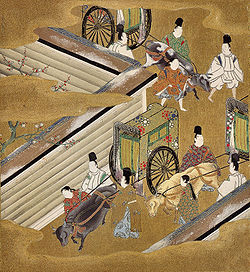
Title
According to most, the title for the novel, The Tale of Genji, was not coined by Murasaki herself, in the later period of the work's existence. The most ancient of the names known to researchers is “The Tale of Murasaki” (“Murasaki-no-monogatari”) - named after one of the heroines. It is found in the diary of the mid-11th century, Sarasina-Nikki (The Lonely Moon of Sarasin). There is a well-known version of the name “The Tale of the Brilliant Genji” (“Hikaru-Genji Monogatari”).
Work structure
The work consists of 54 chapters. The chapter “First Greens” has two parts, the chapter “Concealment in the Clouds” is known only by its name. The current practice divides the novel into three parts:
- Chapters Pavilion Pavilion - Wisteria Leaves (33 chapters). A story about the life of Genji from childhood to adulthood. Having overcome difficulties, Genji reaches the highest degree of power.
- Chapters “The First Green” - “The Wizard-Taoist” (8 chapters). The story of Genji's old age, ending with the death of a hero.
- Chapters "The fragrant prince" - "Floating bridge of dreams" (13 chapters). The story of the heirs of Genji, whose main character is Ukifune.
The division is based not only on the content of the parts, but also on the difference in style and method of presentation, which gave rise to doubts that the author of the work was one person. At different times, the work was divided in different ways, for example, “Uji Heads” were considered both one chapter and ten separate chapters. Until now, the question of in which order the chapters should be arranged has not been unambiguously resolved. This is because the plots of the chapters are often not connected with each other, and it is difficult to compose a novel in such a way that it does not contain chronological or other contradictions. Researchers found that individual chapters are key ( moto no maki ), with the help of them a stable plot of the work is built, while others are secondary chapters ( nami no maki ). Side chapters can go deeper into the main chapter, revealing its contents in more detail, or they can serve as a continuation of the storyline [2] .
Chapter List
| Chapter | In Japanese | Transfer |
|---|---|---|
| one | Kiritsubo ( 桐 壺 ) | Pavilion Pavilion |
| 2 | Hahakigi ( 帚 木 ) | Wood broom |
| 3 | Utsusemi ( 空 蝉 ) | Cicada empty shell |
| four | Yugao ( Japanese. ) | Evening face |
| five | Wakamurasaki ( Japanese 若 紫 ) | Young Murasaki |
| 6 | Suezumuhana ( 末 摘花 ) | Saffron |
| 7 | Momiji no ha ( Japanese 紅葉 賀 ) | Scarlet Leaf Festival |
| eight | Hana no en ( Japanese 花 宴 ) | Flower festival |
| 9 | Aoi ( Japanese 葵 ) | Mallow |
| ten | Sakaki ( Japanese 榊 ) | Sacred sakaki tree |
| eleven | Hanatirusato ( Japanese 花 散 里 ) | Garden where flowers fall |
| 12 | Suma ( Japanese 須 磨 ) | Suma |
| 13 | Akashi ( Japanese 明石 ) | Akashi |
| 14 | Miotsukushi ( 澪 標 ) | Coastal buoys |
| 15 | Yomogiu ( Japanese 蓬 生 ) | In the thickets of wormwood |
| sixteen | Sekiya ( Japanese 関 屋 ) | Outpost |
| 17 | Eawase ( Japanese 絵 合 ) | Pattern matching |
| 18 | Matsukadze ( Japanese 松風 ) | Wind in the pines |
| nineteen | Usugumo ( 薄雲 ) | Melting cloud |
| 20 | Asagao ( Japanese 朝 顔 ) | Morning face |
| 21 | Otome ( Japanese 乙 女 ) | Young maiden |
| 22 | Tamakazura ( Japanese 玉 鬘 ) | Precious thread |
| 23 | Hatsune ( 初 音 ) | First song |
| 24 | Kotyo ( Japanese 胡蝶 ) | Butterflies |
| 25 | Hotaru ( Japanese. ) | Fireflies |
| 26 | Tokonatsu ( Japanese 常 夏 ) | Eternal summer |
| 27 | Kagaribi ( Japanese 篝火 ) | Night light |
| 28 | Novaki ( Japanese 野 分 ) | Piercing fields |
| 29th | Miyuki ( Japanese 行 幸 ) | Highest exit |
| thirty | Fujibakama ( Japanese 藤 袴 ) | Purple harem pants |
| 31 | Makibashira ( Japanese 真 木柱 ) | Cypress pillar |
| 32 | Mume-ga e ( Japanese. ) | Plum branch |
| 33 | Fujiuraba ( Japanese 藤 裏 葉 ) | Wisteria Leaves |
| 34 | Wakana (-jo) ( Japanese 若 菜 上 ) | First green I |
| 35 | Wakana (-ge) ( Japanese 若 菜 下 ) | First green II |
| 36 | Kashiwagi ( Japanese . ) | Oak |
| 37 | Yokobue ( Japanese 横笛 ) | Flute |
| 38 | Suzumushi ( Japanese 鈴 虫 ) | Bell cricket |
| 39 | Yugiri ( Japanese 夕 霧 ) | Evening fog |
| 40 | Minori ( Japanese 御 法 ) | Great law |
| 41 | Maborosi ( Japanese 幻 ) | Wizard Taoist |
| - | Kumogakure ( 雲 隠 ) | (Hiding in the clouds) |
| 42 | Nyoumiya ( Japanese 匂 宮 ) | Fragrant prince |
| 43 | Kobay ( Japanese 紅梅 ) | Red plum |
| 44 | Takekawa ( 竹 河 ) | Bamboo river |
| 45 | Hashihime ( 橋 姫 ) | Virgin at the bridge |
| 46 | Shiigamoto ( Japanese 椎 本 ) | Under the tree |
| 47 | Agemaki ( Japanese 総 角 ) | Triple knot |
| 48 | Savarabi ( 早 蕨 ) | Fern shoots |
| 49 | Yadorigi ( Japanese 宿 木 ) | Ivy |
| 50 | Azumaya ( Japanese 東 屋 ) | Gazebo |
| 51 | Ukifune ( 浮 舟 ) | Rook on the waves |
| 52 | Kagero ( Japanese. ) | Mayflies |
| 53 | Tenarai ( 手 習 ) | Practicing calligraphy |
| 54 | Yume-no Ukihashi ( 夢 浮橋 ) | Floating bridge of dreams |
Story
| The fact that she (Murasaki Shikibu) created "Genji" seems surprising, impossible in our world. None other than this miracle created by the Buddha in response to her prayers.The treatise "Anonymous Note" ( Mumezoshi ), the beginning of the XIII century |
The story is based on a love biography of Prince Genji , the emperor’s late son.
Monogatari is a plexus of three genres: painting, poetry and prose. The monogatari scroll consisted of drawings and explanations for them. Readers unfolded the scroll (horizontally) and examined the pictures, while reading the explanations. Probably, initially the monogatari could resemble a manga , that is, have more drawings than text. However, nothing particularly plausible can be said about monogatari, since not a single story has been preserved in its original form. The well-known texts are taken from much later copies, which, most likely, were also taken from copies.
The novel is a chain of short stories , each of which sets forth a separate episode from the life of Genji. The author with great tact maintains the pose of a deadpan biographer, alien to moralization. For 44 parts (the whole novel consists of 54 parts), the hero conquers all women he comes across with an exquisitely bored look. This enables the author to show a gallery of female types of the Heian court world. The hero is not endowed with particular legibility: from the concubine of his father, he goes to the young maid of honor, then to the lady, whose “nose is big and red, disgusting, like an elephant”, then to the dignified 58-year-old woman and even tries to seduce her adopted daughter- teenager. The novel is purely realistic, the plot develops very slowly (the language of the novel contributes to this - the cutesy ceremonial language of the maid of honor of that time). The everyday life of the Heian aristocrats and the idle atmosphere of the palace quarter are conveyed with great skill.
However, unlike don Juan , Genji is not a lover-destroyer, but a reliable and faithful companion. This is what every lady of the Heian era would have dreamed of, when the position of a woman was so fragile, and her whole life depended on a man. A matured Genji takes care of every woman, which is emphasized by the author more than once. It is absolutely incredible by the nobility (for that era) and his behavior towards Madame Murasaki. As a girl, she was completely in his power, had no other support in life and did not give him a single child - and yet she remained a beloved wife!
The novel is divided into three parts: Genji's youth; mature years - exile and return to the capital, fame and death; life of Kaoru - the adopted son of Genji. The novel does not have a clear logical ending, traditional for contemporary literature, which gave rise to some researchers to declare the novel incomplete. One of the chapters (the arrangement of the last fourteen scroll chapters is not exactly known) consists only of the name - "Hiding in the Clouds", which probably symbolizes the death of Genji. There are two main hypotheses: the author deliberately left only the title of the chapter, for it was too sad for her to tell about the death of her beloved hero; the scroll was lost.
The plot of the novel is looped - if in his youth, Genji, seducing the concubine of his father, became the father of the prince who ascended the throne, then at the end of his life he learns that his beloved San no Maya is not faithful to him, and the father of her son is a young courtier. This plot loop corresponds to the concept of karma , which is typical for the Heian era: literature at that time was strongly influenced by Buddhism . Researchers suggest, based on the impression of incompleteness created by the ragged storylines of the last chapter, that the novel might not be finished by the author.
Actors
According to researchers, the main character of the novel, Genji, is not a historical person. His image is synthetic, and it is only possible to make assumptions about which of the facets of his personality was borrowed from one or another real historical figure. Among the possible prototypes of the prince are Minamoto Takaakira (914–982), the son of the emperor Daigo , Arivaru Narihira , Tair Sadafumi, Sugawaru Mizizane, and Prince Atsuhira [2] .
Scene
The scheme of the imperial palace complex |
|
|
Novel Style
The author’s achievement is the style of the novel - barely noticeable accents, elusive and elusive feelings, every thought seems to pass through a sieve of court etiquette, and meanwhile Murasaki Shikibu creates visible and saturated images, and her attitude to them (not expressly expressed anywhere) is obvious to the attentive reader. The novel has a huge number of poems, which is associated with the great importance of poetry in the life of the Heian aristocracy, when the Japanese five-poem - tanka - defeated the Chinese samples and became the basis of personal correspondence, flirting, rivalry, grief, philosophical thoughts. In those days, the beauty of a lady hidden from view by many screens and curtains was judged by the beauty of her poems, and her mind - by the speed of her answers in poetic correspondence.
The Age of Writing
The novel was written during the Heian era , when Japanese culture reached one of the peaks of its development. It was during this period that there was a departure from traditions inherited from China, and it was at this time that the national distinctive Japanese style was formed. The elite circles of the Japanese aristocracy lay the foundations of many arts with a pronounced national sound. Along with painting, music, calligraphy, Japanese prose makes an unprecedented leap, which, having barely emerged, immediately reaches the heights of style. And "The Tale of Genji" is precisely that embodiment of the achieved heights.
Since the art of poetry was most valued in the upper classes, prose partly remained aloof. But it was precisely this that made it possible to express in prose that which could remain bypassed by the jewelry art of court versification. Prose absorbed life without embellishment, grew directly from the events of everyday life, due to which it achieved amazing organicness and naturalness, and captured the smallest details of everyday life of those times [2] .
Writing Time
There is no consensus on what period of his life Murasaki created the novel. There are several versions, of which more often than others are called the one that suggests that the novel was started by Murasaki after the death of her husband, Fujiwara Nobutaki, that is, about 1001. This version is supported by the fact that by the time Murasaki entered the service of the emperor (1008), "The Tale of Genji" was already popular with the female part of the inhabitants of the palace. Perhaps it was this popularity that became the reason for inviting the girl to the palace. Based on this version, the first written chapters should be considered those that tell about the life of middle-class women (for example, “An empty shell of a cicada”, “Evening face”). Later, becoming an observer of court life, Murasaki begins to write about the inhabitants of the palace.
According to another version, Murasaki began a romance only after leaving service. According to one legend, the novel was created at the behest of Empress Shoshi and was written during the stay of the creator in the monastery. But this legend is not very reliable.
Finally, according to another version, the inspiration for the Japanese woman was the stories about the imperial life that she heard from her father. Fascinated by what she heard, Murasaki writes the chapter “Pavilion of Paulownia,” while still very young, perhaps even before marriage with Nobutaki.
Sources
The original work was not preserved, as, however, and any copy of Murasaki’s lifetimes. However, the total number of surviving copies of the copied copies of the novel is quite large. Back in the Kamakur era, attempts were made to put together all the existing versions of the most popular work, as a result of which three large groups of texts were formed, differing in the original versions on the basis of which they were created.
“Books from Kawati” This group includes versions of the novel based on the materials of Minamoto Tikayuki, the ruler of the province of Kawati . A poet and scientist, Minamoto took the time and effort to analyze the many available lists of the work and compile them into one. His work was highly appreciated by contemporaries, but now it no longer has such an influence. There are speculations that Minamoto replaced some fragments of Murasaki's text with his own arrangement of the plot.
Blue Notebooks The most authoritative group of lists of works is based on the work of Fujiwara Take (1162–1241), an outstanding Japanese poet and philologist. However, it is likely that in his version of the novel Murasaki was revised. Nevertheless, it is known that the Minamoto and Fujiwara variants were very similar to each other.
The third group includes versions of the text that are not associated with either the “Books from Kawati” or the “Blue Notebooks”.
Authorship Problem
Translations
The novel is translated into a number of European languages. The work was translated into Russian in 1993 by T. L. Sokolova-Delyusina [3] .
The novel was translated into English five times:
- Suematsu Kento ( 1882 ) [4]
- Arthur Whaley ( 1926 - 1933 ) [5] ,
- Edward Saydenstiker ( 1976 ) [6] ,
- Helen McCullough (1994, excerpts) [7] ,
- Royal Tyler ( 2001 ) [8] .
The work was translated into Czech by Karel Fiala ( Czech. “Příběh prince Gendžiho” [9] ).
The chapter “Wind in the Pines” by Yu. V. Osadcha was translated into Ukrainian [10] .
Theatrical performances
- Opera
- Based on the Tale of Genji , an opera was written, written during 1999 by composer Miki Minoru and first performed the following year at the St. Louis Opera House . The libretto was written in English by Colin Graham , then the libretto was translated into Japanese.
Films
- Films
- The Tale of Genji (1951), directed by Kozaburo Yoshimura
- The New Story of Genji (1961), directed by Kazuo Mori
- The Tale of Genji (1966), directed by Kon Ichikawa
- Sennen no Koi - Hikaru Genji Monogatari (2001) - Director Horikawa Tonko
- Genji monogatari: Sennen no nazo / 源氏物語 千年 の 謎 (2011), directed by Yasuo Tsuruhashi
- Cartoons
- Повесть о Гэндзи (1987), аниме, режиссёр Гисабуро Сугии . Фильм не показывает всю историю, а охватывает первые 12 глав.
- Тысячелетняя история о Гэндзи: Гэндзи (2009), ( аниме -сериал по мотивам произведения режиссёра Осаму Дэдзаки .
Notes
- ↑ Мурасаки Сикибу. Повесть о Гэндзи (Гэндзи-моногатари). Prince 1. Пер. with yap. - M .: Science. Главная редакция восточной литературы, 1991.- 330 с. Стр.1
- ↑ 1 2 3 Murasaki Shikibu . The Tale of Genji (Genji Monogatari). Application. - M .: Science. The main edition of oriental literature, 1992. - 192 p. - S. 10-43.
- ↑ The Tale of Genji (Genji Monogatari): at 2 p.m. / Translation from Japanese. Sokolova-Delyusina T. L. - Moscow: "Oriental literature, 1993.
- ↑ Suematsu, Kencho. The Tale of Genji. London: Trubner, 1882.
- ↑ Waley, Arthur. The Tale of Genji. A Novel in Six Parts by Lady Murasaki. 1926-1933.
- ↑ Seidensticker, Edward G. The Tale of Genji. New York: Alfred A. Knopf, 1976.
- ↑ McCullough, Helen Craig. Genji & Heike: Selections from The Tale of Genji and The Tale of the Heike. Stanford: Stanford University Press, 1994.
- ↑ Tyler, Royall. The Tale of Genji. New York: Viking, 2001
- ↑ Fiala, Karel. Příběh prince Gendžiho. Vol. 1. Prague: Nakl. Paseka, 2002. 380 pp. ISBN 80-7185-452-2 Vol. 2, 2005, ISBN 80-7185-709-2 .
- ↑ Japanese Literature: A Reader. Volume I (VII — XIII centuries) / Compiled by Bondarenko I.P., Osadchaya Yu.V. - M.: Publishing House of Dmitry Burago, 2010. - P. 446-463
Literature
- Murasaki Shikibu. The Tale of Genji, era, author // The Tale of Genji (Genji Monogatari). Application. Entry Art., comp., per. with yap. poetry texts by T. L. Sokolova-Delyusina / Otv. ed. T.P. Grigorieva . - M .: Nauka, 1992 .-- S. 3–49. - 192 p. - ISBN 5-02-016877-7 .
- Boronina I. A. Classical Japanese novel (“Genji Monogatari” by Murasaki Shikibu) / Otv. ed. T.P. Grigorieva . - M .: Nauka, 1981 .-- 295 p.
- Goreglyad V.N. Japanese literature of the 8th – 16th centuries: The beginning and development of traditions. - 2nd ed. - SPb. : Petersburg Oriental Studies, 2001. - 400 p. - ISBN 978-5-85803-076-9 .
- Konrad N.I. Japanese literature. From Kodziki to Tokutomi / Comp. N.I. Feldman-Conrad. - M .: Nauka, 1974 .-- 568 p.
- Sisauri V.I. Japanese novel of the X — XII centuries .. - St. Petersburg. : Faculty of Philology, St. Petersburg State University; Nestor-Istoriya, 2011 .-- 248 p. - ISBN 978-5-98187-877-0 .
- Bowring R. Murasaki Shikibu: The Tale of Genji: [ eng. ] . - 2nd Edition. - Cambridge University Press, 2004 .-- 122 p. - ISBN 978-0-521-83208-3 .
- Emmerich M. The Tale of Genji: Translation, Canonization, and World Literature: [ eng. ] . - Columbia University Press, 2013 .-- 512 p. - ISBN 978-0-231-16272-2 .
- Envisioning The Tale of Genji: Media, Gender, and Cultural Production: [ eng. ] / Edited by Haruo Shirane. - Columbia University Press, 2008 .-- 416 p. - ISBN 978-0-231-14236-6 .
- Reading The Tale of Genji: Sources from the First Millennium: [ eng. ] / Edited by Thomas Harper and Haruo Shirane. - Columbia University Press, 2015 .-- 632 p. - ISBN 978-0-231-16658-4 .