Yoma (also Yoma, Yuma) is an evil forest witch in Komi folklore [1] . Later it was contaminated with the image of Noon ( Komi Xiu Palad, plöznich ), mistress of fields and cereals. The name goes back to fin. jumala “god of thunder”, Karelian. jomal "god" [1] .
| Yoma (Yoma, Yuma) | |
|---|---|
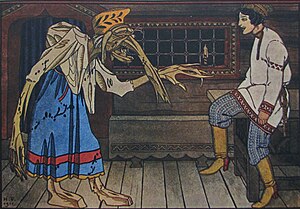 Illustration of Ivan Bilibin to "The Tale of the Three Tsar Divas and Ivashka, the Priest's Son", 1911 | |
| Mythology | Komi |
| Terrain | Komi-Perm region |
| Floor | Female |
| Occupation | Witchcraft, the patronage of the dark forces |
| Father | Yong |
| Mother | referred to as a “woman” |
| Spouse | Pile or ogre Gundyr |
| Children | Yoma nyy |
| In other cultures | Baba Yaga , Midday |
In her honor was named the crown of Creep on Venus [2] .
Content
Pantheon location and description
The daughter of the demiurge god En and his wife. Sister of the north wind god Voipel [3] . Mother of the daughter of Yoma-nyy [4] , less often of hairy many-headed sons [5] . The wife is either Pile or the cannibal Gundyr [1] or Kudryash [5] .
In mythology, Komi Yoma was negative. She was the embodiment of illness, death, decay [1] .
The appearance of Yoma caused a repulsive appearance: the teeth and nails of iron are blind, but other sensory organs are developed in return [1] .
She had furry eyes , a long nose , falling to the floor. She sat on three, six, less often on nine chairs, despite the fact that her ass also hung at the edges [5] .
In the early days, Yoma, together with his mother and brother, lived in heaven, but the insidious Omol threw them to the earth [1] . It is characteristic that the Finno-Ugrians also saw a moral aspect in the act of falling. Yoma became the patroness of underground and demonic creatures [6] , and in Komi tales she becomes the mistress of the underwater world [7] .
In Russian folklore, it is close to Baba Yaga [8] .
Yoma in Komi folklore
In the folklore of the Komi-Zyryan and Komi-Permyaks, the image of Yoma is presented in a very colorful way.
The main feature in Finno-Ugric myths about evil spirits and forces is that with the help of good work you can enlist their location and support.
Yoma is also the patroness of female crafts . A number of fairy tales on the subject of weaving and spinning are associated with it. She is the owner of all spinning wheels, balls, knitting needles, skeins of yarn. Yoma can give them, or it can demand back [5] as, for example, in a short story about the benefits of labor and the harmfulness of laziness.
It is possible that initially the essence of Yoma came from the theme of sowing, ripening and harvesting cereals, baking bread. It was also believed that she patronizes the flora and fauna, lives in a dense forest in a forest hut on chicken legs (or elk legs) [5] .
Yoma is the guardian of fire. In Komi-Zyryan fairy tales, people come to her for him, but often Youma herself is burned in a furnace [5] .
Yoma loves to eat young children. These are the motives of the fairy tale about the abduction of a little girl with the size of a spindle [5] [9] .
The benefits of labor and the harmfulness of laziness
Once upon a time there was a family of father , mother and daughter . Mother dies and father marries again. The stepmother also has a daughter, but she does not load her with work.
In relation to the poor stepdaughter, she is severe and scoffs at her. Once she ordered her stepdaughter to rinse a skein of thread in a pond, but the water was so cold that she accidentally released a ball and he sank. The stepmother told me to get the skein at all costs.
Thanks to the diligence, zeal of the stepdaughter, responsiveness to others, passed the tests, Yoma, the mistress of the underworld and the underwater world, gave her a skein of thread and gave her a new house.
Upon her return, her stepdaughter married a guy and they began to live happily in a new house.
Her stepmother didn’t like it. She decided to send her daughter, a belorushka, for a dowry to Yoma. So that the fingers would not freeze from the hot water, the white-handed woman threw a skein of thread into the water and herself rushed into the depths of the river. However, the selfishness of the felid did not allow her to pass all the trials and difficulties of life. Returning home, she found her own hut burnt down [7] [10] .
About kidnapping a little girl
One day, Yoma came to her parents and threatened to take her son into the husband of the girl. However, she did not have a son . Yoma set out to destroy her.
First she sent her for wool to her sheep . Her sheep were wolves . A kind old woman taught her how to avoid danger.
Then she decided to destroy her by sending milk to her cows . But her dairy cows turned out to be. Again, a good old woman taught how to get out of a difficult situation.
Then Yoma sends her to her sister for a birch bark. But the kind old woman sensed something was amiss and gave the girl oil, cereals, a hair comb, a bar and a basket of resin.
When Yoma's sister went to sharpen her teeth , the girl rushed to the door, which did not open. She guessed to grease the hinges with oil and the door opened. Black crows came upon her, but she sprinkled grain on them.
Yomin's sister from the closet returned, but the girl did not. She rushed in pursuit.
Then the girl threw a hair comb under her legs and a dense forest blocked her path. But Yomina's sister crept through him.
The girl threw a bar and behind her that hour the mountains began to rise. Sawed Yoma's sister and the mountain range.
The last thing left was a basket of resin . And the girl threw her, but mixed up the words of the spell. Suddenly a tar river appeared, but not behind, but in front of the girl. And they got stuck together in this quagmire.
The girl turned to the raven, so that he would tell her parents about the trouble and told them to take iron scrap and fire . Arriving, his father drove Yoma’s sister with a crowbar into the tar river, melted the tar and rescued the girl [9] .
Notes
- ↑ 1 2 3 4 5 6 Petrukhin V. Ya. Myths of the Finno-Ugric peoples. M .: Astrel; AST; Transitbook, 2005.S. 202.
- ↑ Description of the crown on the WGPSN website
- ↑ Petrukhin V. Ya. Myths of the Finno-Ugric.-M.: Astrel: AST: Transitbook, 2005.-p.201
- ↑ Petrukhin V. Ya. Myths of the Finno-Ugric.-M.: Astrel: AST: Transitbook, 2005.-p.203
- ↑ 1 2 3 4 5 6 7 Mythology of Komi. Youma Archived March 5, 2016 on Wayback Machine
- ↑ Petrukhin V. Ya. Myths of the Finno-Ugric.-M.: Astrel: AST: Transitbook, 2005.-p.204
- ↑ 1 2 Old Woman Yoma and two girls
- ↑ Petrukhin V. Ya. Myths of the Finno-Ugric.-M.: Astrel: AST: Transitbook, 2005.-p.202-205
- ↑ 1 2 Daughter with a Spindle
- ↑ Petrukhin V. Ya. Myths of the Finno-Ugric.-M.: Astrel: AST: Transitbook, 2005.-p.202-203
Literature
- Petrukhin V. Ya. Myths of Finno-Ugric.-M.: Astrel: AST: Transitbook, 2005.-463 p. ISBN 5-17-019005-0 ISBN 5-271-06472-7 ISBN 5-9578-1667-1