
João di Barrush ( port. João de Barros , pronunciation: [ ʒuˈɐ̃w̃ dɨ ˈbaʁuʃ ]; 1496-1570) - Portuguese historian and writer, later called the "Portuguese Libya ." In the Portuguese spelling used during his lifetime, his name was written as Ioam or Ioã ; in Russian, it is also sometimes mistakenly transcribed as “Joao”.
The literary work of di Barrush is very versatile. His contribution to Portuguese public education and the development of the literary language was the first grammar of the Portuguese language ( Gramática da Língua Portuguesa ), and a number of moral content dialogues that could be used in the educational process. An important source on the history of the era of the great geographical discoveries is the Asia decalogy that he began. He is also the author of the chivalrous novel “The Chronicle of Emperor Clarimundo” ( port. Crónica do Imperador Clarimundo ; 1522), allegedly translated from the Hungarian and glorifying legendary ancestor of the then Portuguese kings.
- The letters of the alphabet from the grammar of di Barrusha (1539)
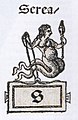
Letter S, "Serea"

Letter N, "Náo"

Letter O, "Olho"

Letter X, "Xaroco"


Asia
Анsia de Ioam de Barros, dos feitos que os Portuguezes fizeram na conquista, Juan di Barrush began and managed to write almost four volumes (“decades”) of the decalogue “Asia Juan di Barrush: Acts by the Portuguese during the Discovery and Conquest of the Seas and Lands of the East” e descobrimento dos mares e terras do Oriente ), which described in detail the history of Portuguese navigation and colonial expansion from the time of Henry the Navigator , in the Atlantic Ocean, off the coast of Africa and in Asia from Arabia to Indonesia and China. They also included brief historical and geographical descriptions of the countries visited by the Portuguese, many of which were previously very little known in Europe. This work is often simply known as The Decalogy of Asia ( Décadas da Ásia ).
The first 3 “decades” were published in 1552, 1553 and 1563. The fourth "decade", not completed during the life of di Barrush, was completed by João Baptista Lavanha and published in 1615. Historiographical work was continued by Diogo di Cutu ; in the end, a total of 12 “decades” were written, which were published, together with a biography of Barrush and an index (in separate volumes) in 1778-1788.
China in the Decalogue of Di Barrush
Although China occupies a relatively small place in the “Decalogy” (compared to the countries of the Indian Ocean), the role of Barrush as a “proto-Sinist” is important. The fact is that the Portuguese were very reluctant to publish information coming from their navigators, conquistadors and diplomats from the Far East, and before the publication of the “Decalogue” of Barrush and the “History of the discovery and conquest of India by the Portuguese” by Fernand Lopez de Castañeda comparable at the same time information about China in European literature simply did not exist [1] .
Although the “Decalogy” of Barrush did not receive timely widespread fame outside of Portugal, the information contained in it about China was included (often almost verbatim) in the first two European books on China, published outside Portugal, written (or rather, composed) by the Spaniards of Escalante (1577) and Mendoza (1585) [2] . Both Spanish books were soon translated into other languages, and the second of them became a true pan-European bestseller [3] .
From the pages of the “Decalogy” there appears the image of China as a great country: both geographically (a huge country occupying the eastern end of the continent, just as “our Europe” occupies its opposite end) and historical and cultural (like the Greeks and Romans) [ 4] .
In addition to detailed reports on visits to the Chinese shores of Portuguese expeditions ( Fernan Pires di Andradi and others), the work of di Barrush contains a rather informative historical and geographical sketch of China (3rd “decade”, book II, chapter VII , “Which describes the land of China and tells about some of the things there, and mainly about the city of Canton, which was discovered by Fernan Pires” [4] ), as well as scattered references to China in other parts of this work (eg, the cape near the “famous city of Ningbo "as the easternmost point of continental th Asia, known at the time the Portuguese [5] ). As the author himself explains (in the 1st decade, published in 1552, but written mainly by 1539 [1] ), information about places where the Portuguese have not yet visited (that is, almost all of China except for its southeast coast), came from Chinese sources:
| We talk about this coast, unknown to mariners, and about the entire inner part of this great Province of China, in the tables of our Geography, extracted from the book of the cosmography of the Chinese, printed by them and containing a full description of the country's geography by the type of route guide that we brought from there and explained ( translated) by the Chinese, which we have for this [5] . Original text (port.) Da qual costa não sabida dos navegantes damos demonstração, e de todo o interior desta grande Provincia da China, em as Taboas da nossa Geografia, tiradas de hum livro de Cosmografia dos Chijs impresso per elles, com toda a situação da terra em modo de Itine , que nos foi de lá trazido, e interpretado per hum Chij, que pera isso houvemos. |
The same guidebook and other geographical books and maps, the information from which was translated for di Barrush by the same Chinese, are described in the 3rd “decade” [6] .
As modern historians suspect, an educated Chinese man who helped di Barrush to extract information from Chinese literature could be captured by Portuguese pirate traders during one of their raids on the Chinese coast, brought to Portugal, and bought there by di Barrush. According to D. Mungello , it was the first documented case of a Chinese being in Europe [7] [8] .
Based on these sources, Barrush tells the reader a lot of reliable information about inland China, where Europeans have not been since the Mongol yoke (the era of Marco Polo ): names and locations of 15 provinces into which the country was divided in the Minsk era ; The Great Wall and continuous wars with the " Tatars " (Mongols) to the north of it. He lists the names and roles of a number of posts in the Minsk state apparatus, and explains the principle that civilian officials are appointed not to their home province, but to garrison commanders, on the contrary, they are usually appointed from local ones.
Barrush compares the Chinese religion (of which - or, more precisely, of which - he had only approximate information) with the religion of the ancient Greeks and Romans. He discusses (and probably exaggerates somewhat) Chinese cultural influence in neighboring countries (both in Southeast Asia and India), explaining it by the past conquests of the Chinese in these regions, both by land and by sea . In his opinion, leaving India, the Chinese weremuch more far-sighted than the Greeks , Carthaginians or Romans , who, having conquered foreign countries, ultimately lost their [9] .
Of interest is Barrush’s story about Chinese measures of distance (in the context of traveling around the country), which was later borrowed without major changes by Escalante and Mendoza [10] . According to Barrush, 3 units were used to measure the length of the path, which he compares with the Iberian stage , league and “day of the path” ( jornada ). The first of them was well-known ( lij at Barrush), which he described as the distance at which a cry of a person can be heard on a quiet day [6] (which remained popular among the people by the definition of this measure of length even in the 19th century [11] ).
Barrush then claims that 10 li is one pú , comparable to the Spanish League [6] . Although such a unit is not included in the standard set of traditional Chinese length measures, it is nevertheless mentioned by some authors of the 19th century. So, the 1863 reference book contains information that in Guangdong, the “section ( bu , 部) of the track” of 10 li was used as a traditional measure of distance (and was the standard distance between guard posts) [11] . With the same unit ( pau , in their transcription), British missionaries in Fujian also met [12] . Some dictionaries to this day give (apparently outdated) the value “10 li” for 甫 ( fǔ , pù , pǔ ) [13] or 鋪[14]
The third “unit” of Barrush, ychan of 100 li, corresponds to one day's journey [6] . Presumably, ychan Barrush is “一 站” ( yi zhan ) - literally, “one station / stop”; in documents of the Minsk era, 站 ( zhan ) could really be used as a “day of travel” (for land trips) [15] . According to the authors of the XIX century, the day of the journey in China was often often considered as 100 li, regardless of the actual length [10] .
Death
In January 1568, he suffered a stroke and was relieved of duties at the House of India, receiving the title of nobility of King Tensay and King Don Sebastian. He died at his farm in Alitem, Pombal, October 20, 1570 in utter suffering, having so many debts that his children abandoned his will. [sixteen]
Writer Memory
Juan di Barrush is one of the figures immortalized at the Lisbon Discovery Monument , opened in 1960.
See also
- Fernand Lopez de Castañeda (1500–1559), author of The History of the Discovery and Conquest of India by the Portuguese
Notes
- ↑ 1 2 Lach, 1965 , p. 738.
- ↑ Lach, 1965 , pp. 741,743,750.
- ↑ Lach, 1965 , p. 743.
- ↑ 1 2 Page 186—204 in the 5th volume of the 1777th edition. Archived November 2, 2018 on the Wayback Machine
- ↑ 1 2 1st “decade”, book IX, chapter VII. ( p. 288 in 1777 edition)
- ↑ 1 2 3 4 Page 188-189 in the 5th volume of 1777
- ↑ Mungello, David E. (2009), The Great Encounter of China and the West, 1500-1800 (3rd ed.), ISBN 978-0-7425-5797-0
- ↑ A visit to Rome by a native of Hanbalik (Beijing) Rabban Saum in the 13th century is known; but he was, however, from a family of Turkic descent who came to Beijing with the Mongol conquerors.
- ↑ 3rd decade, book II, chapter 7, sheet 46; Page 195-196 in the 5th volume of 1777
- ↑ 1 2 “Lee” in Hobson-Jobson . p. 513.
- ↑ 1 2 Williams, Samuel Wells (1863), The Chinese commercial guide, containing treaties, tariffs, regulations, tables, etc: useful in the trade to China & eastern Asia; with an appendix of sailing directions for those seas and coasts (5 ed.), A. Shortrede & co., p. 286 , < https://books.google.com/books?id=tIhDAAAAIAAJ&pg=PA286 >
- ↑ Edwin Joshua Dukes, Everyday life in China or, Scenes along river and road in Fuh-Kien. London Missionary Society / Religious Tract Society , 1885, p. 172
- ↑ 甫 on Baidu.com
- ↑ phò · , in the Taiwanese dialect ; Maryknoll Taiwanese Dictionary , p. 759; see also [1]
- ↑ For example, in the memoirs of Fei Xin , a member of the voyages of Zheng He , 星槎 勝 覽 (inaccessible link) . See note 210, Xin Fei. Hsing-chʻa-sheng-lan: the overall survey of the star raft / Comp. Roderich Ptak; translation and commentary, JVG Mills. - Otto Harrassowitz Verlag. - S. 74. - ISBN 3447037989 .
- ↑ Jorge Nuno Silva. O jogo de preceitos morais de João de Barros (port) . PÚBLICO. Date of treatment March 19, 2019.
Literature
- Barrus, Hoao // Brockhaus and Efron Encyclopedic Dictionary : in 86 volumes (82 volumes and 4 additional). - SPb. , 1890-1907.
- Donald F. Lach. Asia in the making of Europe. - The University of Chicago Press, 1965. - Vol. I, Book Two.
Links
- Decadas da Ásia
- Livros digitalizados de João de Barros (Biblioteca Nacional de Portugal)