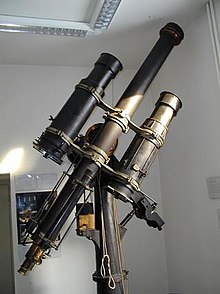
An astrograph (from other Greek: ἄστρον - the sun and γράφω - I write [1] ) is a telescope for photographing celestial objects.
Initially, since the invention of Galileo , telescopes were intended solely for visual observation. At the end of the 19th century , with the invention of photography , the photographic method of observation firmly entered astronomy. A photographic plate or, more rarely, a photographic film was inserted into the focal plane of the telescope , on which the required objects were imprinted. Specialized telescopes, intended only for photographic observations, were called astrographs or cameras [2] .
Now CCD cameras are used as photodetectors.
Nowadays, large tools are intended mainly for photographic observations.
Classical astrographs, the typical representative of which is the Carte du Ciel astrograph-refractor, had a focal length of about 3.5 meters, an aperture of 34 centimeters; We used 13 x 13 centimeter plates with a corresponding field of view of 2 ° 10 ′ and an image scale of about 60 ”in millimeter. The lens is a two-lens one in order to reduce chromatic aberration [3] .
Currently, astrographs are used for astrometry of minor planets and comets and for studying local proper motions in star clusters [3] .
See also
- Astrophotography
- Astrometry
Notes
- ↑ Astrograph // Brockhaus and Efron Encyclopedic Dictionary : in 86 volumes (82 volumes and 4 additional). - SPb. , 1890-1907.
- ↑ Martynov, D. Ya. Practical astrophysics course. - Moscow: "Science", 1977. - S. 16. - 544 p.
- ↑ 1 2 J. Kovalevsky . Modern astrometry. - Fryazino: Century 2, 2004. - ISBN 5-85099-147-6 . - S. 131.