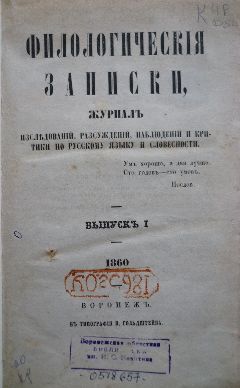
“ Philological Zapiski ” - a Russian private scientific journal “ devoted to research and the development of various issues in language and literature in general - and in comparative linguistics , in Russian language and literature, in particular - and in Slavic narcchi ”; It was published in Voronezh from 1860 to 1917 under the editorship of A. A. Khovansky , and was restored in 1993.
| Philological notes | |
|---|---|
 | |
| Language | |
| A country | Russian Empire , Russian Federation |
| Edition History | 1860 - 1917 , 1971 , from 1993 to the present |
| Established | |
Content
- 1 Magazine in the XIX century
- 2 Log value
- 3 Magazine in the XX-XXI centuries
- 4 Magazine in the XXI century
- 5 notes
- 6 Literature
- 7 References
19th Magazine
“Philological notes” were founded by a teacher of the Russian language and Russian literature of the Voronezh Mikhailovsky cadet corps Aleksey Andreyevich Khovansky at his own expense, the journal was in his own house; issued six times a year.
At that time in Russia there was only one such magazine with scientific and pedagogical content - this is the journal of the Ministry of Education , which, of course, had all the resources to put the matter in the most brilliant way. Now who undertook to compete with him? Yes, some unknown former teacher of cursive writing and the Russian language. Where did you ask? Yes, in some Voronezh, where the first higher educational institution appeared only a little half a century later ( Agricultural Academy , 1913 ). But the result was something amazing. The modest edition of Khovansky gradually begins to attract not only teachers, but also the most outstanding forces of science [2] .
“The guarantee for the dignity and worthiness of any periodical publication is not the place where it is published, nor the name of the publisher or editor ,” writes Alexei Khovansky in his No. I.
In Voronezh, translations of articles by leading European and American scholars - Max Muller , Ernest Renan , Georg Kurtius , August Schleicher , Karl Becker , Herman Brockhaus , Karl Heise , Hippolyt Ten , John Mill , Louis Leger , Berthold Yellub , Yeludel , Berlold Dellebruk , are published Otto Schrader , Hayman Steinthal , Wilhelm Freund , Jacob Grimm , Wilhelm Wackernagel , August Hoffmann , Paul Meyer (fr.) , William Whitney (English) , as well as translations of ancient authors: Plato , Euripides , Lucian , Gorius , Horus Tacitus , Theophrastus , Scandinavian poet Hans Christian Andersen and AG Elenshlegera . The magazine published one of the first translations of Plato’s dialogue “ Criton ”, which is considered an antique model of the social contract theory .
Famous Russian scholars, amateurs of Russian literature, collaborated with the editor of the magazine: Y. K. Amfiteatrov , A. I. Anastasiev , N. Ya. Aristov , A. N. Afanasyev , A. S. Arkhangelsky , N. I. Barsov , I. M. Belarus , I. A. Baudouin de Courtenay , R. F. Brandt , E. F. Buddha , F. I. Buslaev , M. M. Velikanov , A. N. Veselovsky , A. E. Viktorov , V. I. Vodovozov , A. Kh. Vostokov , Prince P.P. Vyazemsky , M. H. Grigorevsky , A. D. Galakhov , P. M. Galkovsky , P. A. Giltebrandt , K. G. Govorov , Prince. N. N. Golitsyn , Y. F. Golovatsky , Y. K. Grot , N. K. Grunsky , V. I. Dal , A. A. Dmitrievsky , K. V. Elnitsky , I. M. Zheltov , P. I. Zhitetskiy , N. P. Zaderatsky , F. F. Zelinsky , P. P. Jessen , E. G. Kagarov , N. I. Kareev , A. I. Kirpichnikov , L. Z. Kolmachevsky , D. N. Korolkov , A. A. Kotlyarevsky , A. A. Kochubinsky , P. A. Kulakovsky , Yu. A. Kulakovsky , N. A. Lavrovsky , P. A. Lavrovsky , M. N. Longinov , V. V. Makushev , A.I. Markevich , V.I. Mezhov , N.D. Mizko , Art. P. Mikutsky , O. F. Miller , V. I. Miropolsky , D. I. Naguevsky , G. P. Pavsky , V. F. Pevnitsky , V. V. Plotnikov , M. G. Popruzhenko , A. A. Potebnya , P.N. Polevoy , S.I. Ponomarev , A.V. Popov , I.G. Pryzhov , V.F. Rzhiga , A.I. Smirnov , A.I. Sobolevsky , M.A. Sokolov , I. I. Sreznevsky , A. I. Stepovich , M. I. Sukhomlinov , P. A. Syrku , N. F. Ternovsky , K. D. Ushinsky , M. G. Khalansky , D. V. Tsvetaev , A. N. Chudinov , M. M. Shapiro , V.I. Scherzl , D.O. Shepping , V.P. Sheremetevsky , I.V. Yagich , G.A. Yanchevetsky and many others. other
The first employees of the magazine were Khovansky’s colleagues in the Mikhailovsky Cadet Corps — P. V. Malykhin , M. F. De-Poule , K. G. Govorov , and N. F. Bunakov . Khovansky’s task - to establish a connection between metropolitan academics and provincial teachers, to create a portal popularizing the latest achievements of philology - was fully successful. You could say, “Phil. Notes "liberated backstage science, made it accessible to the widest layers.
In the XIX century. “Philological notes” gained not only all-Russian fame: the journal was written out by the universities of Paris , Leipzig , Prague , Zagreb , Berlin , Jena , Vienna , Uppsala , Strasbourg and even America. Great interest in the magazine was in Slavic countries - it systematically placed materials on the issues of language and literature of Ukrainian, Bulgarian, Serbian, Czech and other Slavic peoples: “ Russian language and generally Slavism were a favorite subject of Khovansky .” Khovansky magazine argued that " without the study of the Old Church Slavonic language, it is impossible to understand many phenomena of the modern Russian language, generally study it ." [3]
Since 1866, the section “ Slavic Herald ” was opened in the journal, where studies on topical problems of Slavic studies were published. “Slavic Bulletin” became “the first experience in Russian literature - to give an exclusive place in a special publication to the study of Slavic literature, antiquity and nationality ” [4] . In 1860, the magazine was devoted to the study of only the Russian language, and since 1866 - all Slavic dialects, comparative linguistics.
A. A. Khovansky always considered the question of staging the Russian language “the most burning issue”. Therefore, “Philological Notes” constantly developed and defended their main principles and teaching methods, which, according to the authors of the journal, consisted in the close connection of the educational process with new scientific achievements, as well as in the modernization of outdated methods of school work [5] .
Since the founding of the Philological Society at St. Petersburg University in 1867, the journal has become its official publication. Prior to the organization of the Russian Philological Bulletin in Warsaw in 1879, the Voronezh Journal remained the only special periodical in Russia devoted to questions of philological science and the teaching of the Russian language and literature.
| Philological notes have long been the only Russian philological journal: it found the place of work of all the best Russian philologists, on its pages young scientists tried their hand. If the Russian language in the history of its latest development owes to the latest word artists, then Russian philological science, which reveals the richness and power of Russian speech, the Russian word, owes a lot to the magazineP. A. Kulakovsky |
In 1898, the General Directorate of Press was allowed to publish Philological Notes without prior censorship; the magazine enjoyed this privilege even in the revolutionary years. Of the two concepts of modernization of Russian society, Khovansky chose enlightenment instead of revolutionary violence.
Since 1917, the magazine temporarily ceased to exist. In Soviet times, during the heyday of Marrism and the disgrace of proponents of comparative linguistics , the magazine was subjected to a fair amount of criticism, in particular for “ ignoring the Marxist law of unity and the struggle of opposites in public life ”, “for eclecticism”. The editor of the magazine, on the contrary, has professed different values all his life: “ Khovansky was neither a“ liberal ”, nor a“ conservative ”, etc., - he was highly humane, deeply believing in God ..., well-disposed towards people and responsive to all truly good people. ”
The Importance of the Journal
“Philological notes” is one of the most authoritative publications of this kind in the national science of language, a journal of the highest linguistic culture, more than three hundred issues, more than two thousand articles: “Strictly pursuing the intended goal of the program: in comparative linguistics, classicism, philology, Slavic studies, The Russian language, literature, poetry, history and literature, the issues of education and teaching of the mother tongue, the editors carefully followed each new manifestation in pedagogical and school affairs, trying to answer all possible requirements by a modern article. ” [6]
The journal was of greatest importance in the early period of its existence, in the 19th century, while it was the only scientific philological journal before the appearance of the Russian Philological Bulletin and the Izvestia of the Russian Language and Literature Department of the Academy of Sciences .
“Even a cursory list of materials published on the pages of the Voronezh magazine shows that without getting acquainted with the contents of the Philological Notes, it is impossible to get a complete picture of the study of the problems of Russian and foreign literature in pre-revolutionary literary criticism.” [7] And according to N.K. Mikhailovsky , "the whole history of modern Russian literature is actually the history of journalism ."
For almost thirty years (1860–1890), the translation and popularizing activities of the editorial office of Philological Notes were extremely important for the development of linguistics in Russia, for acquainting a wide circle of Russian philologists with foreign linguistics. This is clearly evidenced by the fact that until 1865, in addition to those translations that were made by the journal, in Russia there were only four translations of the works of foreign philologists ( V. Humboldt , preface to the book “On the language of the island of Kavi”, translation of Bilyarsky; Steintal , published by Bilyarsky in Izvestia OAN, lectures by M. Muller in the Library for Reading and Darwin's Theory as applied to the science of language by A. Schleicher [8] .
Particularly noteworthy is the influence of Philological Notes on the formation of the most important etymological field, the comparative historical methodology (comparative studies). Domestic comparative studies developed in the XIX century. in a significant way in the Khovansky magazine.
The contribution of the journal to Russian and Slavic linguistics cannot be overestimated: “ The publication of Philological Notes in Voronezh is a significant phenomenon in Russian journalism. Created in 1860, they were for a long time the only magazine in Russia on whose pages philological science developed. " [5] Many of the articles published in the Philological Notes are unique and constitute the Golden Fund of Russian Philology.
Russian philology is a rather young branch of the science of language. The word “philology” does not occur at all in M. V. Lomonosov’s , but is originally discussed by V. K. Trediakovsky : “... the midday sun is clearer that all philology in general ... the very thing is only that eloquence”, which “rules, multiplies, claims ... everywhere shines and unites all sciences and knowledge, because all of them speak only through eloquence ” [9] . The word sciences began to be called “philological” only in the middle of the 19th century. First it was called the historical and philological faculty of St. Petersburg State University (until 1850, the faculty of historical and verbal sciences), then K. P. Zelenetskiy wrote "Introduction to General Philology" in 1853. But all these events concerned only a small part of researchers, but popularization philology and the introduction of scientific achievements in the masses are connected with the Khovansky journal. Vostokov was still a writer , and Khovansky had already become a philologist , having created the most modern, innovative journal, which minimized the distance between the behind-the-scenes scientific discovery and its popularization.
| For Voronezh, Khovansky magazine was the first institution to carry out scientific activities; science here began with Philological Notes. Like Moses , Khovansky led forty years to the light of scientific knowledge of the inhabitants of a provincial town, which was part of the Kharkov University District in the 19th century [10] .A. Ivanov |
In the middle of the XIX century. the word "philology" was not particularly popularized in Russia, but thanks to his journal this word was spread in scientific use. That's why they called Voronezh in the 19th century. "Philological" city:
| It was pleasant to the writer of these lines in the 80s to hear from his professors S.-P. B. Univ., light of science, praise. review about Voronezh: in the 80s, communication between professors and students was closer. In the chaos of different. questions had to relate to their native cities. And here, by the way, there was a talk about Russian dialects. I had to name features. some. I have spoken by me in our province. And then, at this time, a professor asks: “And where are you from? - Iz Voronezh. Ah, from the Philological City! ” [eleven]S. Pryadkin |
“Philological notes” reflected the movement of our scientific thought for half a century and in this respect contain material that has not lost its value today. At one time, they successfully fulfilled the patriotic task of developing science in Russia, urging all individuals devoted to science to unite “in the name of their native word” [12] . Director of the Institute of Linguistics of the Russian Academy of Sciences (2000-2012) V.A. Vinogradov so appreciated the contribution of the Voronezh magazine to the development of Russian philology:
| Philological Notes is, indeed, one of the best journals in philology in pre-revolutionary Russia. He played an important role in the development of Russian linguistics and deserves not only respectful mention, but also serious reading today. |
Magazine in the 20th — 21st centuries
In 1961, a scientific conference dedicated to the 100th anniversary of the journal was held on the basis of Voronezh State University, the results of which were published in 1963 in the collection "Materials on Russian-Slavic Linguistics":
- Sobinnikova V. I. "Voronezh" Philological notes ";
- Попова З. Д. Публикации по общему языкознанию на страницах «Филологических записок»;
- Рыкова С. А. Вопросы преподавания языков в «Филологических записках»;
- Федорова М. В. Труды А. А. Потебни в «Филологических записках»;
- Чижик-Полейко А. И. Разработка старославянского языка в «Филологических записках»;
- Соколова Н. К., Соколова А. К. Лексикология и словообразование в «Филологических записках»;
- Кривенко Б. В. Вопросы практического синтаксиса русского языка в журнале «Филологические записки»;
- Слинько А. А. Взаимоотношения А. В. Кольцова и В. Г. Белинского в оценке «Филологических записок»;
- Соколова Н. В. Вопросы методики преподавания литературы на страницах «Филологических записок»;
- Немировский А. И. , Романова И. И. Вопросы римской истории в «Филологических записках»;
- Удодов Б. Т. Вопросы биографии и творчества М. Ю. Лермонтова в «Филологических записках» (1860—1917).
В 1971 году была предпринята попытка восстановить журнал как серийное издание по литературе и фольклору; в свет вышло всего два номера, первый из которых был посвящён юбилею воронежского поэта А. В. Кольцова . В состав редколлегии вошли д.фил.н. С. Г. Лазутин и к.фил.н. О. Г. Ласунский . В 1993 году журнал был восстановлен под эгидой филологического факультета Воронежского государственного университета . В новейшее время издание представляет собой вестник литературоведения и языкознания. До 1996 года О. Г. Ласунский, затем д.фил.н. В. А. Свительский возглавляли журнал в должности редактора, а с 2005 года изданием руководит д.фил.н. А. А. Фаустов .
Журнал в XXI веке
3 октября 2014 года состоялась международная научно-практическая конференция «Сопоставительная и славянская филология: история, состояние, перспективы», организованная Фондом им. А. Хованского на базе ВГУ и посвящённая 200-летнему юбилею первого редактора-издателя «Филологических записок». Результатом работы конференции стал юбилейный выпуск журнала, составленный из статей по темам, соответствующим разделам дореволюционного журнала: по теории и философии языка, лингвокультурологии и культуре речи, педагогике и методикам преподавания, славяноведению, литературоведению и искусствоведению. В публикациях сборника приняли участие 17 докторов наук, среди которых член-корреспондент РАН В. М. Алпатов , З. Д. Попова , С. Г. Тер-Минасова , Г. Ф. Ковалев , Л. М. Кольцова , Н. Ф. Алефиренко , И. А. Стернин , академик ПАНИ Л. А. Константинова, академик РАЕН М. Р. Желтухина, 34 кандидата наук, 7 аспирантов, 3 магистранта и один независимый исследователь.
Несколько статей сборника были посвящены непосредственно журналу, главным образом — эвристической методике интеллектуального и нравственного развития « Живое слово »:
- Алефиренко Н. Ф. Ценностно-смысловая аура живого слова;
- Комарова Э. П. Модернизация образования: история и перспективы;
- Кольцова Л. М., Чигирева Е. М. Педагогические идеи А. А. Хованского и развитие образования в Воронежской губернии пореформенного периода;
- Kornienko N. G. The cultural life of Voronezh in the correspondence of M. F. De-poule and A. A. Khovansky (1865-1885);
- Krivotulova E. V. The scientific and pedagogical journal “Philological notes” as a result of the design activity of A. A. Khovansky;
- Lazarev A. I. The concepts of biblical philosophy in grammar and the visual arts (based on the materials of the journal Philological Notes);
- Lyzhova L. K. The relevance of the methodological ideas of the magazine “F. Z. ”A. A. Khovansky today;
- Panina L. Yu., Zavarzina L. E. Speeches by N. F. Bunakov on the pages of Philological Notes;
- Rusinova E. E. The Living Word methodology in the context of the modernization of Russian education;
- Sidorova E. V. Contribution of A. V. Barsov and A. A. Khovansky to “Living Word for the Study of the Mother Tongue”;
- Slinko M. A. Journal “Philological notes” in the comprehension of A. A. Slinko;
- Chepyakova I. Yu. Psychological and pedagogical features of teaching prefixed verbs of the spatial meaning of the ancient Greek language to classical students based on the Living Word methodology [13] .
Notes
- ↑ Philological Notes // Encyclopedic Dictionary - St. Petersburg. : Brockhaus - Efron , 1902. - T. XXXVa. - S. 811.
- ↑ Pryadkin S. In memory of A. A. Khovansky // Philological notes, Voronezh, 1900.
- ↑ B. Gvozdikov. Elementary grammar of the Old Church Slavonic language // Philological notes, Voronezh, 1908.
- ↑ Khovansky A. “Slavic Bulletin”, its significance // Phil. notes, Voronezh, 1866. (unavailable link) . Date of treatment October 31, 2011. Archived November 11, 2013.
- ↑ 1 2 Antyukhin G.V. Essays on the history of the press of the Voronezh Region 1798-1917. Voronezh State University Publishing House, 1973.
- ↑ Khovansky A. The twenty-fifth anniversary of the publication of the journal Philological Notes // Phil. notes ", Voronezh, 1887.
- ↑ Slinko A. A. Voronezh "Philological notes" // Essays on the literary life of the Voronezh region. Voronezh, 1970.
- ↑ Popova Z. D. Publications on general linguistics on the pages of "Philological notes" // Materials on Russian-Slavic linguistics. - Voronezh, 1963 .-- S. 171-176.
- ↑ Trediakovsky V.K. 1745. - Cit. according to the article: Annushkin V. I. "Philology - literature - linguistics in the classical Russian tradition and the modern scientific and pedagogical process."
- ↑ Ivanov A. Golden Fund of Russian Philology (inaccessible link) . Voronezh, 2011.
- ↑ Pryadkin S. In memory of A. A. Khovansky // Philological notes, Voronezh, 1900.
- ↑ Sobinnikova V. I. "Voronezh Philological Notes" // Materials on Russian-Slavic linguistics. - Voronezh, 1963 .-- S. 165-171.
- ↑ Comparative and Slavic philology: history, state, prospects // Materials of the international scientific-practical conference dedicated to the 200th anniversary of A. A. Khovansky. - Voronezh: Quart. - 2014 .-- 425 s.
Literature
- Voronezh Encyclopedia , ed. Karpachev M.D. - Voronezh, 2008.
- Lesnaya G. M. New life of the Voronezh Philological Notes // Tomsk State University Journal. Mosk. University . Ser. 9, Philology. - 1996. - No. 3 . - S. 173-177 . - ISSN 0130-0075 .
- Materials on Russian-Slavic linguistics. - Voronezh, 1963.
- Pryadkin S. In memory of A. A. Khovansky // Philological notes, Voronezh, 1900.
- Radishauskaite N.V. Journal “Philological notes” (1860-1917) / Annotated index of articles (based on materials from the Department of valuable and rare editions of the Far Eastern National Library of Science and Technology), 2016.
- Telkova V. A. Journal “Russian language at school” and its predecessors // Rus. lang in school - 2014. - No. 7 . - S. 34-39 . - ISSN 0131-6141 .
- Philological Notes // Brockhaus and Efron Encyclopedic Dictionary : in 86 volumes (82 volumes and 4 additional). - SPb. , 1902. - T. XXXVa. - S. 811.
- Philological notes // Russian periodicals (1702-1894): Reference book / Edited by A. G. Dementiev , A. V. Zapadov , M. S. Cherepakhov . - M .: State. political literature publishing house , 1959. - S. 405–406. - 835 s.
Links
- Summary of the journal
- Philological Notes in the Brockhaus and Efron Dictionary