Emperor Uda ( 宇 多 天皇 ud tenno: October 6, 867 - September 3, 931 ) - 59th emperor of Japan , Shinto deity . Rules from December 5, 887 to August 4, 897 [1] . Name - Gardens [1] . Nicknames - Teijin-no Mikado, Kuri, Suzakuin-daijo [1] .
| By the gardens | |||||||
|---|---|---|---|---|---|---|---|
| 宇 多 天皇 | |||||||
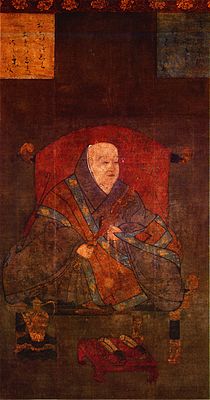 Emperor Ouda | |||||||
| |||||||
| Coronation | 887 | ||||||
| Predecessor | Emperor Coco | ||||||
| Successor | Emperor Daigo | ||||||
| Birth | October 6, 867 | ||||||
| Death | September 3, 931 (63 years old) | ||||||
| Burial place | |||||||
| Kind | and | ||||||
| Father | |||||||
| Mother | |||||||
| Spouse | , and | ||||||
| Children | , , , , , and | ||||||

Content
- 1 Biography
- 2 Board mottos
- 3 Pedigree
- 4 notes
- 5 Literature
- 6 References
- 7 See also
Biography
Before his accession to the throne, his personal name was Gardens. Emperor Ouda was the third son of Emperor Coco . His mother was the Dowager Empress Hansi, daughter of Prince Nakano (who was the son of Emperor Kammu ). Emperor Oud had five spouses and 20 children. Among them were Prince Atsumi and Prince Atsuzane (897–966).
In ancient Japan there were four noble clans. One of these clans was the Minamoto clan , also known as the Genji. Some of the grandchildren of Emperor Oud belonged to this clan. Minamoto was the most common surname of ex-emperors. In order to distinguish the descendants of Emperor Uda from other branches of the Minamoto or Genji clan, they began to call Uda Genji. Some of the Uda Genji clan moved to Omi and became known as the Sasaki clan or Omi Genji.
Among Uda Genji, Minamoto-no Masanobu, the son of Prince Atsuzane held the post of sadaijin (left minister). One of Masanobu’s daughters, Minamoto-no Rinsey, married Fujiwara-no Mitinaga, and three empresses and two regents were born from this marriage. The fourth son of Masanobu, Sukeyoshi became the founder of the Sasaki clan.
Sadami's father, Emperor Coco demoted his sons in order to reduce government spending and their political influence. Then the Gardens was given the name Minamoto and it became known as Minamoto-no Gardens. Later, in 887, when Emperor Coco needed to appoint his heir, with the support of the Fujiwara no Mototsune Campaign, the Gardens reappeared the title of Imperial Prince. After the death of his father in September of that year, Sadami ascended the throne under the name of Emperor Oud.
On September 17, 887, Uda was declared Emperor of Japan.
On January 4, 888, Fujiwara no Mototsune asks Emperor Oud permission to resign, but the emperor replied: “Because of my youth, I’m still not able to rule the state and if you stop giving me your wise advice, I will have to renounce throne and retire to the monastery. " Thus, Mototsune continued to act as regent of the campaign of the new emperor.
In 888, the construction of the new Ninna-ji Buddhist monastery was completed, and Kukai's disciple became rector of this monastery.
In 889, the former Emperor Yozei was again subjected to mental illness. He became more and more furious. Riding a horse, he could head into the crowd and crush the hooves of people.
During his reign, Uda tried to restore real imperial power and limit the influence of the Fujiwara Regent clan . Soon after the death of Fujiwara no Mototsune, Uda appointed Sugawara no Mizizane to the post of right minister. This worried the Fujiwara family very much. Meanwhile, more and more non-Fujiwara officials began to occupy high posts at the court, and the Minamoto and Sugawara no Mizizane clans became one of these officials.
Emperor Ouda, during his reign, attempted to return to politics through a system of code of ritsure. During his reign, interest in Confucianism and Chinese culture increased. In July 896, Uda sent Sugawara no Mitizane to review the charges for the prisoners and provide a general amnesty for the wrongfully accused in accordance with Chinese practice. Emperor Ouda also passed a law that strengthens the rights of peasants to own land and protects them from attacks by powerful families and monasteries.
In 897, Emperor Uda abdicated in favor of his eldest son, Prince Atsuhito, who would later become Emperor Daigo . Uda left his son a testament in which the general commandments were written. The document praised Fujiwara no Tokihira as an adviser, but cautioned the young Daigo against the debauchery of Tokihira. Sugawara no Mitizane was glorified as a good mentor to Emperor Uda. Both of these officials were appointed by Emperor Uda to look after the young Emperor Daigo until he reached maturity.
Three years later, in 900, Uda became a Buddhist monk at the age of 34. Having established the Ninna-ji Temple, Uda made it his new home after his abdication. His Buddhist name was Congo Kaku. Uda died in 931 at the age of 65.
Board motto
The emperor reigned under the following mottoes : [1]
- Ninna (885–889)
- Kampyo (889–898)
Pedigree
Note: the title was bluishly worn by the princes of blood , possible heirs to the throne, and Nisin - the princesses. The monastic princes held the title of Hoshin ( 法 親王 ).
| (54) Emperor Nimmyo | (55) Emperor Montoku | (56) Emperor Save | (57) Emperor Youjo | Minamoto no Kiyokage | |||||||||||||||||||||||||||||||||||
| Koretaka Sino | Sadasumi Sino | Minamoto no Tsunemoto | |||||||||||||||||||||||||||||||||||||
| (58) Emperor Coco | (59) Emperor Uda | (60) Emperor Daigo | |||||||||||||||||||||||||||||||||||||
| Sanejasu-sinno | Fujiwara no Mototsune | Shinjaku hoshino | |||||||||||||||||||||||||||||||||||||
| Atsuzane-sino | Minamoto no Masanobu | ||||||||||||||||||||||||||||||||||||||
Notes
- ↑ 1 2 3 4 Kontsevich, 2010 , p. 729.
Literature
- Kontsevich L.R. Chronology of the countries of East and Central Asia . - Moscow: Oriental literature of the Russian Academy of Sciences, 2010. - 806 p. - ISBN 978-5-02-036350-2 .
- History of Japan / Ed. A.E. Zhukova. - M .: Institute of Oriental Studies, Russian Academy of Sciences , 1998. - T. 1. From ancient times until 1968 - 659 p. - ISBN 5-89282-107-2 .
- (Fr.) Isaac Titsingh . Nihon give itiran, or Review of Imperial Reigns in Japan = Nipon o daï itsi ran, ou, Annales des empereurs du Japon. - Paris, 1834. - 460 p.
Links
- List of Emperors of Japan (Japanese)
See also
- Incident with ako