Shlomo Zalman Oyerbach ( July 30, 1910 , Jerusalem - February 19, 1995 , ibid.) - Israeli rabbi, one of the most important religious authorities of the second half of the 20th century; head of the yeshiva Kol Torah.
| Shlomo Zalman Oyerbach | |
|---|---|
| שלמה זלמן אוירבך | |
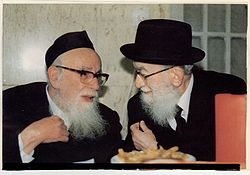 Shlomo Zalman Oyerbach and Gedalich Eisman (1989) | |
| Birth | July 30, 1910 Jerusalem |
| Death | February 19, 1995 (84 years old) Jerusalem |
| Buried | |
| Father | |
| Children | and |
Biography
Born in Jerusalem in 1910. His father, Rabbi Haim Yuda-Leib Oyerbach, was one of the central figures of the old Yishuv and the head of the Kabbalistic yeshiva Shaar Hashamayim in Jerusalem. He studied at Yeshiva Etz Chaim.
At 24, he wrote the book "Maurey Ash." The views expressed in this book were supported by its teacher, Iser-Zalman Meltser , as well as Chaim-Ozer Grodzensky from Vilnius.
In 1929, Rokhamkin married Khae Rivka and continued his studies in the kollel of Rabbi Zvi-Pesach Frank (Midrash Bnei Zion), who specialized in Seder Zraim and the laws relating to life in the Holy Land of Israel (his innovations were included in the books “ Kerem Zion ”and“ Maadani Arez ”).
He also studied with the rabbis of Dov-Berish Weidenfeld, Samson-Aaron Polanski and Zelig-Reuven Bengis.
He became famous for his innovative and comprehensive views on the decrees of the Halakha , especially those related to new technologies.
In 1948, he was appointed head of the yeshiva of Kol Torah , which he ruled for 40 years, until his death.
All his life he lived in Jerusalem, in the Shaare Zedek quarter.
He was known for his delicacy, sensitivity and friendliness.
Oierbach was repeatedly offered various high rabbinical posts, including the post of chief rabbi of Jerusalem, but he refused them.
With the creation of Beit Hadin Hadad Gadol leirurim (Supreme Religious Court of Appeal), Rabbi Yitzhak Aizik Herzog proposed Oyerbach to become one of the main judges, but he refused. Despite this, they still turned to him for the solution of halakhic issues.
Although Oyerbach belonged to the ultra-Orthodox Haredim , he was a recognized religious authority among other Orthodox movements of Judaism.
Oyerbach highly appreciated and revered Rabbi A.-I. Cook , whom he met through his father. Cook held his wedding ceremony and gave his Haskama to the book "Maurey Ash."
He supported the settlement movement in Judea and Samaria.
Halaha Rava Oyerbach
The fact that his father was a Kabbalist did not affect the halachic decrees of Rabbi Oyerbach, in addition, there is no evidence that he ever engaged in Kabbalah.
Most of his halachic decrees came in the form of articles; he also gave them orally or in writing; some of them were later included in books. Among them are answers to personal questions about halachic dilemmas, a look at various Talmudic topics, both practical and theoretical, as well as a discussion of the commandments attached to the earth. But still, the main theme of his decisions was the daily life of a single person.
He paid special attention to solving halakhic issues related to new technologies and medicine. He was the initiator of scientific experiments, the purpose of which was to establish some principles of halacha. For example, establishing the exact moment of death or the minimum temperature for cooking in cases in which cooking was previously prohibited. He devoted his first book, Meorei Ash, to the problem of using electricity on Shabbat.
In its r. Oyerbach, in addition to classical sources, also relied on moral and human considerations. He focused on the need to separate the law itself and gzerot , and quite often tended to make a softer decision, on the basis that today no new gzerot are being created.
Sometimes he applied a rather innovative approach to solving halachic issues, but he did it in certain cases with the clarification that he was not going to establish a new halacha, only with the consent of other authoritative religious figures.
Books
Published before his death
- Meorey Ash, 1935
- Maadani Arez, 1946
- Maadani Arez, 1952
- “Minhat Shlomo” (first volume), 1986
Published after his death
- “Minhat Shlomo” (second and third volumes), 1999
- Minhat Avot
- "ShULkhan Shlomo"
- "Halichot Shlomo"
Amir Mashiach, Rabbi Narya Gutel and some others claim that the books published after the death of Rabbi Oyerbach underwent editing, which runs counter to his ideas. Their opponents argue that editing does not contradict the source text and explain the claims to the editors of his books by not understanding the fact that the language has changed over the years. [1] [2]
Sources
Notes
- ↑ Doctorate of Amir Mashiach on מחשבת ההלכה במשנתו של הרשז"א
- ↑ שבוע הספר | ספרים מומלצים: הקרב על "מעדני ארץ" - תרבות וספרות - הארץ