Karel Kozhelug ( Czech Karel Koželuh , also spelled Karol ; March 7, 1895 , Prague - April 27, 1950 , Prague ) - a Czech athlete known as a tennis player , hockey player and soccer player .
| Karel Kozhelug | |
|---|---|
| Karel Koželuh | |
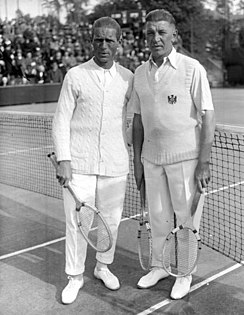 Karel Kozhelug (left) and Roman Nayuh | |
| personal information | |
| Floor | |
| A country |  Austria-Hungary , Austria-Hungary ,  Czechoslovakia Czechoslovakia |
| Specialization | tennis , ice hockey , football |
| Club | , , , and |
| Date of Birth | March 7, 1895 |
| Place of Birth | Prague , Austria-Hungary |
| Date of death | April 27, 1950 (55 years old) |
| Place of death | Prague, Czechoslovakia |
| Working side | |
| Growth | 172 |
| Weight | 65 |
In tennis - the repeated winner of the US Championship among professionals and the French championship among professionals , one of the best professional tennis players in the world of the late 20s and early 30s of the 20th century. Member of the International Tennis Hall of Fame since 2006 .
In ice hockey - European champion in 1925 in the national team of Czechoslovakia .
In football - a player in the team of Cisleitania (in 1917 and 1918 ) and the team of Czechoslovakia (in 1923 ).
Sports career
Football and Hockey
Since childhood, differing in their abilities for sports, up to 16 years old Karel Kozhelug played primarily in rugby , although he paid attention to other sports. Subsequently, he seriously took up football and in 1914 was invited to one of the strongest clubs in the Czech Republic, Prague Sparta , and in 1916 he moved to another Prague club, DFC , for which he continued to play until 1920 [1] . In 1917, he was included in the team of Cisleitania , where players from all over the Austro-Hungarian Empire played, with the exception of Hungary itself. For two years, he spent four games for the national team, scoring one goal in a victory match against the Swiss team [2] .
After the end of the First World War, Kozhelug, who continued to play football, also took up hockey . From 1919 to 1925 he played in the Sparta team [3] (for a while he returned to this club as a footballer in the championship season of 1923/24 [1] ). During this time, he twice played for the Czechoslovak team at the European Championships , winning a bronze medal in 1923 and becoming a champion in 1925 in his homeland. At this championship, he became the author of the winning goal against the national team of Switzerland [4] .
After leaving DFC in 1920, Kozhelug played football for the Teplitser club for several years, and then spent six months each at Sparta and the Austrian Wiener club [1] . In 1923 he was invited to the Czechoslovak team , for which he spent two matches, scoring one goal against the Italian team [2] .
Tennis
Acting as an amateur in football and hockey competitions, Kozhelug early began to earn his living as a tennis coach. This choice led to the fact that in the mid-1920s he was forbidden to play in amateur clubs, and later he completely focused on tennis not only as a coach, but also as a professional player (his brother Jan was an amateur tennis player and played in the national team of Czechoslovakia in the Davis Cup [5] ).
Since the mid-1920s, Kozelug has become one of the leading professional tennis players in Europe. His unflappable game from the back line, rarely interrupted by outcrops to the net, exhausted his opponents, making them make mistakes. That is how Kozhelug won the Bristol Cup in the Riviera in December 1926 against the Irishman Albert Burke , whose game was more spectacular, but less reliable. The year before, Kozhelug won the unofficial “World Professional Championship” held in Deauville (France). Since 1928, Kozhelug was the permanent owner of the Bristol Cup until the abolition of this tournament in 1933 .
In 1928, Europe's leading professional tennis player Vincent Richards , a two-time Olympic champion in 1924 and the winner of the first professional US championship, conducted his tour in Europe. In August, Kojelug and Richards announced a series of matches as part of a joint tour. The first matches of the tour were on the clay courts of Europe and ended in the victory of Kozhelug. A series of matches continued in the USA, where Richards defeated Kozhelug in the final of the US Championship on a wet-wet grass court , where he could fully use his crown outcuts to the net, but in general the series ended with a convincing victory for Kozhelug, who won 15 out of 20 matches [6 ] .
At the beginning of 1929, Kozhelug challenged any amateur tennis player, offering to meet in a series of three matches on a clay court; the proceeds from the sale of tickets were proposed to be transferred to charity. The leader of amateur tennis, Henri Cochet , responded to the challenge, but the French Tennis Federation forbade him to participate. Over the year, Kozhelug spent seven matches against Richards, including the second consecutive final of the US professional championship, which he won in a five-set marathon match. In this game, Richards failed to realize the three match-balls and ended it with a double mistake, completely exhausted by a stubbornly defending opponent. Of all seven matches, Kozhelug won five. Having won both major professional tournaments of the season, he proved that at this moment he is the best professional tennis player in the world. Nevertheless, a number of experts, paying tribute to his defense game, concluded that the leading masters of the grid game among amateurs, such as Koshe and Bill Tilden , have an advantage over him [7] .
In 1930, Kojelug won first the Bristol Cup, and then held the first French Championship among professionals , defeating Roman Nayuh in the final. At the U.S. Championship, he twice lost to Richards in the final, both singles and doubles. After that, they again conducted a short tour of six matches, of which Kozhelug won four (including the Richards victory in the US championship) [7] .
At the very end of 1930, one of the best amateur tennis players in the world, Bill Tilden, became a professional. Their joint tour with Kozhelug in the first half of 1931 ended in a convincing victory for Tilden, who won the first nine matches in a row and 27 out of 33 in total [8] . This result clearly indicated a change of leader in world professional tennis. However, in subsequent years, Kozhelug constantly remained one of the contenders for the highest places in the professional hierarchy. In particular, he twice became the champion of the United States among professionals - first in 1932 , and then in 1937 , when he was already 41 years old. In 1934 and 1935, he played in the finals of the US Championship. He continued to perform during the Second World War , holding demonstration matches in the UK, where Czech rivals were among his rivals, among others. The proceeds from these appearances went to the International Committee of the Red Cross [9] .
Throughout the years of performances, Kozhelug continued to work as a tennis coach, first in France and later in the USA, including at the highest level. In 1929, he worked in Europe with the US team [7] , and in the post-war years he coached the tennis team of Czechoslovakia [9] .
Karel Kozhelug died in 1950 in a car accident on the way to his country house in Klanovice (near Prague). In 2006, on the initiative of another famous Czech master Jan Kodesh [9], the name Kozhelug was included in the lists of the International Tennis Hall of Fame .
Career Grand Slam Tournament Finals
| Result | Year | Tournament | Coating | Opponent in the final | Final Score |
|---|---|---|---|---|---|
| Defeat | 1928 | US Championship | Grass | Vincent Richards | 6-8, 3-6, 6-0, 2-6 |
| Victory | 1929 | US Championship | Grass | Vincent Richards | 6-4, 6-4, 4-6, 4-6, 7-5 |
| Victory | 1930 | French Championship | Priming | Albert Burke | 6-1, 6-2, 6-1 |
| Defeat | 1930 | US Championship | Grass | Vincent Richards | 2-6, 8-10, 3-6, 4-6 |
| Victory | 1932 | US Championship | Priming | Hans Nüsslein | 6-2, 6-3, 7-5 |
| Defeat | 1934 | US Championship | Priming | Hans Nüsslein | 4-6, 2-6, 6-1, 5-7 |
| Defeat | 1935 | US Championship | Priming | Bill tilden | 6-0, 1-6, 4-6, 6-0, 4-6 |
| Victory | 1937 | US Championship | Bruce barnes | 6-2, 6-3, 4-6, 4-6, 6-1 |
Notes
- ↑ 1 2 3 Karel Kozhelug in the Worldfootball.net database (English)
- ↑ 1 2 History of appearances for football teams in the RSSSF database
- ↑ Profile in the Elite Hockey Prospects Database
- ↑ 1925 European Championship in the Hockey Archives database (fr.)
- ↑ Karel Kozhelug on the Grand Slam Tennis website
- ↑ Ray Bowers. History of the Pro Tennis Wars, Chapter 2, part 1: 1927-1928 . The Tennis Server (March 1, 2001). Date of treatment July 4, 2011. Archived on August 18, 2011.
- ↑ 1 2 3 Ray Bowers. History of the Pro Tennis Wars, Chapter 2, part 2: 1929-1930 . The Tennis Server (April 1, 2001). Date of treatment July 4, 2011. Archived on August 18, 2011.
- ↑ Ray Bowers. History of the Pro Tennis Wars, Chapter 3: Tilden's Year of Triumph: 1931 . The Tennis Server (March 3, 2002). Date of treatment July 4, 2011. Archived on August 18, 2011.
- ↑ 1 2 3 Jirka G. Novák. Koželuh bude zřejmě do tenisové Síně slávy uveden is trofejemi (Czech) . Sport.cz (28..6.2006). Date of treatment July 4, 2011. Archived on August 13, 2012.
Links
- Karel Kozhelug on the website of the International Tennis Hall of Fame
- Karel Kozhelug - singles results on Tennis Archives website