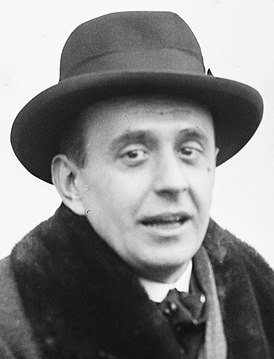
Jan Garrigue Masaryk ( Czech Jan Garrigue Masaryk ; September 14, 1886 , Prague , Austria-Hungary - March 10, 1948 , ibid., Czechoslovakia ) - Czechoslovak diplomatic and statesman. In 1940 - 1948 - Minister of Foreign Affairs of Czechoslovakia . The son of the first president of Czechoslovakia, Tomasz Masaryk .
| Ian Garrig Masaryk | |||||||
|---|---|---|---|---|---|---|---|
| Czech Jan Garrigue Masaryk | |||||||
 | |||||||
| Head of the government | Jan Shramek Zdenek Fierlinger Clement Gottwald | ||||||
| The president | Edward Benes | ||||||
| Predecessor | Frantisek Hvalkovsky | ||||||
| Successor | Vladimir Clementis | ||||||
| |||||||
| Head of the government | Jan Shramek | ||||||
| The president | Edward Benes | ||||||
| Predecessor | Sergey Ingr | ||||||
| Successor | Ludwik Freedom | ||||||
| Birth | September 14, 1886  Prague , Austria-Hungary Prague , Austria-Hungary | ||||||
| Death | March 10, 1948 (61 years old) Prague , Czechoslovakia Prague , Czechoslovakia | ||||||
| Burial place | |||||||
| Father | Tomas Masaryk | ||||||
| Mother | Charlotte Garrig | ||||||
| Spouse | Francis Crane Litherby | ||||||
| The consignment | non-partisan | ||||||
| Education | |||||||
| Religion | |||||||
| Awards | [d] ( April 25, 1948 ) [d] ( 1948 ) [d] ( May 25, 1947 ) [d] ( May 25, 1947 ) [d] ( 1946 ) | ||||||
| Battles | |||||||
Biography
The early years
Born in Prague , in the family of Professor Tomas Masaryk and his wife, an American Charlotte Garrig , a relative of Charles Crane . Masaryk was educated in Prague, and then in the USA , where he earned his own labor, working, in particular, as an employee in a steel company. Yang came to America in 1907. He was admitted to the Cranes Steel Mill in Bridgeport. For six years, Jan Masaryk was either a laborer, then a sifter of sand, then a moulder, but he recalled the years spent in Bridgeport as one of the happiest in his life. He returned home in 1913 .
During the First World War he fought in the ranks of the Austro-Hungarian army . After the collapse of Austria-Hungary and the formation of Czechoslovakia, he entered the diplomatic service, from 1919 to 1922 he was a charge d'affaires of Czechoslovakia to the United States , and in 1925 became ambassador to the UK . He continued to hold this position even after the departure of his father, Tomas Masaryk, from the post of president of the country in 1935 .
World War II
In September 1938, the Sudetenland of Czechoslovakia was occupied by German troops. Most members of the government, including President Edward Benes , have resigned. Jan Masaryk also left his post, but at the same time remained in London . In March 1939, the remainder of Czechoslovakia was divided between Nazi Germany ( Protectorate of Bohemia and Moravia ), Hungary ( Subcarpathian Rus ), Poland (Tesinska oblast) and the Slovak Republic .
In 1940, the Czechoslovak government in exile was formed in Great Britain, in which Masaryk was appointed Minister of Foreign Affairs. During the war, he regularly performed on the BBC , speaking on the radio to residents of occupied Czechoslovakia . July 18, 1941 signed the Soviet-Czechoslovak agreement on cooperation in the fight against Germany. In 1942, Bates College of America awarded Masaryk a doctorate in law .
Post-war period
After the liberation of Czechoslovakia and the end of World War II, Masaryk remained on the post of Minister of Foreign Affairs of the country. Despite the multi-party system, the Communist Party of Czechoslovakia , led by Clement Gottwald , had the greatest weight in the country, whose positions strengthened after the elections in 1946 .
Masaryk was preoccupied with the policies of the Communists, who established close ties with the USSR and refused to participate in Czechoslovakia in the implementation of the Marshall Plan . In February 1948, most non-communist cabinet members resigned, hoping for the dissolution of the government and new elections, but instead a new, pro-communist government was formed by the communists. The incident went down in history as the February events in Czechoslovakia . Masaryk, in turn, did not participate in the speeches and remained the Minister of Foreign Affairs. He was the only non-partisan minister in Gottwald’s office.
Death
On March 10, 1948, Jan Masaryk was found dead in the courtyard of the Ministry of Foreign Affairs (“Third Prague Defenestration ”). He was lying under the window leading to the bathroom, in his pajamas. The initial investigation concluded that he committed suicide .
During the events of Prague in 1968, the provisional authorities launched a new investigation into the circumstances of Masaryk’s death, excluding the possibility of an accidental fall. A third investigation in the 1990s also found suicide.
At the same time, in 1992, a certain Leonid Parshin came to the Czech embassy in Berlin, who stated that his mother Elizaveta (1913-2002) was a staff member of the NKVD-MGB and knows the man who killed Masaryk. [1] On March 28, 1994, on the air of the Vremechko program, Elizaveta Parshina reported that Masaryk was killed by an MGB agent, but refused to give his name. [2] Several years later , Vladimir Tolts, the host of Radio Liberty, and Colonel Ilya Pravda, an employee of the Office for Documentation and Investigation of Crimes of the Communist Criminal Police of the Czech Republic, said that Elizaveta Parshina revealed the names of Masaryk’s murderers. According to her, the murder was organized by Mikhail Belkin , head of the Ukr MGB of the USSR of the Central Group of Soviet Forces, and Bondarenko, the junior operative, was the direct perpetrator of the murder. [2] [3]
Former secretary of Masaryk, Antonin Sum, said in 2002 that he did not believe the versions of the murder and still believed that his boss committed suicide - according to Sum, Masaryk was in a severe depression in the last days of his life and, obviously, decided to commit suicide [4] . In 2004, a new version of the murder of Masaryk appeared. Forensic expert Jiří Straus stated that Masaryk - a heavy person and, of course, not an athlete - would have landed much closer to the building if he had jumped. He says that the fact that Masaryk was found more than two meters from his window is convincing evidence that he was pushed out of it. He also noted that Masaryk landed on his feet - suggesting that he was trying to save himself from a 14-meter drop [5] . The Bureau of Documentation and Investigation of the Crimes of Communism claims that they were forced to close the case because the Russian authorities refuse to provide materials that could help identify the killers.
Family
From 1924 to 1931, Masaryk was married to Francis Crane Litherby. She was the daughter of the famous industrialist, banker and diplomat Charles Richard Crane , the heiress of a large company producing water pipes and equipment and elevators, and the sister of Richard Teller Crane 2nd, US Ambassador to Czechoslovakia. Married to Liserby, Masaryk had three adoptive children: Charles, Robert Jr. and Richard Crane Litherby, who were married to Francis and Robert Lizerby.
Masaryk had no children of his own.
Passion for music
From an early age, Masaryk was fond of music and even wanted to become a musician. For this reason, in order to distract his son from a frivolous passion, Tomas Masaryk sent him to the United States. Here, in addition to working in the steel company, Jan worked as a pianist during the film projection of the first silent films .
As Minister of Foreign Affairs, Masaryk often after banquets and official meetings played the piano or piano in the presence of politicians and diplomats.
Notes
- ↑ Radio Prague - Only Russian archives will help reveal the death of Jan Masaryk
- ↑ 1 2 TASS is not authorized to declare: “testament” of Jan Masaryk
- ↑ "Mr. Stalin, I can only die ..." - True Gulag - Novaya Gazeta (inaccessible link) . Date of treatment June 20, 2012. Archived June 23, 2012.
- ↑ Last Night of Jan Masaryk - Izvestia
- ↑ POLICE CLOSE CASE ON 1948 DEATH OF JAN MASARYK - MURDER, NOT SUICIDE
Links
- Michal Lashtovichka. Tomas Garrig Masaryk, his son Jan and their love of music // Radio Praha: Radio (text version). - March 11, 2002.
- Biography on hrono.ru
- Vitaly Yaroshevsky. "Mr. Stalin, I can only die ..." (inaccessible link) . New newspaper (December 16, 2011). Date of treatment June 20, 2012. Archived May 14, 2012.