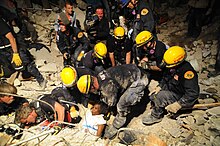
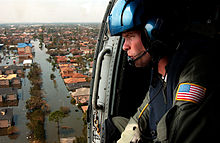
Emergency and rescue operations are actions to rescue people, material and cultural values, protect the natural environment in an emergency zone, localize emergency situations and suppress or bring to the lowest possible level the impact of their characteristic hazards. [1]
Emergency work in emergency response is an activity to provide comprehensive emergency and rescue work, provide medical and other types of assistance to the people affected in emergency situations, create the conditions that are minimally necessary to preserve the lives and health of people and maintain their health. [1]
The decision on the conduct of rescue and other urgent work is taken by the head of work on emergency response . [2]
Emergency and rescue operations are associated with factors that threaten the life and health of the people conducting these works, and require special training, equipment and equipment. [1] Even in case of emergency, only certified people can be involved in rescue operations. Non-rescuers can be involved in carrying out emergency work on a voluntary basis. [1]
In Russia, the list of rescue operations is established by the law “On Rescue Services and Rescue Status” and can be supplemented by government decisions. [1]
Content
History
In the USSR, in the framework of civil defense, the term "rescue and emergency rescue and recovery operations" was used.
Rescue services and formations (in Russia)
To perform work on the prevention and elimination of emergency situations in Russia, it is possible to create three types of emergency services and formations: professional services, professional units; abnormal formations; public formations. To solve the tasks of civil defense , rescue services and rescue units, [3] or non-staff units to ensure the implementation of civil defense measures are used. [four]
In 2017, there were 6403 services and formations in Russia, of which 1126 were non-staff. [3]
In Russia, for conducting rescue operations by services and formations, certification is required. Permission to conduct other work, including solving civil defense tasks, is not required. [3]
Professional
Object
Emergency and rescue services and formations are created in organizations, if they are legally provided for, depending on the type of organization’s activities. [1]
Municipal
The local government independently finances emergency protection measures within the municipality, and only when the municipal forces and assets are insufficient, attract the forces and resources of the subject of the Russian Federation. [five]
Regional
Departmental
Federal executive authorities or their subordinate organizations can create departmental emergency services. [6] One of such services (subordinated to the federal executive body) is the Search and Rescue Service of the EMERCOM of Russia . [7]
Non-standard
The abnormal basis of formation of formations does not allow to refer them to the forces of constant readiness, since members of the formation in the normal mode of operation (when there are no emergencies, accidents and incidents) are engaged in performing duties at the main place of work and temporarily interrupt this work only to eliminate emergency situations (accidents, incidents) when they occur. They are not subject to the requirements applicable to professional formations. They should not be on duty round the clock; not involved in emergency situations outside their area of responsibility; It does not require the availability of operational vehicles equipped with special signals. [3]
Non-standard formations can be created for various purposes:
- for liquidation of emergency situations according to the plans of warning and liquidation;
- for solving the tasks of civil defense according to plans of civil defense and protection of the population
- for other tasks depending on local conditions. [3]
Emergency civil defense units may carry out non-hazardous work and emergency work during emergency response. [four]
Public
Rescuer
The rescuer is a citizen trained and certified for rescue operations. [1]
“Rescuer” as the word of general literary Russian language began to denote the profession relatively recently (the 90s of the twentieth century). In Russian terminology of life safety, there are no other lexemes to denote occupations in the field of emergency response (the exception is the firefighter profession). Differentiation of rescuers according to the work they perform occurs through the formation of phrases with the word “rescuer”: a rescuer, a gas rescuer, a mine rescuer, a mountaineer rescuer, a rescue diver. [eight]
Rescuers are required [9] :
- be ready to participate in emergency response, improve their physical, special, medical, psychological training;
- improve the skills of actions in the emergency response teams;
- strictly observe the technology of rescue operations;
- actively search for victims, take measures to rescue them, provide them with first aid and other types of assistance;
- To comply strictly with the orders given during the work on emergency response by the heads of emergency services, emergency response teams, in which rescuers take part in carrying out the said works;
- explain to citizens the rules of safe behavior in order to prevent emergency situations and procedures in case of their occurrence.
In Russia, a citizen who has reached 18 years of age, trained and certified for emergency rescue operations can become a professional lifeguard. [9]
The training of the “Savior” profession is carried out in secondary and higher educational institutions of the Emergencies Ministry of Russia and educational and methodological centers of the Civil Emergency Situations.
Emergency and Rescue Equipment
Special equipment and tools, equipment and equipment, communications equipment and other means are used to rescue people and carry out rescue operations, protect and provide first aid to victims. [ten]
Notes
- ↑ 1 2 3 4 5 6 7 Law “On Emergency Rescue Services and the Status of Rescuers”
- ↑ Emergency response manager // Civil Protection. Encyclopedic Dictionary - M.: FSBI VNII GOCHS (FC), 2015
- ↑ 1 2 3 4 5 P. A. Monakhov On some issues of certification of non-standard emergency response and rescue units // Civil Security Technologies, vol. 14, 2017, No. 3 (53)
- ↑ 1 2 Civil Defense Formations (non-standard) // Civil Protection: Encyclopedia in 4 volumes. T. IV (T - I) —M .: FSBI VNII GOCHS (FC), 2015
- ↑ Zokoev V. A., Semenova A. G. Competence of local governments in the field of protection of the population and territories from emergency situations // Problems of risk management in the technosphere N 3 (31), 2014
- Departmental rescue (search and rescue) service // Civil Protection: Encyclopedia in 4 volumes. T. I (A - I) - M .: FSBI VNII GOCHS (FC), 2015
- ↑ EMERCOM of Russia. Search and rescue service
- ↑ Ulyanova O. V., Ivushkina N. V., Yushkov V. P. Semantic features of the names of occupations in the field of life safety in Russian and English languages // Philological Sciences. Questions of theory and practice — Tambov: Letter, 2016. No. 6 (60): in 3 hours. Part 3. C. 143-145.
- ↑ 1 2 Federal Law No. 151 “On Emergency Rescue Services and the Status of Rescuers”
- ↑ Emergency and Rescue Equipment // Civil Protection: Encyclopedia in 4 volumes. T. I (A — I) —M .: FSBI VNII GOCHS (FC), 2015.