1st Ski Division ( German 1. Skijäger-Division ) - military unit of the Third Reich army. The first and only division specially trained in winter warfare.
| 1st ski division | |
|---|---|
 | |
| Years of existence | September 1943 - 1945 |
| A country |  Germany Germany |
| Subordination | Wehrmacht |
| Included in | Army Group Center |
| Type of | Military skiers |
| Function | winter military operations |
| Equipment | arctic outfit |
| Participation in | The Second World War |
| Marks of Excellence |  |
| Commanders | |
| Famous commanders | Martin Berg |
Content
History
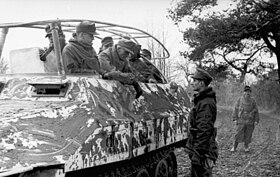
In September 1943, of the six rifle battalions (2nd, 4th, 5th, 7th, 9th and 11th), which were combined into two ski regiments, the 1st ski or 1 Wehrmacht Ski Jaeger Brigade . This was the first compound specially trained for warfare in winter conditions. June 2, 1944 the compound received the status of a division. For the formation of the division, servicemen of the 19th tank and grenadier brigade, the 65th regiment of heavy artillery, the 152nd anti-tank battalion, the 18th missile battalion and the 615th anti-aircraft battalion were involved. With the help of these volunteers, the brigade was strengthened and became a division. She fought in Belarus (the swamps of Pripyat ), southern Poland and Slovakia . Surrendered to Soviet troops in May 1945.
Division Composition
General composition
As of January 1945, the division included:
- Division headquarters
- 1st ski ranger
- 2nd ski ranger
- 152nd artillery regiment
- 1st heavy ski battalion
- 1st Ski Fusilier Battalion
- 152nd anti-tank division (formerly 270th assault guns division)
- 85th ski sapper battalion
- 152nd Communication Battalion
- ski field reserve battalion
Parts and Weapons
Each regiment consisted of three battalions of skiers, an engineering platoon, a signalman detachment, and an anti-tank detachment (he was given two anti-tank guns). The battalion, in turn, consisted of the following units:
- Battalion headquarters
- Three companies of shooters (nine light machine guns)
- Two assault platoons (each was given StG 44 assault rifles)
- Heavy rifle company (eight heavy machine guns, one manual, four 75 mm guns and six 80 mm mortars)
The division also included several more units armed with the following weapons. So, in the 13th motorized auxiliary company there were several platoons:
- Platoon with eight 20 mm FlaK anti-aircraft guns
- A platoon with six heavy machine guns
- A platoon with six Pak 40 75 mm anti-tank guns, 18 anti-tank rifles and a light machine gun.
The 152nd artillery regiment included four battalions with the following guns:
- Twenty four 105 mm howitzers
- Twelve 120 mm mortars
- Twelve 150 mm howitzers
- 59 machine guns
The first ski fusilier battalion consisted of four companies of machine gunners, armed in the same way as a regular battalion of skiers (nine machine guns, two assault platoons and a heavy rifle company).
The most important and strongest division of the ski division was the 1st heavy battalion. The composition of this battalion included:
- Anti-tank company (12 heavy guns and 12 machine guns)
- A company of self-propelled 150-mm howitzers with a crew armed with seven machine guns
- Company of self - propelled 37 mm FlaK anti-aircraft guns
- The 4th armored company, which fought on captured T-34s with 76.2 mm guns and three 7.62 mm machine guns each.
Finally, the division included the 152nd anti-tank division, divided into two batteries, each of which had 5 StuG III self-propelled guns. The division was supported by the 85th battalion of skiers-sappers, the 152nd detachment of skiers-signalmen and the 152nd battalion of the reserve.
Commanders
- Major General Martin Berg (June 5 - October 2, 1944)
- Lieutenant General Gustav Hundt (October 2, 1944 - January 1945)
- Major General Hans Stets (January - February 1, 1945)
- Lieutenant General Gustav Hundt (February 1 - May 8, 1945)
Awarded the Knight's Cross of the Iron Cross
Knight's Cross of the Iron Cross (9)
- Willy Fikendey, 09/17/1944 - Chief Corporal, Division Commander of the 7th Company of the 1st Ski Jaeger Regiment
- Karl Neubert, 10/04/1944 - Major, commander of the 1st heavy ski battalion
- Herbert Gladewitz, 10/20/1944 - reserve lieutenant, commander of the 7th company of the 1st ski jaeger regiment
- Willy Schülke, 10/28/1944 - Lieutenant Commander of the 3rd Battalion of the 1st Ski Jaeger Regiment
- Joseph Trauznits, 11/03/1944 - Chief Sergeant of the 3rd company of the 85th ski sapper battalion
- Xaver Whist, 11/26/1944 - Chief Chasseur, Commander of the 3rd Company Division of the 1st Ski-Jaeger Regiment
- Erich Schäfer, 01/31/1945 - reserve captain, commander of the 2nd battalion of the 2nd ski-jaeger regiment
- Gustav Hundt, 04/15/1945 - lieutenant general, commander of the 1st ski division
- Bruno Weiler, 05/09/1945 - Colonel, commander of the 1st ski jaeger regiment (award is not confirmed)
Knight's Cross of the Iron Cross with Oak Leaves (2)
- Hans-Christian Stock (No. 628), 10.23.1944 - captain, commander of the 2nd company of the 152nd anti-tank division
- Willy Schülke (No. 740), 02.16.1945 - captain, commander of the 3rd battalion of the 1st ski jaeger regiment
Literature
- Nigel Thomas The German army on the eastern front (1943-1945) . 2001.
- Merriam, Ray, Gebirgsjaeger: Germany's Mountain Troops, Merriam Press, 1999 ISBN 1-57638-163-3
- Anderson, Thomas, Skijäger: une “nouvelle race” de guerriers, Batailles & Blindés n ° 40, décembre 2010-janvier 2011, éditions Caraktère.