Aravanic , or bone - lingual [1] ( lat. Osteoglossidae ) is a family of tropical freshwater ray-finned fish from the order of Araranidae .
| Aravanic | |||||||||||||||||||||||||||||||||||||||||
 Aravana ( Osteoglossum bicirrhosum ) | |||||||||||||||||||||||||||||||||||||||||
| Scientific classification | |||||||||||||||||||||||||||||||||||||||||
|---|---|---|---|---|---|---|---|---|---|---|---|---|---|---|---|---|---|---|---|---|---|---|---|---|---|---|---|---|---|---|---|---|---|---|---|---|---|---|---|---|---|
| |||||||||||||||||||||||||||||||||||||||||
| International scientific name | |||||||||||||||||||||||||||||||||||||||||
Osteoglossidae Bonaparte , 1832 | |||||||||||||||||||||||||||||||||||||||||
| Geochronology appeared 140 million years
◄ Nowadays◄ Cretaceous-Paleogene extinction◄ Triassic extinction◄ Mass Permian Extinction◄ Devonian extinction◄ Ordovician-Silurian extinction◄ Cambrian explosion | |||||||||||||||||||||||||||||||||||||||||


Content
Description
The Aravanovs have a somewhat elongated, most laterally compressed body, especially the abdominal part, covered with very large scales with a well-defined sculpture. The head is covered with bone plates. The mouth is very wide, the upper, some medium. The dorsal fin is carried far back to the tail, and is located on the caudal stem opposite the anal fin. The pectoral fins are low. Abdominal are located behind the base of the chest. In the ventral fins of 6 rays. There are teeth on the maxillary bone. A very large swim bladder has cellular walls penetrated by a dense network of blood vessels, so it can act like a lung, absorbing oxygen from the air . The swim bladder does not penetrate into the cranial cavity. Some species have a special suprajugal organ, which also allows you to breathe atmospheric air. The ability to use oxygen directly from the atmospheric air for breathing was developed by the Aravanovs, apparently due to the fact that they live most of the time in densely overgrown reservoirs, where oxygen deficiency often occurs. In the lateral line 21–55 scales. The vertebrae are 60-100. Most are omnivores or predators.
Habitat and habitat
A circum tropical family of freshwater fish distributed in South America , Africa , Southeast Asia , northern Australia , the islands of the Malay archipelago and New Guinea . They live in stagnant bodies of water.
The remains of the oldest known Aravanov found in sediments of the early Cretaceous age 140.2-136.4 million years old in Japan . Fossils of various fossils of the family were also found in North ( USA , Canada ) and South ( Brazil ) America, Africa ( Kenya , Sudan , Tanzania , Niger ), Asia ( India , Pakistan ) and Western Europe ( Great Britain ) [2] .
Captivity
Popular aquarium fish are often on display in public aquariums and zoos .
Classification
In the Aravanian family, there are 2 modern subfamilies with 4 genera and 11 species [3] [4] , as well as several fossil genera [2] [5] :
- Subfamily Heterotidinae
- Arapaima - Arapaima
- Arapaima gigas - Giant arapaima
- Heterotis - Heterotis
- Heterotis niloticus - Nile heterotis
- † Joffrichthys - Paleocene (65.5–55.4 Ma), North America
- † Joffrichthys symmetropterus
- † Joffrichthys triangulpterus - Upper Paleocene (56.8–55.4 Ma ago)
- Arapaima - Arapaima
- Subfamily Osteoglossinae
- Osteoglossum - Arawans
- Osteoglossum bicirrhosum - Aravana
- Osteoglossum ferreirai - Black Aravana
- Scleropages - Baramunda
- Scleropages aureus
- Scleropages formosus - Malaysian scleropages
- Scleropages inscriptus
- Scleropages jardinii - Northern Scleropages , or Northern Barramundi
- Scleropages legendrei
- Scleropages leichardti - Scleropages leichardt
- Scleropages macrocephalus
- Osteoglossum - Arawans
- Osteoglossidae incertae sedis
- † Brychaetus - 55.4—37.2 million years ago, North America , Europe
- † Brychaetus muelleri - 55.4-50.3 million years ago, North America
- † Cretophareodus
- † Cretophareodus alberticus
- † Genartina
- † Osteoglossidarum
- † Osteoglossidarum intertrappus - 70.6-65.5 Ma ago, India
- † Phareodus - Eocene - Oligocene , North America , Australia , Europe
- † Singida
- † Singida jacksonoides - 48.6—40.4 Ma ago, Tanzania
- † Brychaetus - 55.4—37.2 million years ago, North America , Europe
Photo
Northern Scleropages
Arapaima
Scleropages leichardt
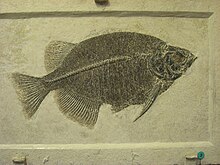
Phareodus testis
Phareodus testis
Nile heterotis
Notes
- ↑ a) Nelson D.S. Fishes of World Fauna / Transl. 4th rev. English ed. N. G. Bogutskaya, scientific. Ed. by A. M. Nasek, A. S. Gerd. - M .: LIBROCOM Book House, 2009. - S. 174. - ISBN 978-5-397-00675-0 .
b) The life of animals. Volume 4. Lancelet. Cyclostomes. Cartilaginous fish. Bone fish / ed. T. S. Rassa , ch. ed. V. E. Sokolov . - 2nd ed. - M .: Education, 1983 .-- S. 200 .-- 575 p.
c) Reshetnikov Yu.S. , Kotlyar A.N. , Russ T.S. , Shatunovsky M.I. Fish. Latin, Russian, English, German, French. / edited by Acad. V. E. Sokolova . - M .: Rus. Yaz., 1989 .-- S. 100 .-- 12,500 copies. - ISBN 5-200-00237-0 . - ↑ 1 2 The Paleobiology Database: Osteoglossidae
- ↑ FishBase: SpeciesList of Osteoglossidae
- ↑ Tyson R. Roberts (2012). " Scleropages inscriptus , a new fish species from the Tananthayi or Tenasserim River basin, Malay Peninsula of Myanmar (Osteoglossidae: Osteoglossiformes)." Aqua , 18 (2): 113-118. [1] (inaccessible link)
- ↑ The Paleobiology Database: Joffrichthys
Literature
- Nelson D.S. Fishes of World Fauna / Transl. 4th rev. English ed. N. G. Bogutskaya, scientific. Ed. by A. M. Nasek, A. S. Gerd. - M .: Book House "LIBROCOM", 2009. - S. 174-176. - ISBN 978-5-397-00675-0 .
- Life of animals. Volume 4. Lancelet, Cyclostomis, Cartilaginous fish, Bone fish / ed. T. S. Russ. - 2nd ed. - M .: Enlightenment, 1983. - S. 200-201. - 575 s.
Links
- The Aravanov family (English) in the World Register of Marine Species Osteoglossidae .