Clever Geek Handbook
📜 ⬆️ ⬇️

Stepanov's theorem

Stepanov's theorem is a generalization of Rademacher 's theorem on the differentiability of a Lipschitz function.

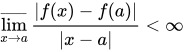
Suppose functionf {\ displaystyle f} f defined on an open setΩ {\ displaystyle \ Omega} \ Omega Euclidean spaceA⊂Ω {\ displaystyle A \ subset \ Omega} A \ subset \ Omega and

lim¯x→a⁡|f(x)-f(a)||x-a|<∞{\ displaystyle \ varlimsup _ {x \ to a} {\ frac {| f (x) -f (a) |} {| xa |}} <\ infty} {\ displaystyle \ varlimsup _ {x \ to a} {\ frac {| f (x) -f (a) |} {| x-a |}} <\ infty}

for alla∈A {\ displaystyle a \ in A} a \ in A . Thenf {\ displaystyle f} f differentiable almost everywhere inA {\ displaystyle A} A .

Proved by Stepanov [1] .


Literature

  • Federer G., Geometric theory of measure, 1987, p. 236, (Theorem 3.1.9)

Notes

  1. ↑ H. Stepanoff: Über totale Differenzierbaгkeit. Math. Ann. 90 (1923), 318-320.


Source - https://ru.wikipedia.org/w/index.php?title=Stepanov theorem&oldid = 83962265


More articles:

  • Whitewash
  • Navya-Nyaya
  • Wimbledon Women's Singles Tournament 2011
  • Central Bus Station (Chisinau)
  • Hey Mama
  • Grishin, Evgeny Borisovich
  • Vaal, Frans de
  • Borzova, Elena Petrovna
  • Portage Bridge
  • Shavlakadze, Robert Mikhailovich

All articles

Clever Geek | 2019