Celsus (also used Kels [1] [2] ) ( lat. Celsus ; Greek Kέλσος ; the name comes from lat. Celsus "elevated, high") - the Roman philosopher - Platonist of the second half of the II century ; one of the most famous ancient critics of Christianity . Friend of Emperor Marcus Aurelius . Known, above all, his work "True (or true) word" , written approx. 177-179 years and against early Christianity.
| Celsus | |
|---|---|
| Celsus | |
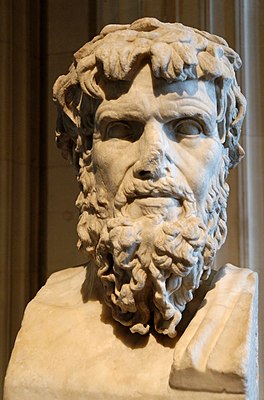 The head of a philosopher. The Louvre | |
| Date of Birth | |
| A country | |
| School / Tradition | platonism |
| Period | |
| Main interests | |
Content
Celsus
We can say practically nothing about the philosopher Celsus as a historical person. His name itself is known only from the book “Against Celsus” by Origen (“Contra Celsum”), in which he criticizes the attacks of Celsus from the point of view of a Christian theologian, a representative of early patristics. Origen mentions two philosophers who bore the name "Celsus", one of whom lived during the imp. Nero , the second - with Adriana .
Apparently, the book "The True Word" belongs to the second of those mentioned, and this assumption helps to identify it with Celsus, to whom Lucian devotes his satire "On the death of Peregrin."
We can say with sufficient confidence that he was an educated Roman or Greek, a philosopher and thinker who masterfully owned a pen, so that according to the same Origen, under the influence of Celsus, some of the Christians renounced their faith.
Origen considered him an epicurean - hiding his true views in the guise of adherence to Platonism . Modern researchers are inclined to believe that Celsus was more likely a Platonist philosopher, his “accusations” in epicureanism represent a polemical attack by Origen, designed to discredit the author of the “True Word” in the eyes of Christian readers. Despite the fact that, in the spirit of epicureanism, it is possible to interpret some of his statements (about the eternity of the world, about the negation of providence, about attitudes towards sorcery) - the rest Celsus manifests himself as a Platonic philosopher, but Platonism itself has changed quite a bit over the past centuries, becoming to some extent eclectic philosophy, which absorbed the achievements of many schools. It is also characteristic that by mentioning and quoting Plato in his work 28 times, Heraclitus 9, Pythagoras 7, Socrates 3, Epictetus 2, Empedocles 1, and without mentioning Epicurus .
In addition to philosophy, the author of The True Word was well acquainted with the historical and artistic literature of his time (in particular, only thanks to him were fragments from Heraclitus reached - I, 5; VII, 62; VI, 12; VI, 42; Empedocles - VIII, 53; Ferekid - VI, 42; comedies of an unknown author - VI, 78).
He probably traveled in Egypt , Syria and Palestine , and in Phenicia and Palestine (VII, 11), and in Egypt (VI, 41) he exposed charlatans and magicians. This last aspect may serve as additional evidence in favor of the identity of the author of the “True Word” and Celsus — Lucian’s friend — their views and interests coincided sufficiently. He knew well the contemporary Christian writings and books of the Old Testament , he was so well acquainted with the writings of Christian gnostics , that sometimes Origen became stalled (V, 62; VI, 27).
In addition to the “Truthful Word” under the name of Celsus, several books were known that criticized magic and sorcery, but Origen was not sure whether they belonged to the same author or his namesake. These books have not reached us.
Summary of the "True Word"
- God, without changing to the bad side, cannot approach man.
- Christian teaching is nothing original, it is rooted in Eastern mythology.
- The practice of Christian doctrine threatens the state.
Examples of the views of Celsus from the "True Word":
Like all screamers, they gather crowds of slaves, children, women, and onlookers. I write with bitterness, only because I myself am bitter. The masters inviting us in the Mysteries say otherwise. They say: come to us, those whose mouths and hands are clean, those who are not tainted with a crime, those whose conscience is clear before God, those who did justice and lived honestly. Christians say: Come, those who sinned, those who are children or fools, those who are unhappy and poor, and you will enter the kingdom of heaven. The fraudster, the thief, the villain, the poisoner, the defiler of temples and tombs are their converts.
The idea of the incarnation of God is simply absurd; Why do people consider themselves so much higher than bees, ants and elephants, that they put themselves in such a unique position to their creator? And why would God decide to come to people as a Jew? The Christian idea of divine providence is nonsense, an insult to the deity itself. Christians are like a host of frogs in a swamp or a synod of worms on a heap of dung, they croak and squeal: “For our sake the world was created!”
Jesus, they say, was sent to save sinners; wasn’t he sent to help those who kept themselves away from sin? They say that God will save a dishonest person if he repents and resigns himself, but he (God) doesn’t even look at an honest person who adheres to the virtues from the cradle.
Above all, Christians are not loyal and every church is an illegal college, an institution that is deadly at all times, especially under Marcus Aurelius. Why can't Christians associate themselves with the great philosophical and political leaders of the world? Properly placed worship of any gods and demons is perfectly combined with pure monotheism, they should abandon the crazy idea to turn all rulers to their faith or to achieve universal agreement on all divine things.
Celsus gives some arguments addressed to Christians allegedly "on behalf of the Jews": Jesus was born out of wedlock and grew up in Egyptian wisdom. His claims to the "Divine position" are refuted by his poverty and the unfortunate end of life. Christians are not confirmed in the Old Testament, and their talk about the coming, supposedly "open" to only some of their adherents, is nonsense. At the same time, Celsus writes that the Jews are almost as ridiculous as their enemies, whom they criticize: they believe that the Savior from heaven has already come, and these are still waiting for His coming, although the Jews have the advantage of an ancient nation with the ancient beliefs.
He speaks with disdain of the exorcists, "who themselves were clearly in the same league with demons," and an excessive number of undisciplined vagrants, calling themselves prophets, who wander through camps and cities, imposing themselves on their inhabitants.
For Celsus, it was preferable to believe that every corner of the world has its own deity, and the prophets and supernatural messengers appeared in different places instead of one. Besides the fact that Christianity is a bad philosophy and built on a fictitious history, it also does not deserve respect - Christian teachers are mostly weavers and shoemakers who do not have power over people with education.
Celsus urged Christians to overcome their isolationism from Roman society, not to evade service in the legions, especially in the border guards, since it became more difficult to restrain the onslaught of the Germans. He argued that the disobedience of Christians weakens the empire, and the new “Jewish” religion contradicts all traditional Roman values and splits society.
In his work, Celsus claimed that Jesus was the illegitimate son of a Roman soldier who served in Judea, called Panther [3] .
Works
- Celsus True word . (Published according to the book: A. Ranovich, “Original sources on the history of early Christianity. Ancient critics of Christianity”. M. 1990)
Notes
- ↑ For example, Chapter 2. Early Patristics (II — III cc.) // History of Philosophy: West-Russia-East / Ed. Motroshilov N.V. - M .: "Greek-Latin Cabinet", 2000. - T. 1. - 448 p. - ISBN 5-87245-047-8 .
- ↑ M.V. Belkin, O. Plakhotskaya. Dictionary "Antique writers." - SPb. : “Lan”, 1998.
- ↑ see the Works section
Literature
- Origen . Against Celsus .
- N. I. Lebedev. “The work of Origen against Celsus” ( M. , 1878);
- Lebedev N. I. “Celsus and Origen” (“Readings in the Society of Spiritual Lovers. Enlightenment”, 1879,);
- Smirnov E. "History of the Christian Church" (St. Petersburg, 1901);
- Tselz, philosopher // Encyclopedic dictionary of Brockhaus and Efron : in 86 tons (82 tons and 4 additional). - SPb. , 1890-1907.
- Keim, "Celsus Wahres Wort" (edition of the text in it. Translation, 1873);
- his own, Rom und das Christentum (1881);
- J. Müller , "Die Wahre Geschichte des Celsus" (in "Deutsche Rundschau", 1895).