Giordano Bruno ( Italian: Giordano Bruno ; nee Filippo Bruno [5] , nickname Bruno Nolanets ; 1548 , Nola near Naples - February 17, 1600 , Rome ) - Italian monk - Dominican , philosopher - pantheist and poet ; author of numerous treatises. He is recognized as an outstanding thinker of the Renaissance [6] and a great representative of esotericism [7] . Because of his penchant for reading essays considered by the Catholic Church to be suspicious, and because of doubts expressed about the transubstantiation and immaculate conception of the Virgin Mary , as well as his unorthodox approach to the interpretation of the Trinity , he incurred suspicions of heresy and was forced to leave the Dominican order (1576 ) and wandering around Europe: he lived in Switzerland, France, England and Germany [7] [8] . Returning to Italy (1592), he was arrested in Venice and extradited to the Inquisition Court in Rome. He refused to renounce his teachings and after seven years in prison was burned at the stake as a heretic and violator of a monastic vow [6] . In 1889, a monument was erected to him at the place of execution in Rome.
| Giordano Bruno | |
|---|---|
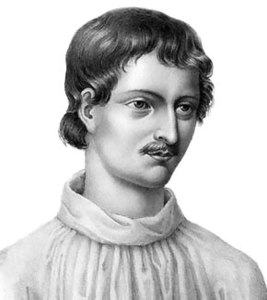 A modern copy of the engraving of the beginning of the 18th century | |
| Date of Birth | |
| Place of Birth | |
| Date of death | |
| Place of death | |
| A country | |
| Scientific field | and |
| Place of work | |
| Alma mater | |
| Known as | heliocentric , who put forward a series of revolutionary cosmological theories (about the infinity of the universe, about stars as distant suns, about the absence of celestial spheres), a victim of the Roman Inquisition |
One of the many accusations made against him is Bruno’s doctrine of the infinity of the universe and many worlds. Opponent of scholasticism and scholastic Aristotle , Bruno was influenced by the Elean , Platonic , and partly Epicurean ideas. His worldview is pantheistic: God and the universe are one and the same being ; the universe is infinite in space and time; it is perfect because God abides in it. The simple, indecomposable elements of everything that exists are monads ; they do not arise, do not disappear, but only connect and disconnect; these are metaphysical units, mental and at the same time material points. The soul is a special monad; God is the monad of monads [6] .
Bruno opposed the Aristotle-Ptolemaic system of world order, prevailing in his time, contrasting it with the Copernican system , which he expanded by drawing philosophical conclusions from it and pointing out such separate facts that are now recognized by science as undeniable: that the stars are distant suns , about the existence of celestial bodies unknown in his time within the limits of our Solar system , that there are countless bodies in the Universe similar to our Sun [6] . The glory of his work was promoted, first of all, by the German philosophers F. G. Jacobi (1785 [9] ) and Schelling (1802 [10] ) [8] .
Biography
The early years
Filippo Bruno was born in the family of a soldier Giovanni Bruno, in the town of Nola near Naples in 1548 . At age 11 he was brought to Naples to study literature , logic and dialectics . At the age of 15 he entered the monastery of St. Dominic (1563), where in 1565 he tonsured monks and received the name Giordano. Bruno dedicated his first work, Noah's Ark, to Pope Pius V during his visit to Rome in 1568 [7] .
In 1572, the 24-year-old Giordano became a Catholic priest. In Campaign , in the provincial city of the Kingdom of Naples , a young Dominican first served his Mass [11] .
In 1575, during a stay in the monastery of St. Dominica, Giordano incurred suspicions of reading forbidden books, in addition, he took out icons from his cell and left only a crucifix . The authorities had to start an investigation of his activities. Without waiting for the results, Bruno moved to Rome in 1576, but considering this place not safe enough, he moved to the north of Italy ( Genoa , Turin , Venice ), and then to Switzerland - to Geneva, where he became a Calvinist (1578) [7] . In 1579 he was enrolled in the University of Geneva , but at the debate he was again harassed by the charge of heresy - already from the Calvinists.
First French Period (1580-1583)
Having moved to Toulouse at the beginning of 1580, Bruno receives the scientific title of Magister artium [7] and for almost 2 years gives a philosophy course and public lectures on Aristotle's book “ On the Soul ” ( lat. De anima ) [8] .
In the summer of 1581, Bruno moved to Paris , where he became a teacher at the University of Sorbonne . Here Bruno publishes his first work on mnemonics (Shadows of Ideas; De umbris idearum ) and lectures on the book by Raimund Lullius “The Great Art: A Brief Discovery of Truth” ( lat. Ars magna: compendiosa inventendi veritam ; c. 1272) [8] . There, Bruno was noticed by King Henry III of France , who was present at one of his lectures, who were impressed by the knowledge and memory of Bruno. In 1582, Bruno dedicated the work “ Ars memoriae ” to Henry III and published other works, including the theatrical play “Candlestick” (in another translation “Neapolitan Street” [12] ; Italian: Candelaio ) [7] . The king invited Bruno to the court and provided him with peace and security for several years (until 1583), and later, when Bruno’s disputes with Aristotle’s supporters forced him to leave Paris [8] , he gave letters of recommendation for his trip to England. In 1583, Bruno went to London, where he remained for two years.
English period (1583-1585)
At first, the 35-year-old philosopher lived in London , under the auspices of the French envoy Michel de Châteauneuf de la Movisiera [8] , then in Oxford , but after a quarrel with local professors he again moved to London, where he published a number of works, among which one of the main ones is “ About infinity, the universe and worlds ”(1584). Other works of this period: "Feast on the Ashes" [13] [14] ; “The Exile of the Triumphant Beast” [15] , in which he mentions Egyptian beliefs; “The Kabbalah of the Pegasus horse” (or “ The Secret of Pegasus ”; 1585); " Killensky donkey "; “On Heroic Enthusiasm” [16] [17] and others.
In England, Giordano Bruno tried to convince senior officials of the Kingdom of Elizabeth that the ideas of Copernicus were true, according to which the Sun, not the Earth, is at the center of the planetary system. This was before Galileo generalized the doctrine of Copernicus. In England, he never managed to spread the simple Copernican system: neither Shakespeare nor Bacon succumbed to his efforts, but firmly followed the Aristotelian system , considering the Sun to be one of the planets orbiting the rest around the Earth. Only William Gilbert , a physician and physicist, took the Copernican system for truth and experimentally came to the conclusion that the Earth is a huge magnet . He determined that the Earth is controlled by the forces of magnetism in motion.
Return to the Continent (1585)
In October 1585, Bruno returned to Paris, where he gave a course of lectures on the Physics of Aristotle. In June 1586, Bruno moved to Germany, where he unsuccessfully sought work in Mainz and Wiesbaden . In Marburg , after enrolling in university staff, he was soon forbidden to lecture.
From there he moved to Wittenberg , where he received a more cordial welcome, and where he spent two years (1586-1588), giving lectures. Upon departure, Bruno gave a hot, commendable speech to Luther [8] .
In 1588, the 40-year-old Bruno moved to Prague , where his literary work focuses on works on the theme of magic , especially his work “ De magia naturali ”, where he has nine different forms of magic (1 / magic of the sages [18] ; 2 / medico - alchemical ; 3 / magic; 4 / natural; 5 / mathematical or occult ; 6 / demonic ; 7 / necromancy ; 8 / destructive and malicious ; 9 / prophetic ) [7] .
In 1589 he was already in Helmstedt , and in 1590 he came to Frankfurt , where he publishes his works and receives a substantial fee. However, in 1591, Bruno was forced to hastily leave Frankfurt.
Judgment and Execution (1592-1600)
In 1591, Bruno accepted an invitation from the young Venetian aristocrat Giovanni Mocenigo to teach the art of memory and moved to Venice . However, soon the relationship of Bruno and Mocenigo deteriorated. On May 23, 1592, Mocenigo sent his first denunciation to Bruno to the Inquisitor of Venice, in which he wrote: [19] [20]
I, Giovanni Mocenigo, report on duty of conscience and on the orders of the spiritual father that I heard many times from Giordano Bruno when I spoke with him in his house that the world is eternal and there are endless worlds ... that Christ performed imaginary miracles and was a magician , that Christ was dying not of his own free will and, as far as he could, tried to avoid death; that retribution for sins does not exist; that souls created by nature pass from one living being to another . He talked about his intention to become the founder of a new sect called "new philosophy." He said that the Virgin Mary could not give birth; monks disgrace the world; that they are all donkeys; that we have no evidence of whether our faith has merits before God.
On May 25 and 26, 1592, Mocenigo sent new denunciations to Bruno, after which the philosopher was arrested and imprisoned. On September 17, Rome received a demand from Venice to extradite Bruno for trial in Rome. The public influence of the accused, the number and nature of the heresies in which he was suspected, were so great that the Venetian Inquisition did not dare to end this process itself. According to A. Shtekli, the extradition of Bruno was the result of political relations between Venice and Rome, which entered into conflict on the problem of “fuorushiti” [21] .
February 27, 1593 Bruno was transported to Rome . He spent six years in Roman prisons, not agreeing to acknowledge his natural philosophical and metaphysical beliefs as a mistake. On January 20, 1600, Pope Clement VIII approved the decision of the congregation and decided to transfer Brother Giordano to the hands of secular authorities.
On February 9, the Inquisition Tribunal recognized Bruno as "an unrepentant, stubborn, and unyielding heretic ." Bruno was deprived of priesthood and excommunicated. He was transferred to the court of the governor of Rome, instructing to subject him to “punishment without shedding blood” [22] , which meant the requirement to be burned alive. In response to the verdict, Bruno told the judges: “You are likely to pronounce the verdict with great fear than I am listening to him,” and repeated several times: “Burning does not mean to refute!”
The death sentence that has reached us does not mention the heliocentric system and science in general [23] .
By a decision of a secular court, on February 17, 1600, Bruno was betrayed to be burned in Rome on the Square of Flowers ( Italian: Campo dei Fiori ). The executioners brought Bruno to the place of execution with a gag in his mouth, tied to a pole, which was in the center of the fire, with an iron chain and pulled it with a wet rope, which, under the influence of fire, pulled and crashed into the body. The last words of Bruno were: “ I die a martyr voluntarily and know that my soul will ascend to paradise with a last breath ” [19] .
All the works of Giordano Bruno were listed in the Catholic Index of Prohibited Books in 1603 and were in it until its last edition in 1948 .
Posthumous Recognition
On June 9, 1889, a monument was solemnly unveiled in Rome on the same square of Flowers, on which the Inquisition 289 years ago committed its execution. The opening ceremony turned into a noisy anti-papal demonstration [24] . The statue depicts Bruno at full height. At the bottom of the pedestal is the inscription: " Giordano Bruno - from the century that he foresaw, in the place where the fire was lit. "
On the 400th anniversary of Bruno’s death (2000), Cardinal Angelo Sodano called the execution of Bruno “a sad episode”, but, nevertheless, indicated the fidelity of the actions of the Inquisitors, who, according to him, “did everything possible to save his life” [ 25] . The head of the Roman Catholic Church also refused to consider the issue of his rehabilitation, considering the actions of the Inquisitors justified [26] [27] .
Views and Creativity
Philosophy
In his works, Bruno often referred to the name of Hermes Trismegistus . The concept of Bruno as a sealant and “Renaissance magician” is contained in the work of Francis Yates “Giordano Bruno and the Hermetic Tradition” (1964). In later studies, this thesis has been criticized [28] [ clarify ] , although a certain effect of hermeticism on Bruno is not negated.
Mnemonics
He wrote books on the mnemonic technique "On the shadows of ideas" (1584) and "Song of the Circe", which, according to researchers [ who? ] Bruno’s creativity, rooted in hermeticism .
Cosmology
Developing the heliocentric theory of Copernicus and the philosophy of Nikolai Kuzansky , Bruno expressed a number of guesses: about the absence of material celestial spheres, about the infinity of the Universe, that the stars are the distant suns around which the planets revolve, about the existence of planets unknown in his time within our Solar system . Responding to opponents of the heliocentric system, Bruno made a number of physical arguments in favor of the fact that the Earth’s movement does not affect the course of experiments on its surface [29] , refuting the arguments against the heliocentric system based on the Catholic interpretation of the Holy Scriptures [30] . In contrast to the opinions prevailing at that time, he considered comets to be celestial bodies, and not evaporations in the earth's atmosphere. Bruno rejected the medieval notions of the opposite between the Earth and the sky, asserting the physical homogeneity of the world (the doctrine of the 5 elements that make up all bodies - earth , water , fire , air and ether ). He suggested the possibility of life on other planets. In refuting the arguments of opponents of heliocentrism, Bruno used the theory of impetus .
In Bruno’s thinking, a mystical and natural science understanding of the world was bizarrely combined. According to some authors, the enthusiasm with which Giordano Bruno welcomed the discoveries of Copernicus was explained by his confidence that the heliocentric theory had a deep religious and magical meaning (during his stay in England, Bruno preached the need to return to the magical religion of Egypt in the form as described in the Asclepius treatise.). Copernicus Bruno calls "the dawn, which should precede the sunrise of true ancient philosophy" [31] .
So, the German philologist and historian of science L. Olszki writes in 1922: [32]
He lectured on the teachings of Copernicus throughout Europe, and in his hands Copernicanism became part of the Hermetic tradition ... Bruno turned mathematical synthesis into a religious teaching, viewed the universe in the same terms as Raimund Lullius , Ficino and Pico did, that is, as a magical universe . The philosopher's task was to use the invisible forces that permeate the universe, and Trismegistus held the key to these forces.
Other authors expressed the same opinions [33] [34] [35] .
Mircea Eliade believes that some sense of superiority of Giordano Bruno over Copernicus is caused by his conviction that the latter, as a mathematician, does not understand his own theory, while Bruno himself is able to decipher the scheme of Copernicus as a hieroglyph of divine secrets. [36] .
Confirmation of this opinion is sometimes seen in the words of Bruno himself: [31]
Nolan replied that he did not look with the eyes of Copernicus or Ptolemy, but with his own. These mathematicians are like intermediaries translating words from one language to another; but then others delve into the meaning, and not themselves. They are similar to those ordinary people who tell the absent commander about the form in which the battle took place and what its result was, but they themselves do not understand the cause, the reasons and the art, thanks to which these won ... To him (Copernicus) we obliged to free from some false assumptions of a common vulgar philosophy, if not to say, from blindness. However, he left not far from her, because, knowing mathematics more than nature, he could not go so deep and penetrate the latter as to destroy the roots of difficulties and false principles, than he completely resolved all the opposing difficulties, would save himself and others from many useless studies and would fix attention on the affairs of constant and definite.
A number of other science historians disagree with the hermetic nature of Bruno's cosmology. It is indicated that he supported purely physical arguments in support of the idea of the Earth’s motion [37] , used heliocentrism to explain the observed phenomena [38] , that his cosmology in many respects radically contradicts hermetic ideas [39] and is based not only on theological ones [40] ] , but also astronomical [38] and logical arguments [41] that Copernicanism did not at all become part of the Hermetic tradition [42] . According to this view, Bruno's heliocentrism was a physical, not a religious doctrine, although it was part of his general philosophical doctrine. These authors believe that Bruno’s claim to Copernicus was not due to the fact that he did not establish a connection between heliocentrism and hermetism, but that the Polish scientist did not understand that the heliocentric system implies the absence of the need for the sphere of fixed stars, and also left in his theory epicycles and deferents [43] . A number of arguments by proponents of a hermetic interpretation of cosmology have been criticized by Bruno in later studies [42] . The great influence of his ideas about the infinity of space and the relativity of motion on the further development of physics is indicated [44] .
Cosmological issues (mainly his doctrine of the multiplicity of worlds) were repeatedly discussed during the inquisition investigation over Bruno, especially towards the end of the process. Although the heliocentric system was not yet officially banned by the Inquisition during the process [45] , the Inquisition Tribunal pointed out to Bruno that the theory of the motion of the Earth contradicts a literal reading of the Holy Scriptures [46] . Существуют различные точки зрения на то, как повлияли космологические представления Бруно на ход инквизиционного следствия. Одни исследователи полагают, что они сыграли в нём незначительную роль, и обвинения шли в основном по вопросам церковного вероучения и теологическим вопросам [47] [48] , другие полагают, что непреклонность Бруно в некоторых из этих вопросов сыграла существенную роль в его осуждении [49] . В дошедшем до нас тексте приговора над Бруно указано, что ему инкриминируется восемь еретических положений, но приведено только одно положение [50] , содержание остальных семи не раскрыто. В настоящее время невозможно с исчерпывающей достоверностью установить содержание этих семи положений обвинительного приговора и ответить на вопрос, входили ли туда космологические воззрения Бруно.
Общая оценка места учения и роли Бруно
В отличие от Марселио Фичино , труды которого Бруно активно использовал, сам Бруно вышел далеко за рамки того «христианского герметизма », к которому тяготел Фичино.
Бруно стал ярким выразителем мятежного гуманистического духа эпохи Возрождения — одним из символически завершающих этот период ключевых деятелей:
Бруно, в рамках философии Возрождения, определенно наиболее сложный из философов. Отсюда различные толкования его учения. В настоящее время многие интерпретации его идей пересматриваются. Делать из него предтечу современного ученого эпохи научной революции смешно, ведь его интересы были иной природы (магико-религиозной и метафизической), отличной от той, на которой базировались идеи Коперника. Сомнительно, что Бруно понимал научный смысл этого учения. Невозможно выявить и математический аспект сочинений Бруно, потому что его математика — это пифагорейская аритмология, а следовательно, метафизика. Но Бруно удивительным образом предвосхищает некоторые положения Спинозы , и особенно — романтиков. Свойственное этим философам опьянение Богом и бесконечным уже присутствует в трудах Бруно. У Шеллинга (по крайней мере на одной из фаз его развития) мы увидим отдельные наиболее яркие черты сходства с нашим философом. Одно из самых прекрасных и волнующих сочинений Шеллинга носит название «Бруно». В целом творчество Бруно знаменует собой вершину Возрождения и в то же время эпилог этого неповторимого периода развития западной мысли. [51]
Literary work
Как поэт Бруно принадлежал к приверженцам литературного гуманизма . В своих художественных произведениях — антиклерикальной сатирической поэме «Ноев ковчег», философских сонетах , комедии «Подсвечник» ( 1582 , русский перевод 1940) — Бруно порывает с канонами «учёной комедии» и создаёт свободную драматическую форму, позволяющую реалистически изобразить быт и нравы неаполитанской улицы. Бруно высмеивает педантизм и суеверие , с едким сарказмом обрушивается на тупой и лицемерный аморализм, который принесла с собой католическая реакция.
List of works
- «О тенях идей» ( De umbris idearum ; Париж, 1582) — о проявлении Божественных идей в мире;
- «Искусство памяти» ( Ars memoriae ; 1582);
- «Песнь Цирцеи» ( Cantus Circaeus ; 1582) — о магическом преобразовании мира Цирцеей ;
- «О сокращённом построении и дополнении искусства Луллия» (De compendiosa architectura et complemento artis Lullii ; 1582) — об искусстве памяти Луллия ;
- театральная пьеса «Подсвечник», также «Светильник», или « Неаполитанская улица » ( Candelaio ; Париж, 1582);
- «Искусство запоминания», или «Искусство вспоминания» ( Ars reminiscendi ; 1583);
- «Изъяснение тридцати печатей» ( Explicatio triginta sigillorum ; 1583) — о запоминании при помощи особых символов;
- «Печать печатей» ( Sigillus sigillorum ; 1583) — о запоминании при помощи особых символов;
- «Пир на пепле», или «Великопостная вечеря» ( La cena de le ceneri ; 1584) — первый из шести итальянских философских диалогов Бруно;
- «О причине, начале и едином» ( De la causa, principio et uno ; 1584) — из пяти диалогов, предваряемых стихами «К своему духу», «К времени», «О любви», «Единое, начало и причина…»; 1-й диалог ; 2-й диалог ; 3-й диалог ; 4-й диалог ; 5-й диалог ;
- «О бесконечности, вселенной и мирах» ( De l'infinito, universo e mondi ; 1584) — вступительное письмо и пять диалогов ;
- «Изгнание торжествующего зверя» ( Spaccio de la bestia trionfante ; Лондон, 1584) — объяснительное письмо и три диалога ;
- «Тайна Пегаса», или «Каббала Пегаса» ( Cabala del cavallo pegaseo ; 1585) — вступительное письмо и три диалога ; рассказ-аллегория о перевоплощениях души и истории оккультного знания;
- «Килленский осёл» ( Asino Cillenico ; 1585) — русский текст ;
- сборник сонетов «О героическом энтузиазме» ( De gli eroici furori ; 1585) — 71 сонет, вступление, часть первая из пяти диалогов, часть вторая из пяти диалогов, рассуждения о пяти диалогах в первой части ;
- «Лекция по физике Аристотеля в образах» ( Figuratio Aristotelici Physici auditus ; 1585);
- «Два диалога» ( Dialogi duo de Fabricii Mordentis Salernitani ; 1586);
- «Торжествующий простак» ( Idiota triumphans ; 1586);
- «О толковании снов» ( De somni interpretatione ; 1586);
- «Поправки, касающиеся светильника Луллия » ( Animadversiones circa lampadem lullianam ; 1586);
- «Светильник тридцати статуй» ( Lampas triginta statuarum ; 1586) — пер. Горфункеля А. Х. — Философские науки , 1976, № 3;
- «Сто двадцать положений о природе и мире против перипатетиков» ( Centum et viginti articuli de natura et mundo adversus peripateticos ; 1586);
- «О комбинаторном светильнике Луллия » ( De lampade combinatoria Lulliana ; 1587);
- «О продвижении и охотничьем светильнике логики» ( De progressu et lampade venatoria logicorum ; 1587);
- «О естественной магии» ( De magia naturali ; Прага, 1588; русский перевод );
- «Прощальная речь» ( Oratio valedictoria ; 1588) — произнесённая в Виттенберге ;
- «Слушания в Камбре», или «Камераценский акротизм» ( Camoeracensis Acrotismus ; 1588);
- De specierum scrutinio (1588);
- «Тезисы против математиков», или «Сто шестьдесят тезисов против математиков и философов сего времени» ( Articuli centum et sexaginta adversus huius tempestatis mathematicos atque Philosophos ; Прага, 1588);
- «Утешительная речь» ( Oratio consolatoria ; 1589) — на смерть брауншвейгского курфюрста Юлия ;
- «О сцеплениях вообще», или «О связях вообще» ( De vinculis in genere ; 1591);
- «О трояком наименьшем и мере» ( De triplici minimo et mensura ; Франкфурт , 1591);
- «О монаде, числе и фигуре» ( De monade numero et figura ; Франкфурт, 1591);
- «О безмерном, неисчислимых и неизобразимых», или «О неизмеримом и неисчислимых» ( De innumerabilibus, immenso, et infigurabili ; Франкфурт, 1591);
- «О сочетании образов, знаков и идей» ( De imaginum, signorum et idearum compositione ; 1591) — об образной памяти (воображении);
- «Луллиева медицина» ( Medicina Lulliana ; 1591) — о медицинской магии;
- «Свод метафизических терминов» ( Summa terminorum metaphisicorum ; 1595).
- Изданные посмертно
- «Искусство речи», или «Искусство завершать речи» ( Artificium perorandi ; 1612);
- «Книга о „Физике“ Аристотеля» («Liber Physicorum Aristotelis»)
- Несохранившиеся
- «Ноев ковчег» ( L'Arca di Noè ; 1568)
- «О знамениях времени» ( Dei Segni dei tempi ; Венеция)
Editions in Russian
- Бруно Д. Изгнание торжествующего зверя. — СПб., 1914
- Бруно Дж. О причине, начале и едином. — М. : Соцэкгиз , 1934. — 232 с. - 7,000 copies.
- Бруно Д. Неаполитанская улица (Подсвечник); per. с сокр. Я. Емельянова, М.—Л., «Искусство», 1940
- Бруно Дж. Диалоги. — М. : Госполитиздат , 1949. — 552 с.
- Бруно Дж. О героическом энтузиазме / Пер. с итал. Я. Емельянова, Ю. Верховского, А. Эфроса. — М. : Художественная литература , 1953. — 212 с.
- Бруно Дж. Трактат Джордано Бруно «Светильник тридцати статуй» \ пер. Горфункеля А. Х. — Философские науки , 1976, № 3
- Бруно Д. Философские диалоги. - M., 2000
- Бруно Дж. Избранное / Пер. с ит., вступ. и прим. А. А. Золотарёва. — Самара: Агни, 2000. — 296 с. — ISBN 5-87931-010-8 .
На сегодняшний день единственным источником, из которого известна значительная доля сочинений Бруно, является «Московский кодекс», или «Кодекс Норова», названный так по имени крупного российского государственного деятеля и библиофила А. С. Норова , который приобрёл рукопись для своей коллекции [52] и впоследствии передал её Румянцевскому музею . Он сохранил до наших дней бесценные автографические наброски и труды философа. Только в самое недавнее время тщательное научное исследование московской рукописи было, наконец, положено в основу выходящего в авторитетном парижском издательстве «Les Belles Lettres» полного собрания сочинений Бруно [53] .
Культурное влияние Бруно
Джордано долгое время жил и работал в Лондоне , а также два года трудился наборщиком в Оксфорде и мог общаться с людьми, близкими к У. Шекспиру , или же с самим драматургом. Это нашло отражение в двух произведениях последнего: « Буря » (речи Просперо) и « Бесплодные усилия любви ».
Джек Линдсей в романе «Адам нового мира» ( Adam of a New World ) (1936, русский перевод 1940) и Александр Волков в романе «Скитания» (1963) описали жизнь Д. Бруно.
Бруно посвящён ряд музыкальных произведений, в частности, песня «Еретик» группы « Легион ».
О Бруно в Италии снят фильм «Джордано Бруно» ( Giordano Bruno , 1973 ), а в СССР ( Киевской киностудией ) в 1955 году — фильм «Костёр бессмертия» (в роли Джордано Бруно — Владимир Дружников ).
В 1988 году композитор Лора Квинт написала рок-оперу « Джордано ». В главной роли — Валерий Леонтьев .
В 2013 году канадская панк-группа Crusades выпустила альбом «Perhaps You Deliver this Judgment with Greater Fear than I Receive It», посвящённый жизни Джордано Бруно, с его изображением на обложке [54] .
В честь Джордано Бруно был назван один из лунных кратеров .
Поэт Иван Бунин посвятил Джордано Бруно одноимённое стихотворение.
See also
- Аристарх Самосский
- Nikolai Copernicus
- Галилео Галилей
- Николай Кузанский
Notes
- ↑ BNF ID : 2011 Open Data Platform .
- ↑ 1 2 3 AA.VV. Dizionario Biografico degli Italiani - 1960.
- ↑ 1 2 3 Bruno // Dictionnaire infernal (6e éd.) - 6 - Plon , 1863.
- ↑ German National Library , Berlin State Library , Bavarian State Library , etc. Record # 118516221 // General regulatory control (GND) - 2012—2016.
- ↑ before being tonsured a monk at the age of 17
- ↑ 1 2 3 4 Bruno // Small Encyclopedic Dictionary of Brockhaus and Efron : in 4 volumes - St. Petersburg. 1907-1909.
- ↑ 1 2 3 4 5 6 7 Sébastien Landemont. Les grandes figures de l'ésotérisme - Leur histoire, leur personnalité, leurs influences. - Paris: De Vecchi, 2005 .-- S. 15 .-- 100 p. - ISBN 2-7328-8238-0 .
- ↑ 1 2 3 4 5 6 7 Bruno, Giordano // Encyclopedic Dictionary of Brockhaus and Efron : 86 volumes (82 volumes and 4 additional). - SPb. , 1890-1907.
- ↑ "Briefen über die Lehre des Spinoza"; Bresl., 1785; 1789
- ↑ Essay “Bruno. Ein Gespräch »
- ↑ Giordano Bruno (1548–1600)
- ↑ The play was first translated by J. Emelyanov with abbreviations: Giordano Bruno. "Neapolitan Street" ("Candlestick"), M. - L., "Art", 1940
- ↑ La cena de le Ceneri (Feast on Ashes), the first of six Italian philosophical dialogues by Giordano Bruno, first published in London in 1584. Neither the place of publication nor the publisher is indicated on the title page, but scholars agree that the book was printed in the London workshop of John Charlywood. The book is divided into five dialogues, which are preceded by an opening letter. It sets forth a new conception of the heliocentric theory of Copernicus, which goes beyond the theory of the latter, but at the same time includes the fact that the Universe is finite and consists of the sphere of fixed stars. Bruno argued that the infinite and homogeneous Universe (both spatially and materially), without a center, includes an infinite number of worlds and countless solar systems.
- ↑ Russian text
- ↑ The exile of the triumphant beast proposed by Jupiter, carried out by the Council, proclaimed by Mercury, narrated by Sophia, heard by Saulin, recorded by Nolan; in three dialogues, divided into three parts
- ↑ "On Heroic Enthusiasm / De gli eroici furori. The entire work consists of 71 sonnets. Their content - lyrical and partly mystical - is explained in the following dialogs." For Bruno, the term “heroic” was used in the original sense of the word “hero” : the hero of Greek myths is a demigod man; he has superhuman abilities and the gods favor him; he is close to the gods and after death can take his place among them. So Brunovsky is enthusiastic because he is already on the path to absolute truth, the highest good to him and his first beauty, bringing himself closer to God with his conscious effort. In the original, Bruno’s treatise literally means “On heroic frenzy (delight).” Just in love and passionate about bodily beauty can also be enthusiastic and in fury; and Bruno points to such a state sensually in love, however, a passionate person with divine knowledge has a different kind of fury, enthusiasm is heroic fury, heroic enthusiasm, divine inspiration. Fury and enthusiasm are equally inherent in the sensually in love and divinely inspired (God-loving). Enthusiasm is inherent only to the latter. This treatise of Bruno is about man overcoming himself, about spiritual exaltation and rebirth. ”/ Huseynov A. A., History of ethical teachings, M.,“ Gardariki ”, 2003, p. 562-563.
- ↑ Nolan’s discourse on heroic enthusiasm written for highly acclaimed Signor Philip Sydney
- ↑ Bruno indicates which sages - Egyptian "Trismegists", Gallic "Druids", Indian "Gymnosophists", Jewish "Kabbalists", Persian "magicians", Greek "sophists" and Latin "wise men".
- ↑ 1 2 Grigulevich, 1985 .
- ↑ Gorfunkel, 1958 .
- ↑ A. Shtekli. Giordano Bruno M.: Young Guard, 1964. - p. 340-343.
- ↑ Antonovsky, 1892 .
- ↑ Hakobyan O., Munipov A. Why did they burn Gordano Bruno for? . Arzamas (November 5, 2015).
- ↑ Bruno, Giordano // Orthodox Theological Encyclopedia . - Petrograd, 1900-1911.
- ↑ Seife, Charles, “Vatican Regrets Burning Cosmologist”, in ScienceNOW, March 1st, 2000
- ↑ “Pope John Paul spoke Russian to me. He told me that my proposal for the rehabilitation of Giordano Bruno could not be accepted, because Bruno, unlike Galileo, was condemned for the incorrect theological assertion that his teaching on the multiplicity of inhabited worlds does not contradict the Holy Scriptures. “Here, they say, find the aliens - then Bruno’s theory will be confirmed and the issue of rehabilitation can be discussed.” Andrey Vaganov The history of jazz - instead of a course in algebra . Interview with Academician Vladimir Arnold // Nezavisimaya Gazeta , 2001-12-27
- ↑ “V. GINZBURG: they didn’t rehabilitate Giordano Bruno, so to speak, because ... ” Svetlana Sorokina Live broadcast of the Echo of Moscow radio station . Interview with Academician Vitaly Ginzburg // Echo of Moscow , January 15, 2006
- ↑ Westman 1977; McMullin 1987; Gatti 1985, 1999, 2002a, b.
- ↑ Massa 1973.
- ↑ Westman 1986.
- ↑ 1 2 Bruno J. Pierce on the Ashes, I.
- ↑ Olshki L. History of scientific literature in new languages. T.3. M.-L. 1933, ss 13-45
- ↑ Kissel, 1997 .
- ↑ Kearney H. Science and Change. 1500-1700. New-York-Toronto, 1971, p. 106
- ↑ Lawrence S. Lerner, Edward A. Gosselin, Galileo and the ghost of Giordano Bruno (inaccessible link) , “ In the world of science ” (Russian translation of “ Scientific American ”). - No. 1. - 1987
- ↑ Eliade M. History of faith and religious ideas . T.3, Ch. Xxxviii
- ↑ Kuznetsov 1970.
- ↑ 1 2 Gatti 1999, 2005.
- ↑ Ibid.
- ↑ Lovejoy 2001.
- ↑ Vizgin 1988.
- ↑ 1 2 Westman 1977; McMullin 1987.
- ↑ Gatti 1999, chapters 4 & 6.
- ↑ Koyre 1943; Kuznetsov 1970.
- ↑ This ban took place in 1616, 16 years after the execution of Bruno.
- ↑ Summary of the investigation of Giordano Bruno .
- ↑ See Michel, Paul Henri. The Cosmology of Giordano Bruno. Translated by REW Maddison. Paris: Hermann; London: Methuen; Ithaca, New York: Cornell, 1962; Birx, Jams H .. "Giordano Bruno". The Harbinger, Mobile, AL, November 11, 1997 .; Turner, William. "Giordano Bruno". // The Catholic Encyclopedia . Vol. 3. New York: Robert Appleton Company, 1908. Jan 13. 2009; Archived copy (inaccessible link) . Date of treatment September 21, 2010. Archived March 19, 2009. ; and http://www.pantheism.net/paul/brunphil.htm
- ↑ Sheila Rabin, “Nicolaus Copernicus” // Stanford Encyclopedia of Philosophy (accessed November 19, 2005, http://plato.stanford.edu/entries/copernicus ), also: Frances Yates, Giordano Bruno and the Hermetic Tradition, Routledge and Kegan Paul, 1964, p450; Adam Frank, The Constant Fire: Beyond the Science vs. Religion Debate, University of California Press , 2009, p24; Blumenberg, H., 1987, The Genesis of the Copernican World, trans. RM Wallace, Cambridge, MA: MIT Press , part 3, chapter 5, titled “Not a Martyr for Copernicanism: Giordano Bruno”).
- ↑ Menzin 1994; Fantoli 1999; Finocchiaro 2002.
- ↑ "was brought to trial in the holy service of Venice for declaring: the greatest blasphemy to say that bread was transformed into the body"
- ↑ D. Antiseri and J. Reale. Western philosophy from the origins to the present day. From the Renaissance to Kant - St. Petersburg, "Pneuma", 2002, 880 s, ill.; p. 79
- ↑ The collection of A. S. Norov (14000 tons, then another 2000) is distinguished by a good selection of scientific publications of the 18th – 19th centuries. It included publications from Greek and Roman writers, the works of Machiavelli, Russian scientific monographs of the first. floor. XIX century Of exceptional value is the one-of-a-kind collection (18 of 26 books) of lifetime editions of the works of Giordano Bruno autographed on one of the books, as well as J. Bruno's own handwritten notebook - “Moscow Codex” (at the location). Norov’s collection contains 155 incunabulae, including the illustrated edition of the Divine Comedy by Dante (Florence, 1481), a rich collection of Elsevirs. In 1867, A. S. Norov handed over to the Museum Library three copies of the “Journey of Hegumen Daniel” published in his Russian language and two copies in French. http://www.rsl.ru/en/s6/s43/d1290/ Archived December 2, 2010 on the Wayback Machine
- ↑ “Program of the International Scientific Conference“ Giordano Bruno in the Context of Russian and World Culture ”and related events”, September 28–30, 2010, Moscow // Institute of Philosophy of the Russian Academy of Sciences
- ↑ Perhaps You Deliver this Judgment with Greater Fear than I Receive It
Literature
- In Russian
- Giordano Bruno // Avadyaeva E.N. , Zdanovich L.I. 100 Great Executions. - M .: Veche , 2000 .-- 171-176 p.
- Antonovsky Yu. M. Giordano Bruno: his life and philosophical activity: biogr. essay: from portr. Giordano Bruno engraved in Leipzig Gedan . - SPb. : Type of. T-va "Public good", 1892. - 80 p. - (The life of wonderful people: F. Pavlenkov's Biographical Library).
- Veselovsky A.N. Giordano Bruno. Biographical sketch // A. Veselovsky. Selected Articles / Under the General Ed. M. P. Alekseev , V. A. Desnitsky , V. M. Zhirmunsky and A. A. Smirnov; Entry article by V. M. Zhirmunsky; Comments by M.P. Alekseev; Inst. Lit. Acad. sciences of the USSR. - L .: Goslitizdat , 1939.
- Vizgin V.P. The Idea of Multiple Worlds: Essays on History / Otv. ed. I. D. Rozhansky . - 2nd, rev. and additional .. - M .: Publishing house LCI, 1988. - 336 p. - ISBN 978-5-382-00195-1 .
- Vizgin V.P. Philosophical and religious sources of science / Auth. collective: P.P. Gaidenko (editor-in-chief), V.P. Vizgin , V.N. Katasonov , M.A. Kissel , L.A. Markova , A.N. Pavlenko , Yu. A. Shichalin . - M .: Martis, IF RAS , 1997. - S. 88-141. - 319 p. - ISBN 5-7248-0045-4 .
- Gaidenko P.P. Christianity and the Genesis of New European Natural Sciences // Philosophical and Religious Origins of Science / Auth. collective: P.P. Gaidenko (editor-in-chief), V.P. Vizgin , V.N. Katasonov , M.A. Kissel , L.A. Markova , A.N. Pavlenko , Yu. A. Shichalin . - M .: Martis, IF RAS , 1997. - S. 44–87. - 319 p. - ISBN 5-7248-0045-4 .
- Gaidenko P. P. Giordano Bruno and the Infinite Universe // P. P. Gaidenko "History of New European Philosophy in its Connection with Science"
- Gorfunkel A. Kh. Giordano Bruno before the court of the Inquisition (Summary of the investigation of Giordano Bruno) // Problems of the History of Religion and Atheism . - 1958. - S. 349-416 .
- Gorfunkel A.H. Giordano Bruno: biography of an individual. - M .: Thought , 1973. - 175 p. - ( Thinkers of the past ).
- Gorfunkel A. Kh. Philosophy of the Renaissance . - M .: Higher school , 1980 .-- 368 p.
- Grigulevich I.R. Inquisition . - 3rd ed. - M .: Politizdat , 1985 .-- 448 p.
- Grotto N. Ya. J. Bruno and Pantheism // Notes of Novorossiysk University . - 1885. - T. 41 .
- Giordano Bruno and the Inquisition. Protocols of the process of Giordano Bruno in the Venetian Inquisition // Questions of religion and atheism . - 1950 .-- T. 1 . - S. 325-419 .
- Melon M.A. Worldview of Giordano Bruno // Bruno J. Dialogues. - M .: Gospolitizdat , 1949. - S. 5-40. - 552 s.
- Eremeeva A.I. Giordano Bruno (on the 450th birthday) // Earth and Universe . - 1998. - No. 6 . - S. 28-36 .
- Yates F. Giordano Bruno and Hermetic Tradition = Giordano Bruno and the hermetic tradition. - M .: New Literary Review , 2000. - 528 p. - ISBN 5-86793-084-X .
- Yeats F. The Art of Memory = The Art of Memory. - SPb. : University Book, 1997. - 479 p.
- Karsavin L.P. Giordano Bruno. - SPb. : Nauka , 2016. - (A Word about Existence; vol. 115). - ISBN 978-5-02-038430-9 .
- Kissel M. A. Christian metaphysics as a factor in the formation and progress of modern science // Philosophical and religious sources of science / Auth. collective: P.P. Gaidenko (editor-in-chief), V.P. Vizgin , V.N. Katasonov , M.A. Kissel, L.A. Markova , A.N. Pavlenko , Yu. A. Shichalin . - M .: Martis, IF RAS , 1997. - S. 265-318. - 319 p. - ISBN 5-7248-0045-4 .
- Koyre A. From the closed world to the infinite universe / Transl. from English K. Golubovich, O. Zaitseva, V. Strelkova. - M .: Logos, 2001 .-- 288 p. - (Sigma). - ISBN 5-8163-0028-8 . In English: The New Astronomy and the New Metaphysics (chapter from a book on cosmology by Giorgiano Bruno)
- Kolchinsky I.G. , Korsun A.A., Rodriguez M.G. Astronomers: A Biographical Reference. - 2nd ed., Revised. and additional .. - K .: Naukova Dumka , 1986. - 512 p.
- Korobkov A.A. Giordano Bruno // Orthodox Encyclopedia . - M .: Church Scientific Center "Orthodox Encyclopedia" , 2003. - V. VI. - S. 269-273. - 752 s. - 39,000 copies. - ISBN 5-89572-010-2 .
- Kuznetsov B.G. Giordano Bruno and the Genesis of Classical Science . - M .: Science , USSR Academy of Sciences IIET , 1970 .-- 212 p.
- Kuznetsov B.G. Giordano Bruno and modernity // Earth and Universe . - 1975. - No. 5 . - S. 18-25 .
- Lovejoy A.O. The Great Chain of Being = The Great Chain of Being: A Study of The History of An Idea / Per. from English V. Sofronova-Antomoni. - M .: House of Intellectual Books, 2001. - 376 p. - ISBN 5-7333-0239-9 .
- Levitan E. For which they burned Giordano Bruno
- Lerner L., Gosselin E. Galileo and the ghost of Giordano Bruno (inaccessible link)
- Losev A.F. Aesthetics of the Renaissance . - M .: Thought , 1978.- 624 p.
- Mentsin Yu. L. “Earthly chauvinism” and the star worlds of Giordano Bruno // Problems of the History of Natural Science and Technology . - 1994. - No. 1 .
- Olshki L. History of scientific literature in new languages = Geschichte der neusprachlichen wissenschaftlichen literatur: Die literatur der technik und der angewandten wissenschaften vom mIttelalter bis zur renaissance / Transl. from the German F. A. Kogan-Bernstein and P. S. Yushkevich . Foreword S.F. Vasiliev. - M. — L .: Gostekhizdat , 1933. - T. 1. Literature of technology and applied sciences from the Middle Ages to the Renaissance.
- Ordin N. The border of the shadow. Literature, philosophy and painting by Giordano Bruno / Per. with ital. A.A. Rossius . - SPb. , 2008 .-- 407 p.
- Pavlenko A. N. Anthropic principle: sources and consequences in European scientific rationality // Philosophical and religious sources of science / Auth. collective: P.P. Gaidenko (editor-in-chief), V.P. Vizgin , V.N. Katasonov , M.A. Kissel, L.A. Markova , A.N. Pavlenko , Yu. A. Shichalin . - M .: Martis, IPh RAS , 1997. - S. 178–218. - 319 p. - ISBN 5-7248-0045-4 .
- Rassadin M.V. Giordano Bruno. Hermetic tradition and Renaissance magic
- V.S. Rozhitsyn . Giordano Bruno and the Inquisition. - M .: Publishing House of the Academy of Sciences of the USSR , 1955. - 384 p.
- Fantoli A. Galilei: in defense of the teachings of Copernicus and the dignity of the Holy Church. - M .: MIK, 1999 .-- 423 p.
- Hramov Yu. A. Bruno Giordano // Physicists: Biographical Reference / Ed. A.I. Akhiezer . - Ed. 2nd, rev. and add. - M .: Nauka , 1983 .-- S. 47 .-- 400 p. - 200,000 copies. (in per.)
- Chanyshev A.N. Giordano Bruno. On the 500th birthday // Common sense . 2003. No. 4 (29).
- Shtekli A.E. Giordano Bruno . - M .: Young Guard , 1964 .-- 384 p. - The life of wonderful people ex.
- Eliade M. History of faith and religious ideas. Volume III From Mohammed to the Reformation = Histoire des croyances et des idees religieuses. Tome III. De Mahomet a l'age des Reformes / Translated by N. B. Abalakova, S. G. Balashova, A. D. Davydov, HH Kulakova and AA Starostina. - M .: Criterion, 2002.
- In other languages
- Adam Frank , The Constant Fire: Beyond the Science vs. Religion Debate. - University of California Press , 2009
- Blumenberg, H. , 1987, The Genesis of the Copernican World, trans. RM Wallace. - Cambridge, MA: MIT Press
- Birx, Jams H. "Giordano Bruno". The Harbinger, Mobile, AL, November 11, 1997
- Corsano A. Il pensiero di G. Bruno nel suo svolgimento storico. - Firenze, 1940
- Die Frankfurter Schriften Giordano Brunos und ihre Voraussetzungen / hrsg. Von Klaus Heipcke, Wolfgang Neuser und Erhard Wicke. VCH, Acta Humaniora, Weinheim 1991. ISBN 3-527-17760-4
- Finocchiaro MA Philosophy versus Religion and Science versus Religion: The Trials of Bruno and Galileo // In: Giordano Bruno: Philosopher of the Renaissance, ed. Hilary Gatti. - Ashgate: Aldershot (England), 2002 .-- P. 51-96.
- Gatti H. Minimum and Maximum, Finite and Infinite Bruno and the Northumberland Circle // Journal of the Warburg and Courtauld Institutes, V. 48, pp. 144-163, 1985.
- Gatti H. Giordano Bruno and Renaissance Science. - Cornell Univercity Press , 1999.
- Gatti H. Frances Yates's Hermetic Renaissance in the Documents Held in the Warburg Institute Archive // Aries: Journal for the Study of Western Esotericism. V., No. 2. pp. 193-210, 2002a.
- Gatti H. The Natural Philosophy of Giordano Bruno // Midwest Studies In Philosophy, V. 26, Issue 1, pages 111-123, 2002b.
- Gatti H. Giordano Bruno's Copernican Diagrams // Filozofski Vestnik, V. XXV, No. 2, pp. 25-50, 2004 Online
- Giusso L. Scienza e filosofia in G. Bruno. - Napoli, 1955
- Guzzi A. Giordano Bruno. - Torino, 1960.
- Hollister W. Giordano Bruno and the Infinite Universe
- Kearney H. Science and Change. 1500-1700. - New-York-Toronto, 1971
- Massa D. , Giordano Bruno and the top-sail experiment // Annals of Science, Volume 30, Issue 2, pp. 201-211 (11), 1973.
- Michel PH The Cosmology of Giordano Bruno. Translated by REW Maddison. - Paris: Hermann; London: Methuen; Ithaca, New York: Cornell, 1962
- Kessler J. Giordano Bruno: The Forgotten Philosopher
- Koyre A. , Galileo and the Scientific Revolution of the Seventeenth Century // The Philosophical Review, V. 52, No. 4., pp. 333—348, 1943.
- McMullin E. , Bruno and Copernicus // Isis, V. 78, 1987.
- Michel PH La cosmologie de G. Bruno. - P., 1962.
- Pogge RW The Folly of Giordano Bruno
- Rossi P. Clavis Universalis: Arti mnemoniche e logica combinatoria da Lullo a Leibniz. - Mil., 1960.
- Rabin S. "Nicolaus Copernicus" // Stanford Encyclopedia of Philosophy (accessed November 19, 2005)
- Singer DW Giordano Bruno: His life and thought
- Spampanato V. Vita di G. Bruno. - Bari, 1927
- Turner, William . "Giordano Bruno" // The Catholic Encyclopedia. Vol. 3. - New York: Robert Appleton Company, 1908
- Walker DP Spiritual and Demonic Magic from Ficino to Campanella. - L., 1958
- Westman RS , Magical Reform and Astronomical Reform: the Yates Thesis Reconsidered, in Hermeticism and the Scientific Revolution. - University of California Press, Los Angeles 1977.
- Westman RS , The Copernicans and the Churches, God and Nature: Historical Essays on the Encounter between Christianity and Science, ed. by DC Lindberg and RL Numbers, p. 76-113, Berkeley: University of California Press , 1986.
- Yates FA Collected Essays: Lull and Bruno. - L., 1982. Vol. one.
Links
- Giordano Bruno - article from the Stanford Philosophical Encyclopedia
- Giordano Bruno in the Open Directory Project (dmoz) Link Directory
- Bruno Giordano in the Open Directory Project (dmoz) link directory (ital.)