Mehmed Murad V. Sultan Abdul-Majid I.
| Mehmed Murad V | |||||||
|---|---|---|---|---|---|---|---|
| tour. Mehmed V. Murad | |||||||
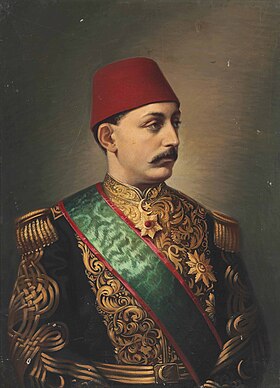 Portrait of Murad V by an unknown artist, second half of the 19th century | |||||||
| |||||||
| Coronation | not crowned | ||||||
| Predecessor | Abdul Aziz | ||||||
| Successor | Abdul Hamid II | ||||||
| Birth | September 21/22, 1840 Chiragan , Istanbul , Ottoman Empire | ||||||
| Death | August 29, 1904 Chiragan, Istanbul , Ottoman Empire | ||||||
| Burial place | Murad V Mausoleum , New Mosque , Istanbul | ||||||
| Kind | Ottomans | ||||||
| Father | Abdul-Majid I | ||||||
| Mother | Shevkefza Sultan | ||||||
| Spouse | Eleru Kadin-effendi , Reftarydil Kadin-effendi , Shayan Kadin-effendi , Mailiservet Kadin-effendi and others | ||||||
| Children | Mehmed Selahaddin Effendi Suleiman Effendi Hatice Sultan Seyfettin Effendi Fehime Sultan Fatma Sultan Alie Sultan | ||||||
| Religion | Sunni Islam | ||||||
| Monogram |  | ||||||

During the reign of his uncle, Abdul-Aziz, Murad was considered by the Ottoman liberals as the most acceptable successor to the Sultan. In the last years of the reign of Abdul-Aziz, the heir came under suspicion of participating in a conspiracy against the Sultan. Murad was placed under constant surveillance and, fearing to be killed, became addicted to alcohol and began to suffer from a mental disorder. In 1876, the conspirators elevated Murad to the throne, but the subsequent assassination of the displaced Abdul-Aziz led to the final deterioration of the mental health of Murad V. He was removed by his own brother Abdul-Hamid II only ninety-three days after accession to the throne, and did not go through the ceremony by the sword . The former sultan with his family was placed in the palace of Chiragan , where he spent almost twenty-eight years. Although attempts were made to release him, Murad himself preferred to remain in custody. He died in Chiragan from diabetes in 1904.
Content
Biography
The early years
Mehmed Murad was born on September 21 (according to other sources, 22 [2] ) September 1840 [3] [4] in the Chiragan Sultan's Palace in Istanbul [5] and was the eldest son of Sultan Abdul-Majid I ; the heir’s mother was the second [6] wife of Abdul-Mejid - a Circassian [7] [8] Shevkefza [2] . Despite the presence of numerous brothers and sisters, Murad had only one full sister - Aliye, who died before reaching the age of two years [9] ; Murad will later name his youngest daughter in memory of his sister. Murad received a good education: he studied the native language, as well as Arabic and French, Ottoman history, natural sciences [2] and philosophy; at an early age, the heir became interested in drawing and music [4] , two Italians were assigned to him, who taught the boy to play the piano and western music [2] .
At the age of twenty, on February 2, 1861, Murad became a father for the first time - his second wife, Reftarydil, gave birth to a son, Mehmed Selahaddin [1] . Five months later, Murad's father, Sultan Abdul-Majid I, died of tuberculosis. According to the laws of the Ottoman Empire, the throne was inherited by a senior member of the male Ottoman dynasty; thus, the uncle Murad Abdul-Aziz became the new sultan. Murad himself was named the heir to the Sultan. In contrast to the new sultan, Murad surrounded himself with intellectuals - both visiting Europeans and Ottomans, who were looking for ways to strengthen the state [4] . The main residence of the heir became a villa in , Kadikoy [2] .
As the heir to Abdul-Aziz Murad, together with the Sultan paid an official visit to Egypt in 1863 and Europe in 1867 [2] . While in London, Murad became close to the heir to the British throne, Edward, Prince of Wales ; This rapprochement probably occurred on the basis of Freemasonry [4] , to which, in the opinion of Gorad Murad Filizten-hanym [10] , both heirs belonged. Murad, influenced by the Greek family of Freemasons Scalleri and Midhat Pasha , was inspired by progressive liberal ideas and, with their assistance, joined in 1872 (the author of the article on Murad V in the Islamic Encyclopedia, Jevdet Kuciuc, indicates the exact date of entry on October 23, 1872 [ 11] ) to the Greek-speaking bed of Constantinople, managed by the Masonic organization " Great East of France " [12] ; Avakyan, author of the article “Freemasonry in the ranks of Ittihad ve Terakki ”, published in the Armenian academic journal “ ”, indicates that “Sultan Murad V deposed in 1876 had the title of master of chair ” [13] .
In the early 1870s, Murad completely disengaged from the autocratic rule of his uncle. Unfortunately, as noted by the Murad brothers, around the same time, the future sultan became addicted to alcohol [4] . During his youth, Murad’s freedom was not restricted, and he showed signs that he could become a good ruler. In this regard, many liberal politicians of the country, such as Midhat Pasha, had high hopes for the heir [14] . Moreover, by this moment the empire had immediately faced several difficulties (Kandy rebellion, loss of Belgrade and others), which the Sultan was not interested in [2] . However, in the last years of the reign of Abdul-Aziz Murad came under suspicion of participating in a conspiracy to overthrow the Sultan, which was supported by the Great Powers. Suspicions were not unfounded: Murad was closely acquainted with Namyk Kemal and other participants in the young movement " New Ottomans " [14] , with whom the heir contacted through his personal doctor Kapoleon-effendi [2] . In addition, he was probably initiated into the plans of the conspirators by Midhat Pasha [15] . Be that as it may, the heir was under vigilant surveillance and began to seriously fear for his life, which led to addiction to alcohol and nervous attacks [14] .
Board
On May 10, 1876, the conspirators, led by former and future great vizier Mutherjim Mehmed Rushdi Pasha , Minister of War Hussein Avni Pasha , Sheikh ul-Islam and the Minister without a portfolio of Midhat Pasha , began to act. On May 12, conspirators convened a council that ruled that Abdul-Aziz was no longer able to occupy the sultan throne. Murad not only knew what was happening, but also approved the displacement of his uncle [15] . On the night of May 29-30 [4] Abdul-Aziz was blocked in the Dolmabahce Palace - all entrances and exits were blocked - and was completely cut off from the outside world. Immediately after this, a battalion formed of cadets of the military academy, under the command of Nazyra Suleiman Pasha, went to the heir’s villa to bring Murad to the Sultan’s palace [15] .
Murad, who did not know that the battalion was called upon to guard him, fearing that the conspiracy had failed and could be arrested, refused to let them into the villa. Only by contacting Hussein Avni, Murad left the villa on a carriage. On the way, during a thunderstorm and heavy rain, Murad changed his carriage several times to avoid provocations. Then, by sea (the heir was also transferred several times to different boats) Murad arrived at Beyazit Square , from where he was delivered by carriage to the gates of Serasker. Here, the great vizier, sheikh-ul-Islam and other dignitaries awaiting Murad, swore allegiance to him as a new sultan. At the same time, fatwa was read to Abdul-Aziz, on the basis of which he was displaced; the fatwa said that the sultan was not interested in government affairs, therefore, should not occupy the throne. At the same time, the property of the family of the former Sultan was plundered; part of the values passed into the possession of the mother of Murad V, the new valid of Shevkefzy-Sultan , and the repayment of debts of Murad V himself, the other part was in the hands of dignitaries who participated in the conspiracy. Abdul-Aziz was taken to the Topkapi Palace when the new Sultan arrived in Dolmabahçe, and then, with the permission of Murad V and his advisers, he moved with his family to the Feriye Palace of his choice [15] .
Although at the time of accession to the throne of Murad V, his mental state was already unstable [14] , in general, he felt pretty good [4] . For approval as the Sultan Murad, a second oath ceremony was held [15] , which had to be reduced because of fears that the Sultan might become ill [14] . In addition, Murad did not go through the ceremony of encircling Osman’s sword in Eyup - an analogue of the European coronation [15] [16] . At the same time, the first disagreements appeared in the council of conspirators who elevated Murad V to the Ottoman throne: from all the top, only Midhat Pasha was an ardent supporter of democracy, while the rest spoke in favor of the continuation of the old regime. Hussein Avni even behaved like a dictator: by his order, without his knowledge, no one could leave the Sultan’s palace, just like no one could enter [15] .
On June 4, 1876, the former Sultan Abdul-Aziz was found dead in the Feriye Palace; Abdul-Aziz’s body was examined by several doctors, and it was officially announced that the ousted sultan committed suicide [4] by cutting the veins on his wrists. Murad V was shocked by what had happened; the mental state of the new Sultan seriously worried his ministers and his family [17] . At the same time, rumors appeared abroad that Abdul-Aziz was killed by order of Murad V [4] . On June 11, one of the wives of Abdul-Aziz, Circassian Nesrin Kadyn-effendi , was found dead in Feriye; on the night of June 16, her brother, Cherkess Hassan Bey , wishing to avenge his sister, broke into the Midhat Pasha’s mansion in order to kill the coup d'état officials. There he killed five people, including Minister of War Hussein Avni Pasha, after which he was captured, put on trial and executed. The attack on the people who brought him to power led Murad V to a deep depression, which finally undermined his mental health [15] .
The state of the Sultan gradually became public. The ceremonies in which the participation of the sultan was required became ever shorter in time and less in number. At the first Friday prayer after Abdul-Aziz’s death in Aya-Sofya, Murad V lost consciousness and was transferred to Yildiz Palace , from where, having regained consciousness, he returned to Dolmabahce. By the second Friday, Murad’s condition became even worse, and he could not attend the mosque. The sultan locked himself in the palace and did not accept anyone. On the third Friday, Murad, in violation of all traditions, was taken to the nearest small mosque, where he held a Friday prayer ceremony, which disappointed the ulama. After the ceremony, the sultan returned to his chambers and, without undressing, went to bed; in the morning the servants found broken glass in the chambers with which Murad tried to kill himself. The government tried to hide the condition of Murad V, but was unsuccessful [15] .
Several servants were assigned to the Sultan around the clock, he was examined by several doctors, and finally, on the recommendation of an English doctor, the famous psychiatrist Maximilian Leidesdorf was called from Vienna [15] . In the report, the personal physician Murad Capoleone-effendi wrote to Leidesdorf: “According to my observations, the mental state of His Majesty the Sultan was significantly shocked due to a disorder of the nervous system. The cause of this disorder should be attributed, firstly, to more than three weeks of imprisonment, which the Sultan, as Prince Murad, had to endure, during which he was in constant fear for his life. Pursued by this thought, he constantly resorted to means of drowning it, and then, in spite of all the convictions of the doctors, he indulged in excessive consumption of alcoholic beverages ” [18] . Leidesdorf concluded that if a cure for the Sultan is possible, then very soon [19] ; he also recommended that Murad be placed in a psychiatric clinic for several months, but the ministers could not wait [4] .
The conspirators who brought Murad to power were completely disappointed in him. The great vizier Mutherjim Mehmed Rushdi Pasha brought up for discussion with other dignitaries the question of appointing his half-brother and heir Abdul-Hamid as regent under Murad V, but he refused to receive only a shadow from the government as regent [19] . As a result, on August 30, 1876, a decision was made to remove Murad V from the throne in favor of Abdul-Hamid II; the next morning the fatwa was announced, declaring the sultan unable to rule the state due to mental illness [11] . Murad’s reign lasted only ninety-three days - the shortest reign in the history of the Ottoman Empire [20] ; Of these ninety-three days, the Sultan stayed in his right mind only seven [11] .
Subsequent years
On August 31, 1876, Murad V, with his family and servants under escort, was sent to the Chiragan palace [19] [20] . Many of Murad’s contemporaries believed that he would face the same fate that his uncle Abdul-Aziz had previously suffered, but he remained alive after the overthrow for twenty-eight years. Jevdet Kuciuc, the author of an article on Murad V in the Islamic Encyclopedia, believed that membership in the Masonic lodge played a role in preserving Murad’s life after the overthrow [11] , and his murder would adversely affect the reputation of his brother, Sultan Abdul-Hamid II [21] .
After nine months of imprisonment in Chiragan, the state of Murad V improved [20] due to long-term treatment [11] . During the first year after the overthrow, supporters of the former Sultan tried three times to free him and return him to the throne [20] : in November 1876, during the first attempt to free the former Sultan, four men were caught (two of them were foreigners, probably Greek Freemasons - by the people of Scalleri [12] ), dressed in women's clothing and trying to get into the palace; On April 15, 1877, his Freemason brothers tried to rescue Murad, but he refused to go with them; the last attempt was made on May 20, 1878, but the main participant in the conspiracy, Ali Suawi, died under strange circumstances. All this bothered Abdul-Hamid II [11] and led to the fact that, on his orders, a cordon was erected around Chiragan to separate the palace from the rest of the city. Nevertheless, Murad lived quite comfortably, enjoying the company of his family and concubines. The closed lifestyle that the former sultan was forced to lead gave rise to numerous rumors: the foreign press often wrote that the former sultan languishes in prison, or fled and was shot, or instructs his brother-sultan on the Armenian issue [20] . In 1884, Murad’s death was officially announced [22] , after which, by order of Abdul-Hamid II, it was forbidden to mention the name of his deposed brother [23] .
Murad suffered from diabetes [24] , from which he died at the age of sixty-three years of August 29, 1904 - just a couple of days before the twenty-eighth anniversary of imprisonment in the palace [20] . The former sultan was buried in the mausoleum of the New Mosque next to his mother [11] , who died in 1889.
Family
Kadyn [3] :
- Eler Mevhibe Kadyn-effendi (6 [1] / August 16, 1835 - February 21, 1936 [25] ; main Kadyn [26] ) - the marriage was made on January 2, 1857 [1] .
- Reftarydil Kadyn-effendi (June 5, 1838 - March 3, 1936; second Kadyn [3] ) - the marriage was signed on February 4, 1859 [1] .
- Mehmed Selahaddin Effendi (February 2, 1861 - April 29, 1915) - had five wives and offspring [1] .
- Shayan Kösem Kadyn-effendi / Shahjan Kadin-effendi [1] (January 4, 1853 - February 5, 1869 [1] ; third Kadyn [3] )
- Hatice Sultan (May 4, 1870 [1] - March 13, 1938) - was three times married, she had offspring from the second and third marriages [1] .
- Mailyservet Kadyn-effendi (October 21, 1854 - December 9, 1903 [1] ; fourth Kadyn [3] ) - the marriage was concluded on June 8, 1874 [1] .
- Fekhime-Sultan (July 3, 1875 - September 15, 1929) - was twice married: the first marriage from September 12, 1901 to Ali Galib Pasha (divorce on November 4, 1908), who allegedly earlier divorced his sister Fekhime Hatice-Sultan; second marriage since June 5, 1910 for Mahmud Bey [1] .
Iqbal / Gozde :
- Ресан Ханым-эфенди (28 марта 1860 — 31 марта 1910 [25] [1] ) — Недждет Сакаоглу называет её главной икбал [3] . Брак заключён 2 ноября 1877 года [1] .
- Фатьма-султан (19 июня 1879 — 20 ноября 1932) — с 29 июля 1907 года была замужем за Рефик-беем и имела потомство [1] .
- Алие-султан (после 1879 — умерла молодой) [1]
- Филизтен-ханым (ок. 1860 [25] или ок. 1861/1862 — ок. 1945 [27] ) — бывшая калфа [28] , затем гёзде Мурада V [29] уже после его смещения [30] . Недждет Сакаоглу называет её второй икбал [3] . Автор мемуаров «28 лет во дворце Чыраган: Жизнь Мурада V» — важнейшего труда, дающего сведения о жизни султана Мурада V [31] .
- Тараныдиль Ханым-эфенди — сестра Рефтарыдиль [1] . Недждет Сакаоглу называет её третьей икбал Мурада V [3] , хотя некоторые источники называют её наложницей султана Абдул-Азиза . Позднее покинула гарем и вышла замуж за Нури-бея [32] .
- Джевхерриз-калфа / Дженаньяр-ханым [1] (1862—1940) — бывшая калфа, обучавшая султанских детей французскому языку [33] , затем гёзде Мурада V до его восшествия на престол [34] [3] . Позднее была замужем за бербербаши Хюсню-беем [35] .
- Невдюр Ханым-эфенди (1861—1927) — икбал [3] .
- Ремишназ Ханым-эфенди (1863—1934) — икбал [3]
- Гевхери-ханым — гёзде Мурада V уже после его смещения [30] .
Помимо Мехмеда Селахаддина сыновьями Мурада V были умершие в детстве шехзаде Сулейман (р. 1866) и Сейфеттин (р. 1872) [1] , однако кто был их матерью, неизвестно.
Notes
- ↑ 1 2 3 4 5 6 7 8 9 10 11 12 13 14 15 16 17 18 19 20 Alderson, 1956 , table XLIX.
- ↑ 1 2 3 4 5 6 7 8 Küçük, 2006 , s. 183.
- ↑ 1 2 3 4 5 6 7 8 9 10 11 Sakaoğlu, 2008 , s. 473.
- ↑ 1 2 3 4 5 6 7 8 9 10 Brookes, 2010 , p. sixteen.
- ↑ Alderson, 1956 , p. 105.
- ↑ Süreyya, 1 Cild, 1996 , s. 43.
- ↑ Alderson, 1956 , p. 83.
- ↑ Brookes, 2010 , p. 128.
- ↑ Alderson, 1956 , table XLVII.
- ↑ Brookes, 2010 , p. 21.
- ↑ 1 2 3 4 5 6 7 Küçük, 2006 , s. 185.
- ↑ 1 2 Ridley, 2011 , Chapter 17 .
- ↑ Авакян, 1994 , с. 130.
- ↑ 1 2 3 4 5 Alderson, 1956 , p. 69.
- ↑ 1 2 3 4 5 6 7 8 9 10 Küçük, 2006 , s. 184.
- ↑ Alderson, 1956 , p. 45.
- ↑ Alderson, 1956 , pp. 69-70.
- ↑ (рус.) // Московскія Вѣдомости : газета. — 1876. — 2 сентябрь ( № 223 ). - S. 3 .
- ↑ 1 2 3 Alderson, 1956 , p. 70.
- ↑ 1 2 3 4 5 6 Brookes, 2010 , p. 17.
- ↑ Alderson, 1956 , p. 29.
- ↑ Гудвин, 2012 , с. 382.
- ↑ Гудвин, 2012 , с. 385.
- ↑ Alderson, 1956 , p. 110.
- ↑ 1 2 3 Sakaoğlu, 2008 , s. 477.
- ↑ Sakaoğlu, 2008 , s. 474.
- ↑ Brookes, 2010 , p. 13.
- ↑ Brookes, 2010 , pp. 67-68.
- ↑ Brookes, 2010 , p. 14.
- ↑ 1 2 Alderson, 1956 , table XLIX (прим. 4).
- ↑ Brookes, 2010 , pp. 13-14.
- ↑ Alderson, 1956 , table XLIX (прим. 5).
- ↑ Brookes, 2010 , p. 64.
- ↑ Brookes, 2010 , p. 68.
- ↑ Alderson, 1956 , table XLIX (прим. 3).
Literature
- Авакян А. Г. Масонство в рядах «Иттихад ве Теракки» // Լրաբեր Հասարակական Գիտությունների (Вестник общественных наук). - 1994. - No. 1 . — С. 130—141 . — ISSN 0320-8117 .
- Гудвин, Джеймсон. Величие и крах Османской империи: Властелин бескрайних горизонтов. — М. : КоЛибри , 2012. — 416 с. — ISBN 978-5-389-02499-1 .
- Alderson, Anthony Dolphin. The Structure of the Ottoman Dynasty . - Oxf. : Clarendon Press , 1956. — P. 29, 69—70, 110.
- The Concubine, the Princess, and the Teacher: Voices from the Ottoman Harem / ed. Douglas Scott Brookes. — University of Texas Press , 2010. — P. 16—17. — ISBN 0292783353 , 9780292783355.
- Küçük, Cevdet. Murad V // Islam Ansiklopedisi. - İslâm Araştırmaları Merkezi, 2006. - Vol. 31. — P. 183—185.
- Ridley, Jasper. The Freemasons: A History of the World's Most Powerful Secret Society . — Skyhorse Publishing, Inc., 2011. — 368 p. — ISBN 1628721170 , 9781628721171.
- Sakaoğlu, Necdet. Bu mülkün kadın sultanları . — Oğlak Yayıncılık, 2008. — С. 473. — 574 с. — ISBN 9753296231 , 9789753296236.
- Süreyya Mehmed Bey. Sicill-i Osmani / ed. Nuri Akbayar. - Istanbul: Tarih Vakfi Yurt Yayınlar, 1996. - T. 1. - ISBN 975-333-049-5 , 975-333-038-3.
- Çırağan Sarayında 28 sene beşinci Murad'ın hayatı / ed. Ziya Şakir. — Anadolu Türk Kitap Deposu, 1943. — 243 p.