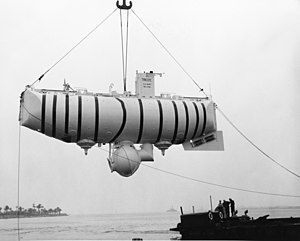
Trieste ( Italian: Trieste ) is a research bathyscaphe , in which a record dive into the Mariana Trench was made in 1960 . [1] [2]
| Trieste | ||
|---|---|---|
| Trieste | ||
 | ||
| Device history | ||
| State flag |  Switzerland Switzerland USA USA | |
| Launching | 1953 | |
| Withdrawn from the fleet | 1963 | |
| Current status | Museum piece | |
| Main characteristics | ||
| Power supply | 24 hours | |
| Speed (underwater) | 1 knot | |
| Crew | 2 pax | |
| Life support | 24 hours | |
| Dimensions | ||
| The greatest length (on design waterline) | 15.24 m (during construction, before reconstruction) | |
| The width of the body naib. | 3,5 m | |
| Height | 5.7 m | |
| Power point | ||
| Batteries and propeller motors | ||
Content
Creation History
The bathyscaphe Trieste was designed by the Swiss scientist Auguste Piccard taking into account its previous development, the world's first bathyscaphe FNRS-2 . Great help in the construction of the bathyscaphe was provided by his son, Jacques Piccard . The device received its name in honor of the Italian city of Trieste , in which the main work on its creation was carried out. Trieste was launched in August 1953 and made several dives in the Mediterranean from 1953 to 1957. The main pilot was Jacques Piccard, and his father, Auguste Piccard, who at that time was already 69 years old, also participated in the first dives. In one of the dives, the device reached a record depth of 3150 m at that time [3] [4] .
In 1958 , the Trieste was bought by the US Navy , since at that time the United States began to show interest in exploring the ocean depths, but did not yet have such devices. After the purchase, the design of the bathyscaphe was finalized - at the Krupp plant in Essen , Germany , a more durable gondola was made. The new gondola was slightly heavier, and the length of the float also had to be increased to accommodate a larger volume of gasoline. The main pilot and technician of the apparatus in 1958-1960 was Jacques Piccard, who by then had extensive experience in diving.
Design
The Trieste bathyscaphe had no fundamental differences from the FNRS-3 bathyscaphe under construction at the same time, as Auguste Piccard took part in their development.
The body of the float has a shape close to cylindrical ; fairings are installed on the bow and stern. Made of 5 mm thick steel sheet and ship set . To prevent the ship from “scouring” when towing, a developed vertical keel is installed in the aft. To reduce side rolling during surfacing, internal keels are installed inside the float (pitch stabilizers).
The float is divided into 14 compartments, the bow and stern compartments are ballast water tanks, when immersed, they are filled with water (air is discharged through the valve), after they float to the surface, the ballast tanks are blown with compressed air , buoyancy increases, the deck rises above the water.
Twelve compartments are filled with gasoline. Gasoline and sea water do not communicate with each other, are separated by an elastic partition , the pressure of the ocean depths is transmitted to gasoline. The elastic partition allows gasoline to be compressed at a depth, thus, the bathyscaphe float metal experiences only mechanical stresses while the vessel is moving, the hydrostatic pressure inside and outside the float is completely compensated .
The central (seventh) compartment has a compensating tank, partially (above) filled with gasoline and partially (below) filled with sea water (water and gasoline do not mix with each other). Part of the gasoline to reduce buoyancy can be released overboard, water takes its place. The compensating tank has the form of a vertical pipe, the wall thickness is 10 mm, a nacelle is suspended from its lower base.
Since at great depths the huge pressure of the water compresses the nacelle, its outer and inner diameters are somewhat reduced. Therefore, the gondola is attached to the compensating tank with steel tapes crosswise, allowing some displacement.
A shaft with a diameter of 0.65 m with a ramp leads to the gondola from the upper deck, connected to the gondola by a "vestibule", which ensures a tight fit of the gondola to the shaft (compensates for the mobility of the gondola at great depths). The upper hatch of the mine is surrounded by an open cabin . When immersed, the mine is flooded, in the underwater position freely communicates with sea water.
On the upper deck on the mast there is a magnetic compass , the readings of which are reproduced in the gondola by an electric repeater , a radio antenna , navigation lights , a lag and a corner reflector , which facilitates the search for a floating vessel by the radars of escort ships.
The immersion and ascent system consists of two silos with steel or cast iron shot . Electromagnets are installed in the narrowest place (“ funnel ”), under the influence of a magnetic field, the fraction “hardens”, when the current is turned off, it gets enough sleep, the buoyancy’s buoyancy increases, the speed of immersion decreases or it begins to surface. The bunkers themselves are held in the float body by electromagnetic latches, when the electric current is cut off or when the batteries are discharged, the bins are accidentally reset.
For a smooth stop near the seabed, a guide was used - a braided steel rope (an anchor chain was used on FNRS-3). When the Trieste approached the seabed, the lower freely hanging end of the guide dropped to the bottom, part of its weight was " removed " from the body of the bathyscaphe, buoyancy increased. At a certain moment, buoyancy became “zero” and the underwater vehicle motionlessly hovered at a certain distance from the bottom. If necessary, an emergency ascent of the guide could be reset by turning off the current in the electromagnetic latches.
|
|
The first (“old”) Trieste gondola was modeled on the FNRS-3 bathyscaphe gondola (a gondola was installed on the FNRS-3 from the first experimental bathyscaphe FNRS-2 , which made only two dives, then the underwater vehicle was dismantled).
The old gondola has a spherical shape, consists of two hemispheres. Each hemisphere is cast , forged and machined on a precision turning rotary machine . The joint, hatch openings, portholes and cable entries are especially carefully processed. The hemispheres are glued together with epoxy resin and pulled together with steel tapes.
- A sphere is a geometric body that has the largest volume with the smallest surface area . A hollow sphere with equal wall thickness (in comparison, for example, with a parallelepiped or cylinder of equal volume) will have less mass . Also, the sphere has absolute symmetry , for a spherical strong body it is easiest to make engineering calculations .
Since at great depths the huge pressure of the water compresses the nacelle, its outer and inner diameters are somewhat reduced. Therefore, the gondola is attached to the "cage" of the float with steel tapes that allow some displacement. All the equipment inside the nacelle is not attached to the walls, but mounted on a frame that allows the walls to come together seamlessly.
A bolted hatch in the shape of a truncated cone leads to the gondola, outer diameter 550 mm, inner diameter 430 mm, thickness 150 mm. A porthole is built into the hatch, through which the crew observed whether water was displaced from the mine before opening the entrance hatch. The second porthole is located strictly symmetrical to the first. Portholes are made of plexiglass , have the shape of a truncated cone, with a small base directed inward. Cable entry holes also have a truncated cone shape. Electrical cables are soldered into conical plastic plugs. Thus, the higher the outboard pressure of the water, the stronger the hatch, portholes and plugs of electric cables are pressed against the hemisphere.
The gondola contains compressed oxygen cylinders , life support and control devices, scientific devices, communication devices, batteries , and places for two crew members.
In 1958, it was decided to make a new gondola that can withstand pressure of more than 1100 atmospheres , allowing to conquer the extreme depths of the World Ocean ( Mariana Trench ), especially since the metal of the old gondola is " tired ". Krupp factories completed the order. The sphere did not consist of two, but of three parts: the central ring and two domed segments. This solution allowed to reduce the weight of the forgings and facilitate the heat treatment necessary to relieve residual stresses .
To conduct tests in a pressure chamber , a gondola model was made on a scale of 1 to 20. The sphere collapsed at a pressure equivalent to an immersion depth of 20 kilometers due to a joint shift. Another model was tested for tightness under a pressure of 1600 atmospheres for seven days. Theoretical calculations showed that the outer diameter of the nacelle at this pressure should decrease by 3.7 mm.
For ventilation of the gondola (before diving and after surfacing, until the crew left the ship), so as not to waste the life support system, a device for air supply was installed on the Trieste.
| Compare value | Gondola for a depth of 4000 m | Gondola for a depth of 11,000 m |
|---|---|---|
| Inner diameter mm | 2000 | 1940 |
| Outer diameter mm | 2180 | 2180 |
| Wall thickness mm | 90 | 120 |
| Porthole wall thickness and hatch thickness, mm | 150 | 180 |
| The mass of the hatch cover, kg | 180 | 200 |
| Outer diameter of the porthole, mm | 400 | 400 |
| Porthole inner diameter, mm | 100 | 60 |
| Porthole thickness, mm | 150 | 180 |
| The mass of the gondola without equipment, tons | 9 | 12 |
Power supply "Trieste" (before the second modernization in 1961) received from a silver-zinc battery installed in the gondola. The movement of the bathyscaphe was reported by two electric motors , the propellers - propellers . An insulating liquid surrounded the electric motors, pressure of sea water was transmitted to it through the membrane. The steering wheel was missing. The turn was made by turning on only one engine, the turn was almost in place - by the operation of the engines in different directions. In the underwater position, the bathyscaphe moved stern forward.
The main technical characteristics of the device (before modernization): [5] [6]
- The length of the float without fairings - 15.1 m;
- Empty float weight - 15 tons;
- Mass of variable ballast (steel shot): 9 tons;
- The volume of gasoline is 86,000 liters;
- The volume of ballast water tanks: 2 × 6 m 3 ;
- The volume of the compensating tank is 4.25 m 3 (gasoline can be replaced by sea water).
Since the mass of the new gondola increased by 3 tons , it was necessary to take an additional 10 m 3 of gasoline into the float, so the float body was lengthened by 2.5 m: the 2nd and 13th compartments were lengthened by 1.25 m each. As a result, the volume of gasoline increased by 24 m 3 , at the same time increased the supply of ballast (steel shot).
Necton Project
In 1957, France began the development of a bathyscaphe with the provisional name B11000 (Bathyscaphe 11,000 meters) for diving to the extreme depths of the oceans , later the ship was called " Archimedes ". However, Auguste Piccard beat France by proposing to modernize Trieste. "Archimedes" was not able to conquer the "Challenger Abyss".
The new gondola allowed the Trieste to descend to any known depths without endangering the crew. Therefore, the place of the next dives was chosen the Mariana Trench , which is the deepest point of the oceans . This series of dives was officially codenamed Project Necton .
During the implementation of the project on January 23, 1960, Jacques Picard and US Navy lieutenant Don Walsh dived to a depth of 10,919 m [7] [8] , which was an absolute depth record for manned and unmanned vehicles.
At 8 hours 23 minutes local time, Trieste received ballast water, the dive began. Depths of 100 meters were reached in 10 minutes, then the ship “hovered” in a layer of cold water, part of the gas had to be released. The stops were also at a depth of 130 and 160 m. After 200 m, descent without stops began, the compression and cooling of gasoline affected. Triest dived to a depth of 7800 m at an average speed of 0.9 m / s, after the discharge of a small part of the steel shot, the dive speed at a depth of 9000 m was 0.3 m / s. At 13:06 local time, the end of the guide dropped to the bottom. I had to release some of the gas in order to “land” the Trieste.
At the bottom, Picard and Walsh saw a fish that looked like flounder and shrimp .
Researchers contacted the escort ship via ultrasonic telephone and reported their arrival at their destination.
The experiments were carried out: the temperature of the water overboard was 3.3 ° C , the radioactive background was measured, the internal diameter of the nacelle was measured with a special ruler, it turned out that it was compressed by 3 mm. The air temperature in the nacelle was 4.5 ° C.
The time spent at the bottom was approximately 20 minutes [9] , then within 10 minutes the ballast was discharged, and the ascent began.
At first, the bathyscaphe surfaced at a speed of 0.5 m / s, at a depth of 6000 m the speed increased to 0.9 m / s, and at a depth of 3000 m - 1.5 m / s, the expansion of gasoline affected.
The climb lasted 3 hours 27 minutes, the total diving time was 8 hours 25 minutes.
The next conquest of Challenger Abyss took place on March 26, 2012 by Canadian director James Cameron at the Deepsea Challenger bathyscaphe.
Other Trieste Dives
In 1961, Trieste was re-modernized, in addition to two electric motors with propellers, three more were installed: one for vertical movement , two for lateral maneuvering . Additional lead batteries were suspended from the float. The batteries were in sealed containers, outboard pressure was transferred to the electrolyte through an insulating liquid , and batteries were dumped during an emergency ascent. Also on the "Trieste" was installed hydrophone and sonar .
In April 1963, Trieste was upgraded for the third time (a television camera and a “ mechanical arm ” capable of lifting objects weighing up to 22.6 kg from the bottom were installed outside the gondola) and was used in the Atlantic Ocean to search for the missing U.S. Navy submarine Thresher . On August 24, the commander of the bathyscaphe, captain-lieutenant Donald Keach, grabbed with a manipulator a piece of pipe about 1.5 m long, which turned out to be a fragment of the Tresher ventilation pipeline.
Trieste participated in military experiments as a deep-sea target , while it was direction-finding using sonars from surface escort ships.
In August 1963, Trieste found the skeleton of a ship off the coast of New England at a depth of 2560 m (8400 feet ) below the surface. Then the bathyscaphe was disassembled.
Over 250,000 photographs have been taken from the bathyscaphe for the entire diving period.
At present, the Trieste bathyscaphe is exhibited in the naval historical center of Washington ( USA ).
The Bathysphere Terni, which was built using the old Trieste gondola, was later used to build the new Trieste 2 bathyscaphe, which in 1964 also spent several dives in search of the Thresher. In 1966, the old Triest-2 bathyscaphe gondola was replaced by a new one designed for work at a depth of 6,100 m (20 thousand feet ).
Notes
- ↑ This article was originally published in the August 1960 issue of National Geographic magazine and retains the original language and spellings. Man's Deepest Dive By Jacques Piccard Archived on April 14, 2012.
- ↑ Written by BJSOnline (January 2006) The Bathyscaphe Trieste unopened (link not available) . Date of treatment November 21, 2012. Archived May 24, 2013.
- ↑ To the Depths in Trieste (inaccessible link) . Date of treatment November 21, 2012. Archived June 10, 2010.
- ↑ Swiss oceanographer Auguste Piccard designed the bathyscaphe. His most successful vehicle, the Trieste, was launched in 1953 and dived to 3,150 meters (10,300 feet).
- ↑ A bathyscaphe is a self-propelled vehicle used for deep-sea dives. Bathyscaphes can dive deeper than a person with scuba gear, and even deeper than submarines.
- ↑ The design bathyscaphe Trieste
- ↑ Trieste. - Yandex. Dictionaries (unavailable link from 06/14/2016 [1177 days])
- ↑ Bathyscaphe - Korabel.ru
- ↑ January 23, 1960, the Trieste reached the bottom of the Challenger Deep in the Pacific Ocean's Marianas Trench and set a deep-diving record 35,810 feet that will likely never be bested.
See also
- Mir-1 and Mir-2 ( USSR , Russia )
- Bathyscaphe " Jiaolong " ( China )
- Consul ( Russia )
Literature
- Jacques Piccard, Profondeur 11000 mètres, Arthaud, 1961
- M.N. Diomidov, A.N. Dmitriev. Conquering the depths. - Leningrad: Shipbuilding, 1964. - S. 252-266. - 379 p.
Pattern: Bathyscaphe