Air force of the USSR (USSR Air Force) - one of the types of the USSR Armed Forces .
| USSR Air Force Soviet Air Force | |
|---|---|
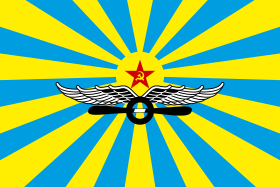 Flag | |
| Years of existence | 1918 - 1991 |
| A country |
 RSFSR (before 1923) RSFSR (before 1923) |
| Subordination | USSR Ministry of Defense |
| Enters into |  USSR Armed Forces USSR Armed Forces |
| Type of | Air Force |
| Function | Air supremacy , air reconnaissance , ground support |
| Number of | 420,000 people (1991) 6,079 aircraft (1990) |
| Dislocation |  Moscow Moscow |
| March | |
| Participation in | Spanish Civil War Fighting on Khalkhin Gol Soviet-Finnish War The Second World War Korean war War of attrition Afghan war Liquidation of the Chernobyl accident |
| Marks of Excellence |  From 1918 to 1943  From 1943 to 1991 |
| Predecessor | Workers 'and Peasants' Red Air Fleet |
| Successor | Air Force of the Russian Federation |
| Commanders | |
| Famous Commanders | See the list here ↓ |

Worn name:
- from 1918 to 1924 - Workers 'and Peasants' Red Air Fleet ;
- from 1924 to 1946 - the Air Force of the Red Army ;
- From 1946 to 1991, the Air Force of the Soviet Armed Forces Soviet Armed Forces .
The main tasks of the Air Force included air cover of the Ground Forces (SV) and the Navy (Navy) , the direct destruction of enemy facilities and troops (forces), participation in special operations, air transfers, and the decisive role in winning air supremacy. The basis of the structure of the Air Force was long-range ( YES ) , military transport ( VTA ) and front-line aviation [1] . Some parts of the USSR Air Force were part of the country's strategic nuclear forces, which provided for the use of nuclear weapons .
In terms of the number of personnel and number of aircraft at the time of their division, they were the largest Air Force in the world. By 1990, they included 6,079 aircraft of various types [2] . In December 1991 , as a result of the collapse of the USSR , the USSR Air Forces were divided between Russia and 11 independent republics ( Latvia , Lithuania and Estonia refused to participate in the division of the USSR Armed Forces for political reasons).
History
Workers 'and Peasants' Red Air Fleet
The air forces of the first Soviet state were created together with the Red Army . Management of their construction was carried out by the People's Commissariat for Military and Naval Affairs under the leadership of Leonid D. Trotsky [3] . On January 2, 1918, the All-Russian Collegium for the Control of the Air Fleet of the Republic was established in its structure , and KV Akashev was appointed as the chairman [3] . The transition to the construction of a regular Workers 'and Peasants' Red Air Fleet was launched in accordance with Order No. 84 of the People's Commissariat for Military and Naval Affairs of January 25, 1918 , which was instructed to "save all aviation units and schools for the working people". On May 24, 1918, the All-Russian Collegium was abolished, and the Main Directorate of the Workers 'and Peasants' Red Military Air Fleet (Glavvoddukhoflot) was formed, which was headed by the Council consisting of the Chief of the Chief Air Fleet and two commissioners [4] . To direct the combat activities of the aviation units on the fronts of the Civil War, in September 1918, the Field Administration of Aviation and Aeronautics of the Army (Aviadarm) was established at the headquarters of the Republic Military Council . At the end of 1921, in connection with the liquidation of the fronts, Aviadarm was abolished. The Headquarters of the Air Force has become the only aviation authority.
By November 1918, there were 38 of the military air force , 61 by the spring of 1919 , and 83 air detachments (including 18 naval) by the end of December 1920 [3] . In total, during the Civil War , up to 350 Soviet aircraft operated simultaneously on the fronts [4] . The division of the Ilya Muromets aircrafts was also at the disposal of the Main Command of the RKKVF [5] .
Red Army Air Force
After the end of the Civil War , the RKKVF was reorganized. In 1924, by the decision of the Council of People's Commissars of the USSR, the Workers 'and Peasants' Air Force was renamed the Red Army Air Force , and the General Directorate of the Air Force was named Air Force [7] . In the same year, bomber aviation was formed as an independent aviation branch, when, with the new reorganization, it was planned to form light bomber and heavy bomber squadrons [8] . Changed the ratio of types of aviation. It became more and more fighters and heavy bombers and fewer scouts. By the mid -1930s, many new types of aircraft appeared in the Air Force, which had an impact on the structure. After entering the armament of the P-6 cruiser squadrons emerged; when in 1936, the first SBs were received from the factories - high-speed bombers, and with the beginning of the development of the DB-3 in 1937 - long-range bombers. Started a rapid quantitative growth of the Air Force. In 1924 - 1933, fighters I-2 , I-3 , I-4 , I-5 , reconnaissance R-3, heavy bombers TB-1 and TB-3 entered service. By the mid-1930s, I-15 , I-16 , I-153 fighters and SB and DB-3 bombers were also put into service. From 1928 to 1932, the aircraft fleet of the Red Army Air Force increased by 2.6 times, while the number of imported aircraft dropped from fighter aircraft from 92 to 4%, to bombers from 100 to 3% [4] .
In 1938 - 1939, the Air Force was transferred from a brigade organization to a regimental and divisional one. The main tactical unit was the regiment, consisting of 4-5 squadrons (60-63 aircraft, and 40 aircraft in a heavy bombing regiment) [9] . In accordance with the purpose and tasks of the Air Force, the specific weight of various types of aviation in the Air Force changed: by 1940 - 1941, bomber and assault aircraft made up 51.9%, fighter - 38.6%, reconnaissance - 9.5% [4] . However, many types of aircraft on the main tactical and technical data is still inferior to the same type aircraft of the Air Force of capitalist states. The growth of technical equipment of the Air Force, their numerical increase demanded a significant improvement in the training of command, engineering and flight technical personnel. In 1938, the training of flight-technical personnel for the Air Force was carried out in 18 flight and technical schools [10] .
In the early 1930s , innovations in the structure of the army began. In the Air Force in 1932 included airborne troops . Later they received their aircraft - transport and reconnaissance aircraft. In September 1935 military ranks appeared in the Red Army . All pilots, by modern standards, belonged to the officers. Flight schools graduated from them in the rank of "junior lieutenant" [8] .
In the late 1930s, the Red Army Air Force was hit by a wave of repression . Many commanders of the Red Army Air Force, among whom there were quite a few pilots with combat experience gained in Spain , China , Finland , were repressed.
For the period from 1924 to 1946, the pilots of the Red Army Air Force participated in armed conflicts in Spain , at Khalkhin-Gol , in the Winter War , as well as in air battles of the Second World War .
Spanish Civil War
In February 1936, during the elections held in impoverished, backward Spain, the Left Popular Front came to power, and five months later the nationalist forces supported by the new fascists started an open rebellion, starting a civil war. Soviet volunteer pilots began to arrive in support of the republic’s loyal Soviet government to Spain. The first air battle with the participation of Soviet pilots occurred on November 5, 1936 , and soon the number of battles increased significantly [11] .
At the beginning of the air battles, the Soviet pilots on the new I-16 fighters managed to achieve significant air superiority over the Luftwaffe pilots who were flying Heinkel He-51 biplanes at the beginning of the war. It was decided to send the latest Messerschmitt Bf.109 to Spain. However, their debut was not very successful: all three delivered prototypes, to one degree or another, suffered from technical flaws [11] . In addition, they all had structural differences, so their maintenance and repair caused great problems. A few weeks later, without taking part in the hostilities, the aircraft were sent back. Then the newest Messerschmitt Bf.109B were sent to the aid of the Franco regime. As expected, the modernized Messerschmitts were far superior to the Soviet I-16 fighters [11] . German planes were faster in horizontal flight, had a larger combat ceiling and were noticeably faster in diving. However, it should be noted that the I-16 outnumbered its competitors in maneuverability, especially at altitudes below 3000 meters [11] .
Some Soviet volunteers, after returning home, were quickly promoted in the service, which was largely due to the cleaning among the senior officers that Stalin began at the time. Therefore, many of those who fought in Spain became colonels and even generals after the start of the German invasion in June 1941 . Recently, advanced officials lacked the flight and crew experience, while older commanders lacked initiative, often sending insignificant requests to Moscow for approval, and insisted that their pilots strictly perform standardized and predictable maneuvers during flight, wishing thereby reducing the accident rate in parts of the air force.
On November 19, 1939, the headquarters of the Air Force was reorganized into the Main Directorate of the Air Force of the Red Army, whose head was Yakov Smushkevich [11] .
Khalkhin Gol Fights
Soviet aviation played a decisive role in the armed conflict that lasted from spring to autumn 1939 near the Khalkhin Gol river in Mongolia, near the border with Manchuria, between the USSR and Japan . An air war unfolded in the sky. The very first collisions at the end of May showed the advantage of the Japanese aviators. Thus, in two days of fighting, the Soviet fighter regiment lost 15 fighters, while the Japanese side lost only one car [12] .
The Soviet command had to take radical measures: on May 29, a group of aces-pilots headed by Deputy Chief of the Red Army Air Force Yakov Smushkevich flew from Moscow to the battle area. Many of them were Heroes of the Soviet Union who had combat experience in the sky of Spain and China. After this, the forces of the parties in the air became approximately equal. To ensure air supremacy, new Soviet modernized fighters I-16 and I-153 "Chaika" were transferred to the Far East. Thus, as a result of the battle on June 22, which became widely known in Japan (during this battle, the famous Japanese pilot Asak Fukuda, who became famous during the war in China, was shot down and captured), Soviet aviation was superior to Japanese seize dominance in the air. In total, in the air battles from June 22 to 28, Japanese aviation forces lost 90 aircraft [12] . The losses of Soviet aviation turned out to be much smaller - 38 cars [12] .
The fighting continued until September 14, 1939 . During this time, 589 air victories were gained (Japanese losses, according to Alexey Stepanov, were 164 aircraft for all reasons [13] ), USSR losses were 207 aircraft, 211 pilots were killed. Several times the pilots who ran out of ammunition went to the ram. The first such attack was conducted on July 20 by Witt Skobarihin [12] .
War with Finland
The leadership of the Soviet Union began to look for ways to best prepare the country for the coming war. One of the important tasks was to optimize the defense of borders. Problems arose in this area: in the north, the border with Finland lay 20-30 kilometers from Leningrad , the country's most important industrial center. In the case of using the territory of Finland for an offensive, this city would inevitably suffer, there was a very real possibility of losing it. As a result of unsuccessful diplomatic negotiations and a number of border incidents, the USSR declared war on Finland. November 30, 1939, Soviet troops crossed the border.
I-16s accounted for half of the Soviet fighter aircraft involved in the conflict, while the other fighters were Polikarpov’s biplanes, which are obsolete by modern standards. The first battles in the skies over Finland showed insufficient combat readiness of the Red Army air force, especially bomber aircraft [14] . Commissar PS Shelukhin, seconded to the headquarters of the North-Western Front, wrote to the Commissar of Defense :
The state of combat training of aviation units is at an extremely low level ... bombers do not know how to fly and especially maneuver the formation. In this regard, it is not possible to create fire interaction and repel the attack of enemy fighters with massive fire. This enables the enemy to deliver sensitive blows with his insignificant forces. Navigation training is very weak, which leads to a large number of errors (as in the document), even in good weather; in bad visibility and at night - massive wanderings. The pilot, being unprepared for the route, and due to the fact that the responsibility for airborne piloting lies on the pilot-observer, neglects in flight and loses orientation, hoping for the pilot-observer. Mass whistles have a very detrimental effect on the combat capability of the units, since they lead to a large number of casualties without any impact from the enemy and undermine the crew’s confidence in their own forces, and this in turn forces commanders to wait for weeks for good weather than the number of departures decreases dramatically ... Speaking of the actions of aviation in general, you need to say most about her inaction or action for the most part idle. For it is impossible to explain in any other way the fact that our aircraft, with such a colossal superiority, could do almost nothing to the enemy for a month ...
For all the time of the Soviet-Finnish war, the USSR lost 627 aircraft of various types [14] . Of these, 37.6% were shot down in battle or landed on enemy territory, 13.7% were missing, 28.87% were lost as a result of accidents and catastrophes, and 19.78% were damaged, which prevented the aircraft from being returned to service. . At the same time, the Finnish side lost in the battle 76 and 51 damaged aircraft, although according to official Soviet data the Finns lost 362 aircraft [15] . The past war showed a serious lag of the Soviet Air Force both in technology and in the organization of hostilities and command and control of troops. On January 1, 1941, the Air Force numbered 26,392 aircraft, of which 14,954 combat and 11,438 training and transport. 363,900 people served in the Air Force. [15]
Great Patriotic War
The events that took place in the summer of 1941 showed that the measures taken to modernize the Soviet Air Force did not lead to significant results. During the military conflicts that took place in the 30s, Soviet pilots flew I-15 , I-153 and I-16 aircraft, designed in the Polikarp Design Bureau. Not yielding to the best aircraft of the rest of the world in 1936 , four years later they were already outdated, since the aviation industry developed very quickly during this period [16] . The sudden attack that the Luftwaffe collapsed on Sunday , June 22, 1941, on airfield airfields, which were located near the western border of the USSR , caught both the Red Army and its air forces unawares.
In most cases, the advantage of the attackers was overwhelming, and many aircraft, including many new ones, were destroyed on the ground in the first hours after the invasion. In the first few days of Operation Barbarossa , the Luftwaffe destroyed approximately 2000 Soviet aircraft, most of them on the ground [16] [Approx. 1] . For a long time it was argued that a comparison of the Air Force and the Luftwaffe on June 22 could not be made simply from the number of vehicles, which would mean more than twice the superiority of the Air Force (only if combat aviation concentrated in the west of the USSR is taken into account). [16] Quite rightly, it was supposed to take into account the insecurity of the crews and the incapacity of the aircraft. There was a true opinion that German planes were superior to Soviet ones in terms of flight characteristics and firepower, and the Germans' qualitative superiority was complemented by organizational advantages. In fact, for example, in the Western District Air Force there were 102 new Yak-1 fighters, 845 MiG-3 and 77 MiG-1, although most of them were not mastered by personnel and with low technical reliability, while the Luftwaffe 440 modern fighter Messerschmitt Bf.109F and a large number of modern fighter Bf.109E. On December 31, 1941, the total losses of the Red Army Air Force amounted to 21,200 aircraft, including combat 9233 [17] .
The most massive aircraft in the Soviet Air Forces during the years of the Great Patriotic War were the Il-2 attack aircraft and the Yak-1 fighter, which made up almost half of the air force fleet. The Yak-1 single-engine fighter was put into production in 1940 and had a large field for modernization, unlike the German Messerschmitt Bf.109 . The appearance on the front of such aircraft as the Yak-3 and Yak-9 brought the establishment of parity with the Luftwaffe, and ultimately, air superiority. More and more airplanes such as the Yak-7 , Yak-9 , Yak-3 , La-5 , La-7 , two-seater Il-2 attack aircraft (and from the summer of 1944, the Il-10 ), Pe- 2 , Tu-2 , cannons, bombs, radar stations, radio communications and aeronautical equipment, aerial cameras and other equipment and weapons. The organizational structure of the air force continued to improve. In March 1942, long-range aviation units were merged into long-range Aviation with direct subordination to the Supreme Command Headquarters ( Supreme Command ). The post of commander of the Long-Range Aviation, to which Alexander Golovanov was appointed, was established. Since May 1942, aviation operational associations, the air armies, began to be created in the front aviation [3] . The system of repair of aviation technology, which was established in the late 30s of the 20th century in the Air Force, having been tested in combat conditions, turned out to be the most difficult part of aviation engineering support when restoring aircraft with combat and operational damage. Aircraft repair bases and fixed aircraft repair shops carried out the bulk of aircraft repairs, but it was necessary to transfer the repair agencies to aircraft units. In order to speed up repairs of aviation technology, the command that had accumulated in the aviation units began a reorganization of the field repair network and the repair management system as a whole. Repair agencies were transferred to the Chief Engineer of the Air Force and the number of mobile aircraft repair workshops increased. The PARM-1 workshops (cars) were transferred to the engineering and aviation service of the air regiments from the rear bodies, and in addition to them, the PARMS-1 special equipment repair workshops were formed. [18]
In the autumn of 1942, the formation of separate air corps and divisions of the reserve of the Supreme High Command began, which made it possible to quickly concentrate large aviation forces on the most important areas. The high combat qualities of the Soviet air forces were especially pronounced in the battles of Moscow , Stalingrad , Kursk , in air battles in the Kuban , in operations in Right-Bank Ukraine, in Belarus, in the Yassko-Kishinev, Vistula-Oder and Berlin operations. If in the operations of 1941, 200-500 aircraft participated, then in 1943-1945 - up to several thousand, and in the Berlin operation 1945 - up to 7500 aircraft [19] .
For the period from January 1, 1939 to June 22, 1941, the Air Force received 17,745 combat aircraft from industry, of which 706 aircraft of the following types: MiG-3 fighter jets - 407, Yak-1 - 142, LaGG-3 - 29, Pe-2 - 128 [20] .
Invaluable for the Soviet Union was the assistance of the United States and Great Britain in the form of lend-lease . In total, between 1941 and 1945, 14,126 aircraft were delivered under Lend-Lease: Curtiss P-40 Tomahawk and Kithiouk , Bell P-39 Aero Cobra , Bell P-63 Kingcobra , Douglas A-20 Boston , North American B-25 Mitchell , Consolidated PBY Catalina , Douglas C-47 Dakota , Republika P-47 Thunderbolt [21] , Hawker Hurricane and Supermarin Spitfire . These supplies certainly played an important role in defeating the common enemy. The supply of aircraft from the United States and Great Britain accounted for almost 12% of the total number of Soviet aviation [21] .
During the war years, 44,093 pilots were trained. Killed in battle 27,600: 11,874 fighter pilots, 7837 attack / attack pilots, 6,613 bomber crew members, 587 reconnaissance pilots, and 689 auxiliary aviation pilots [20]
The most effective fighter pilots of the Great Patriotic War and the Second World War from the Allies were Ivan Kozhedub (62 victories) and Alexander Pokryshkin (59 victories), awarded three times the title of Hero of the Soviet Union.
Cold War
After the end of the Second World War, in which the USSR and the USA were allies, Europe was redivided into spheres of influence. In the 1950s, two main military-political blocs were formed - NATO and the Warsaw Pact , which for decades were in a state of constant confrontation. The Cold War, which began in the late 1940s, could at any time develop into a “hot” Third World War . The arms race promoted by politicians and the military gave a strong impetus to the development of new technologies, especially in military aviation [22] .
For decades, there was a military confrontation not only on land at sea and under water, but primarily in the airspace. The USSR was the only country whose air force was comparable to the US Air Force . The main suppliers of fighters to the Soviet air forces during the Cold War were the design offices of Mikoyan and Gurevich , as well as Sukhoi . The Tupolev Design Bureau had a monopoly on heavy bombers. It specialized in the design of heavy bombers and transport aircraft.
The origin of jet aircraft
In the postwar years, the main direction of development of the Soviet Air Force - the transition from piston aircraft to jet. Work on one of the first Soviet jet aircraft began in 1943–1944 [23] . The first flight of the prototype aircraft made in March 1945 [23] . During flight tests, a speed much higher than 800 kilometers per hour was achieved.
On April 24, 1946, the first Soviet production jet aircraft Yak-15 and MiG-9 took off [24] . On tests, these aircraft showed speeds of about 800 km / h and over 900 km / h, respectively.
Thus, the speed of flight of fighters increased by almost 1.5 times compared with piston aircraft [25] . At the end of 1946, these machines were put into mass production. The new aircraft that entered service with the USSR Air Force belonged to the first generation of subsonic jet fighters. Western counterparts of the Soviet Yak-15 and MiG-9 are the first jet fighters that entered service with the Messerschmitt Me-262 and Heinkel He-162 in Germany in the mid -1940s ; British " Meteor ", " Vampire ", " Venom "; American F-80 and F-84 ; French MD.450 Hurricane [26] . A characteristic feature of these aircraft was a direct glider wing .
On the basis of the generalized experience accumulated during the Great Patriotic War , new combat regulations, manuals and guidelines for the combat use of aircraft types and labors were developed. To ensure reliable navigation, accurate bombing and firing, airplanes are equipped with various radio-electronic systems. The equipment of airfields was started by the system of “blind” landing of aircraft using instruments [10] .
The reequipment of Soviet aviation to jet aircraft that had begun required the modernization of the organizational structure of the Air Force. In February 1946, the Red Army was renamed the "Soviet Army" , and the Red Army Air Force in the USSR Air Force . In the same year 1946, the post of Commander-in-Chief of the Air Force - Deputy Minister of the Armed Forces was introduced. Air Force headquarters transformed into Air Force Headquarters. The country's air defense forces in 1948 became an independent type of the Armed Forces [27] . In the same period, the country's air defense system was reorganized. The entire territory of the USSR was divided into a border strip and an internal territory [28] . Since 1952, the country's Air Defense Forces were equipped with anti-aircraft missile technology, and the first units were created to serve them. Air defense aviation was strengthening [29] .
The air force was divided into front-line aviation and long-range aviation [29] . Amphibious transport aircraft was formed (later a transport landing force, and then a military transport aircraft). The organizational structure of front-line aviation was perfected. Aircraft were re-equipped from piston to jet and turboprop aircraft [29] . Airborne troops in 1946 were withdrawn from the Air Force [29] . On the basis of individual airborne brigades and some rifle divisions, parachute and landing assault formations and units were formed [29] . Many aviation regiments and divisions returned at this time from the occupied countries of Eastern Europe to the territory of the USSR . At the same time, the formation of new air armies was in progress, which included air regiments and divisions that were in the ranks. Large groups of Soviet aviation were stationed outside the USSR on Polish , German , and Hungarian airfields.
Massive use of jet aircraft
In 1947 - 1949-ies there were new jet fighters MiG-15 , La-15 with a swept wing , as well as the first front-line bomber with a turbojet engine IL-28 [30] . These aircraft marked the emergence of a second generation of jet aircraft subsonic .
Of the jet fighters in the mass series was built MiG-15 . This aircraft stands out for its high flight-tactical and operational characteristics. It had a 35-degree swept wing, a three-support chassis with a nose wheel, an airtight cabin equipped with new equipment, a new ejection seat [31] . MiG-15 aircraft received baptism of fire during the war in Korea , where they showed their strengths in front of American fighters of the same class F-86 [32] . Western counterparts of the Soviet fighters were the aforementioned American F-86 fighters, French MD.452 “Mister” -II and MD.454 “Mr.” -IV and British “ Hunter ” [26] .
Bomber aircraft also switched to jet thrust. The successor of the piston Pe-2 and Tu-2 was the IL-28 front-line jet bomber. This aircraft was notable for its simple technological arrangement and was easy to fly [33] . Aeronautical and radio equipment of the aircraft provided the flight at night and in adverse weather conditions. Produced in various versions.
In the late 1940s - early 1950s, Soviet aviation began to develop the Far North and Chukotka . Also on Sakhalin and Kamchatka , the construction of advanced airfields unfolded, aviation regiments and divisions were relocated here. However, after the appearance of Tu-95 strategic bombers with intercontinental range in the long-range aviation regiments, the need to approach airfields to the territory of a potential enemy, the United States, was no longer necessary. Subsequently, only air defense fighter regiments remained in the Far East .
The arrival of a nuclear weapon with an air force led to radical changes in the forms and methods of combat use of the air force, sharply increasing their role in the conduct of the war. The main purpose of aviation from the late 40s to the mid 50s was bombing of objects in Europe , and with the advent of an aircraft carrier with intercontinental nuclear weapons - nuclear strikes on the United States [10] .
Korean war
The war in Korea (1950-1953) was the first armed conflict between two recent allies in the anti-Hitler coalition — the United States and the USSR . In this war, the Soviet air force for the first time tested its latest MiG-15 fighters in combat conditions.
The Soviet government initially provided the DPRK with weapons, military equipment, and material resources, and at the end of November 1950 several aircraft divisions were transferred to northeastern China with some of the best pilots involved in repelling US air raids on North Korea and China (in October 1950 Chinese volunteers were sent to Korea) [34] . Especially for fighting in Korea, the USSR formed the 64th Fighter Air Corps . Commanded them, Major General Ivan Belov. At first there were 209 aircraft in the hull. They were based in Northeast China. The composition of the pilots and the number of aircraft changed. In total, 12 fighter air divisions managed to make war in the corps [35] . The combat task of the Soviet 64th Fighter Aviation Corps was to "cover enemy bridges, crossings, hydroelectric power stations, airfields, as well as rear and communications facilities of the Korean-Chinese forces in North Korea to the Pyongyang-Genzan line from the air strikes of the enemy." At the same time, the corps was supposed to be “ready to repel, in cooperation with parts of Chinese aviation, possible enemy strikes against the main administrative and industrial centers of Northeast China in the Mukden area”.
Until November 1951, the 64th IAK was organizationally part of the operational group of the Soviet Air Force in China, then interacted with the United Sino-Korean Air Army. In addition, four more Chinese air divisions were used in the second and third lines to build up forces and cover airfields. Soviet pilots wore Chinese uniforms, and PLA plaque markings were inscribed on the aircraft.
The main combat aircraft that were in the armament of the corps were jet aircraft MiG-15 and MiG-15bis , which in combat conditions were a kind of "run-in" against the latest models of American fighters, among which stood out the F-86 "Saber" , which appeared on the front in 1951 year [36] . MiG-15 had a greater practical ceiling, good acceleration characteristics, rate of climb and armament (3 guns versus 6 machine guns), although the speed was almost the same. UN troops took a numerical advantage, and soon this allowed them to equalize the situation in the air until the end of the war - a determining factor in the successful initial attack on the north and in opposition to Chinese troops [37] . Chinese troops were also equipped with jet aircraft, but the quality of training of their pilots left much to be desired. The area where the Soviet pilots operated, the Americans called the “ Alley of MiGs .” According to Soviet data, 1,309 enemy aircraft were shot down by forces of the 64th Corps above this “Alley”, including 1097 in air battles, and 212 by anti-aircraft artillery fire [38] .
For the successful fulfillment of the government assignment, 3504 pilots of the air corps were awarded orders and medals, 22 pilots were awarded the title Hero of the Soviet Union [38] .
Beginning of the supersonic era
By the early 1950s, transonic flight speeds were well established. In February 1950, on a serial fighter jet MiG-17 , test pilot Ivan Ivaschenko dived the speed of sound in a dive [39] . The era of supersonic aircraft began . The first Soviet serial supersonic fighter capable of speeding over M = 1 in horizontal flight was the MiG-19 [40] (as well as a modification of the MiG-19 PT). This aircraft was comparable to the American F-100 fighter "Super Slaber" and represented The first generation of supersonic fighters . The MiG-15bis fighter-bombers replaced the outdated ground attack aircraft. [10] The long-range aviation received new heavy jet and turboprop Tu-16 , Tu-95 , M-4 , 3M aircraft, in class corresponding to the American B-52 , B-36 and B-47 bomber [27] .
A distinctive feature of the aircraft of the first generation was equipping them with guns and armament, the ability to carry more than 1000 kg of combat load on the underwing pylons [26] . Radar still had only specialized night / all-weather fighters. Since the mid -1950s, fighters have been arming air-to-air guided missiles [26] .
Since the mid -1950s, changes have occurred in the structure of the Air Force and their organization. For example, a directive by the USSR Minister of Defense Marshal Zhukov in 1956 assault aircraft was eliminated [41] . In 1957, fighter-bomber aviation was formed as part of front-line aviation [42] . The main task of the fighter-bomber aircraft was to support the ground forces and fleet forces by destroying important objects in the tactical and immediate operational depth.
The second generation of supersonic aircraft
In connection with the entry into service of the Air Force of supersonic aircraft armed with air-to-air guided missiles with an infrared (thermal) radar of the GOS and air-to-surface (URVP), by 1960 , long-range and front-line aviation turned into a supersonic and rocket-carrying . This significantly increased the combat capabilities of the Air Force in overcoming the enemy’s air defenses and more reliably defeating air, ground and surface targets.
In 1955, a Su-7 front-line fighter was created in the Sukhoi Design Bureau . Since 1958, the light maneuverable supersonic MiG-21 front-line fighter, having a maximum speed of 2,200 km / h, has been mass-produced [44] . These machines, which are the most characteristic representatives of the second generation of supersonic combat aircraft , had powerful cannon armament and could carry URS and NURS and bombs on board [45] . Since the beginning of the 60s, MiG-21 fighters have been en masse in the Air Forces and Air Defense Air Force combat regiments. For many years, they became the main combat vehicles of the Soviet front-line aviation and air defense. Thanks to the radar, second-generation airplanes became all-weather. The second-generation Soviet aircraft MiG-21 , Su-7 , Su-9 , Su-11 were opposed by similar fighters of the NATO countries : American F-104 , F-4 , F-5A , F-8 , F-105 , French Mirage -III and Mirage-IV [26] . The most common type of wing in these aircraft was triangular.
Bomber aircraft also went to great speeds. The supersonic bomber with two jet engines Tu-22 was developed for operations against NATO naval forces [46] . The American equivalent of the Tu-22 was the B-58 . The B-58 was the first long-range supersonic bomber. At the time of its creation, the maximum speed (M = 2) was not inferior to the fastest fighters. Because of a number of shortcomings, the operation of the B-58 was short-lived, but the aircraft occupied a prominent place in the history of bomber aircraft.
The tactics of long-range and front-line aviation continued to change. Rocket-carrying aircraft have had the opportunity to strike at targets from long distances without entering the zone of action of the air defense systems of enemy targets [10] [47] . Significantly increased opportunities for military transport aviation . It became capable of moving to the deep rear of the enemy formations of airborne troops with their standard combat equipment and weapons [10] .
Along with the technical development of the Air Force, the forms and methods of their use were improved. The main forms of combat operations of the Air Force during this period were air operations and joint operations with other types of armed forces, and the main methods of their combat operations were massive strikes and actions in small groups [10] . The tactics of actions of fighter aviation at the turn of the 50s and 60s were based on the interception of targets by commands from the ground [10] [48] .
Soviet Air Force in the 1970s
At the turn of the 60s and 70s, the Soviet air force began to master third generation combat aircraft. In the mid -1960s, fighter planes like the MiG-25 , capable of flying at speeds three times higher than the speed of sound , and rising to 24,000 meters , began to be used by Soviet air forces. The aerodynamic layout of the MiG-25 was significantly different from the layout of the second generation aircraft. The aircraft was produced in versions of an interceptor fighter, strike aircraft and high-altitude reconnaissance aircraft [49] .
The most characteristic features of third-generation tactical aircraft are multi-mode and improved take-off and landing characteristics due to the variable geometry wing . Thus, in the mid -1960s, a new direction emerged in aircraft construction — the use of pivoting wings, which allowed them to change their sweep in flight [50] .
The first aircraft with variable swept wings, which became famous, was the American F-111 . The first Soviet combat aircraft with variable sweep wing MiG-23 and Su-17 were shown in Domodedovo on July 9, 1967 [51] . Serial production of these aircraft began in 1972-1973 [51] .
Both aircraft belonged to almost the same class of combat aircraft and had almost identical tactical and technical characteristics , however, it was decided to adopt both vehicles, and the MiG-23 was recommended as a multi-purpose tactical fighter for the Air Force and a fighter-interceptor for fighter aircraft Air defense , and the Su-17 as a tactical fighter-bomber (front attack aircraft) for the Air Force [52] . Both models of aircraft formed the basis of the combat potential of Soviet tactical aviation of the 1970s and 1980s and were widely exported [52] . The main fighter-interceptor of the air defense forces, along with the MiG-23 , for many years became the Su-15 , which began to enter combat regiments in 1967 [52] .
In the late 50s, the US Air Force Command came to the conclusion that it was necessary to create a new combat aircraft capable of replacing the F-105 tactical fighter-bomber "Thunderchief" [52] . The heavy fighter-bomber F-111 developed by General Dynamics , entered service with the Air Force in 1967 [52] . In its creation, the requirement was for the new aircraft to have fighter speed, bomber carrying capacity and transport aircraft range. According to the statements of American experts, due to the presence of an automatic system for following the terrain, variable sweep wing and a powerful F-111 powerplant, it is capable of performing a breakthrough through the air defense zone to the object and at supersonic speeds of 1.2 M and at low altitudes hit it with a high degree of probability. The USSR’s response to the appearance of the F-111 was the appearance of a Su-24 front-line bomber [52] . A special feature of the aircraft was the crew’s deployment not in tandem, as was usually done on Soviet aircraft, but shoulder to shoulder, as on the F-111 and deck attack aircraft A-6 "Intruder" [52] . This allows the pilot to control the aircraft when the pilot is injured, which is very important when performing combat flights. Armament included almost the entire range of tactical weapons, including nuclear ones. In total, until 1983, at least 500 machines of this type were built [52] .
In the early 1960s , work began in many countries around the world on the creation of vertical take-off and landing jet aircraft . In the USSR, in 1974, the mass production of the Yak-38 vertical takeoff and landing fighter began. An analogue of such an aircraft in the West was the British Harrier .
In the late 1960s - early 1970s , on the basis of studying the experience of using aviation in local conflicts, the range of tactical use of non-nuclear weapons significantly expanded. Also, the improvement of air defense systems forced aviation to move to low altitudes. The emergence of more advanced Su-17M4 and MiG-27 aircraft in fighter-bomber aircraft led to the gradual emergence of guided means of destruction. In the mid -1970s, air-to-air guided missiles appeared in service with Su-17 fighter-bombers, which meant abandoning the rate of only nuclear weapons. Europe was considered the main battlefield , so the most powerful group of Soviet aviation was based on the territory of the Warsaw Pact countries. In the 1960s and 1970s, the Soviet air force did not participate in armed conflicts. However, aviation participated in numerous exercises such as Berezina , Dnepr , Dvina and others [53] .
In the late 1970s, a wave of organizational restructuring of the Air Force began. In 1980, the air armies of front-line aviation were transformed into air forces of military districts. Air forces of military districts are directly subordinate to the commanders of military districts. In 1980, air defense aircraft was transferred to the beginning of the military districts [54] . Air defense facilities of the country weakened. In all districts, the level of flight crew training has decreased. The main commands of four directions were created: Zapadnoye ( Poland ), Southwestern ( Moldavia ), Yuzhnoye ( Transcaucasus ) and East ( Far East ) [54] . The cost of the reform amounted to about 15 billion rubles [54] .
Soviet Air Force in the 1980s
In the early 1980s, the fourth generation airplanes began to arrive in the Air Force, which were characterized by a sharp improvement in maneuverability. The newest fighters MiG-29 , MiG-31 , Su-27 and attack aircraft Su-25 , the world's largest strategic bombers Tu-160, mastered the combatant regiments. These planes gradually drove out the outdated cars. The fourth generation MiG-29 and Su-27 airplanes, created on the basis of the advanced achievements of science and technology in the USSR, are still in service with the Russian Air Force . Analogues of the fourth generation of Soviet aircraft are the American F-14 "Tomcat" , F-15 "Eagle" , F-16 "Fighting Falcon" and F / A-18 "Hornet" , Italian-German-British " Tornado ", French "Mirage “-2000 [26] . At this time, there was a separation of fighters into two classes: the class of heavy fighter-interceptors with limited capabilities for attacking ground targets ( MiG-31 , Su-27 , F-14 and F-15 ) and the class of lighter fighters for striking ground the objectives and conduct of a maneuvering air combat ( MiG-29 , Mirage -2000 , F-16 and F-18 ).
By the mid-80s, the Air Force had an extensive aerodrome network, which included stationary airfields with concreted runways, dispersal airfields with prepared unpaved runways and specialized road sections [55] .
In 1988, the air armies of front-line aviation, subordinated to the Air Force General Command , were recreated, and the decision of 1980 to liquidate the air armies of front-line aviation and transfer it to military districts was recognized as erroneous [56] [57] .
In the late 1980s, as part of the transition to a new defense sufficiency strategy, reductions in aviation groups began. The leadership of the Air Force decided to abandon the operation of the MiG-23 , MiG-27 and Su-17 aircraft with one engine. In the same period, it was decided to reduce the front-line aviation of the USSR Air Force by 800 aircraft [55] . The policy of reducing the Air Force has deprived front-line aviation of a whole genus — fighter-bomber aircraft [55] . The main attack aircraft of the front-line aviation were to be Su-25 attack planes and Su-24 bombers, and in the future - modifications of the fourth generation MiG-29 and Su-27 fighters . Cuts underwent and reconnaissance aircraft. A number of aircraft, withdrawn from the air force, were sent to the storage bases.
At the end of the 1980s, the withdrawal of Soviet troops from Eastern Europe and Mongolia began . By 1990, the USSR Air Force had 6079 aircraft of various types [2] .
In the 1980s, the USSR Air Force actively participated in only one armed conflict - in the territory of Afghanistan .
Afghan war
In the 46 years since World War II before the collapse of the USSR , the Soviet armed forces participated in only one full-scale war (not counting the Korean conflict). The limited contingent of Soviet troops , introduced in Afghanistan on December 25, 1979, was supposed to prevent the fall of the pro-Soviet regime established in the country after the Saur revolution . Soon it took to attract large forces, first army and front-line, and later long-range aviation.
Like the whole operation "to provide international assistance to the Afghan people", the transfer of aircraft and people was held in conditions of strict secrecy.
The task - to fly over to the airfields of Afghanistan and transfer all necessary property there - was put before the pilots and technicians on the last day. “Outrun the Americans” - it was this legend that was later persistently defended to explain the reasons for the introduction of units of the Soviet army into the neighboring country. First in the DRA two squadrons of Su-17 fighters-bombers from Kzyl-Arvat were redeployed [58] . In Afghanistan, fighters, fighter-bombers, front-line bombers, reconnaissance aircraft, assault aircraft, long-range bombers, as well as a major campaign for the transportation of goods and troops, were executed by the Military Transport Aviation. One of the main participants in the war were helicopters.
The main tasks of Soviet military aviation in Afghanistan were reconnaissance, the destruction of the ground enemy and the transportation of troops and cargo [58] . By early 1980, the Soviet air force in Afghanistan was represented by the 34th mixed air corps (later reformed into the 40th Army's air force) and consisted of two air regiments and four separate squadrons. They consisted of 52 Su-17 and MiG-21 . In the summer of 1984, the 40th Army's air force consisted of three MiG-23 MLD squadrons, which replaced the MiG-21 , the Su-25 assault air regiment of the three - squadron squadron, two Su-17MZ squadrons, a separate Su-17MZR squadron (reconnaissance aircraft), mixed transport regiment and helicopter units ( Mi-8 , Mi-24 ) [59] . From the territory of the USSR, Su-24 front-line bombers and Tu-16 and Tu-22M2 and Tu-22M3 long-range aircraft operated .
In 1980 , four Yak-38s were sent to Afghanistan for testing purposes, where they operated from limited sites in high-altitude conditions. One plane was lost for a non-combat reason.
Soviet aviation suffered the main losses from fire from the ground. At the same time, the greatest danger was represented by portable anti-aircraft missile systems supplied to the Mujahideen by the Americans and the Chinese [59] .
On May 15, 1988, the withdrawal of Soviet troops from Afghanistan began. In total, during the war, almost one million sorties were flown, during which 107 planes and 324 helicopters were lost. The withdrawal was completed on February 15, 1989 [59] .
Fifth Generation Aircraft Development Program
In 1986, the development of a promising fifth-generation fighter in the Soviet Union was given as a response to the American program . Conceptual studies began in 1981 [60] . Work on its creation took OKB them. Mikoyan , who adopted for its offspring aerodynamic design " duck " [60] .
OKB them. Sukhoi investigated the possibility of creating a promising combat aircraft with a backward-swept wing, but these works were carried out to a greater extent on an initiative basis.
The main program remained the project of the new „MiG“. The program went under the designation I-90. The plane was supposed to be equipped with new powerful engines such as the AL-41F developed by NPO Saturn . Thanks to the new engines, the MFI was supposed to fly at supersonic cruising speeds, like the fifth-generation American aircraft, but, unlike them, the stealth technology was given much less attention. The main emphasis was placed on achieving super-maneuverability, even more than that achieved on the Su-27 and MiG-29 . In 1989, a complete set of drawings was released, after some time a glider of an experimental aircraft was built, which received an index of 1.42 [61] , but the lag in the development of the AL-41F engine caused a significant lag in the entire development program of the fifth generation aircraft.
The MiG Design Bureau was also developing a light tactical fighter. This aircraft was an analogue of the American program JSF ( Joint Strike Fighter - lightweight strike aircraft) and was developed to replace the MiG-29 . The creation of this aircraft, which was prevented by the years of perestroika even more than the IFIs, went very far behind schedule. It was never embodied in metal.
OKB them. Sukhoi investigated the possibility of using the forward-swept wing on military aircraft. The development of such an aircraft began in 1983 . In the US, there was also a similar program - the X-29 A. It was carried out on the basis of the F-5 aircraft and was already in flight tests [60] . Sukhovsky S-37 "Berkut" was of a much higher dimension, it was equipped with two double-circuit turbojet engines with an afterburner and belonged to the class of "heavy fighters". According to some experts, the C-37 was positioned as a carrier-based aircraft, which can be shown in proof by a significantly lower height compared to the Su-27 and the perceived convenience in the implementation of the folding mechanism of the wing consoles [60] . The aircraft could be used from the deck of the nuclear aircraft carriers planned for the construction of project 1143.5 Ulyanovsk [60] . But in May 1989, the C-37 program was closed, and subsequent work was carried out exclusively with funds from the design bureau itself.
Many technical solutions for the development of the fifth generation aircraft were subsequently applied to the PAK FA [61] .
The general organizational structure of the Air Force from 1960 to 1991
| Russian Air Force / USSR |
|---|
Russian empire Imperial Navy USSR Air Force Long-range aviation Frontline Aviation Military transport aviation Soviet Navy Aviation (1918–1991) Air Defense Forces (1948–1991) Russian Air Force Strategic Aviation Frontline Aviation Military transport aviation Russian Navy Aviation |
By the beginning of 1960, long-range and military transport aircraft were formed as part of the Air Force as types of aviation. The fighter aircraft received new jet aircraft with rocket and cannon weapons. Instead of assault aircraft created as a kind of fighter-bomber aircraft , capable of using both conventional means of destruction, and nuclear weapons. Frontline and long-range aviation also became missile-carrying. In the Military Transport Aviation , turboprop airplanes of heavy payloads replaced the outdated piston aircraft.
By the early 1980s, the Soviet Air Forces consisted of long-range, front-line , army, and military transport aircraft. The basis of their striking power was long-range aviation, equipped with supersonic bomber and long-range bombers, capable of striking the most important land and sea targets of the enemy in continental and oceanic (maritime) theaters of operations. Front-line aviation , armed with bombers, fighter-bombers, attack aircraft, fighters, reconnaissance aircraft, is able to fight against nuclear missile and enemy aircraft, its reserves, provide ground support for aircraft, conduct air reconnaissance and electronic warfare in operational and tactical depth enemy defenses. The military transport aviation, armed with modern heavy aircraft, is capable of throwing out and dropping landings with standard armament (including tanks, guns, missiles), transporting troops, armament, ammunition and materiel by air over long distances, to provide maneuver of air formations and units , evacuate the wounded and sick, as well as conduct electronic warfare and perform special tasks.
In the Air Force in the 1960s – 1980s, the main ones were:
- Long-range aviation (YES) - strategic bombers;
- Frontline Aviation (FA) - fighters, fighter-bombers, attack aircraft, bombers, which ensured air superiority in the border areas and the interception of NATO aircraft;
- Military transport aviation (VTA) for the transfer of troops.
The air defense forces of the USSR were a separate type of the Armed Forces, which were not part of the Air Force, but had their own aviation units (mainly fighter). During the reorganization of 1981, the Air Defense Forces came under heavy dependence on the Air Force command.
Aviation of the Navy was under the command of the USSR Navy .
One of the types of front-line aviation was attack aircraft , which, by order of the Minister of Defense of the USSR of April 20, 1956, was abolished from the composition of the Soviet Air Force, completely giving way to fighter-bomber aircraft. The new military doctrine, which took into account the possibility of using tactical nuclear weapons, considered the functions of the Air Force over the battlefield in a different way. According to the then military experts, the main forces should have been sent to strike targets located outside the range of the ground forces, while the attack aircraft were intended primarily for operations on the front line.
Thus, the presence in the Air Force of a specialized attack aircraft became unnecessary. Only a few decades later, experts analyzing the actions of attack aircraft in local conflicts once again recognized the need for such aircraft to directly support ground forces on the battlefield. Thus, in early 1969, USSR Minister of Defense Andrei Grechko ordered the aviation industry minister to hold a competition for a light attack aircraft, and in March four design bureaus — Ilyushin, Mikoyan, Sukhoi and Yakovlev — received demands for a new aircraft. The competition for the new aircraft won Sukhoi Design Bureau with its Su-25 attack aircraft . For the first time this plane took to the sky in 1975 . In March 1980, upon the personal instructions of the Minister of Defense Dmitry Ustinov , it was decided to conduct tests in “special conditions” - in the real combat zone in the Republic of Afghanistan . The test program was named Rhomb. In early June 1980, Operation Rhombus was successfully completed, the test program was completed, and the Su-25 couple returned safely to the Union [62] . And in May 1981, the first batch of 12 Su-25 serials entered service in the 200th separate assault squadron. Exactly a quarter of a century later, assault aviation was revived in Russia [62] .
The collapse of the USSR
The collapse of the powerful deep-echelon defense system of the Soviet Union began with its advanced military bases - the withdrawal of groups of troops stationed in Eastern Europe and Mongolia . In accordance with the numerous international obligations of the USSR, since 1991, it has carried out a massive withdrawal of its most powerful advanced Group of Soviet Forces in Germany [63] . The personnel of the group was 370 thousand people, including 100 thousand officers and ensigns, as well as 1842 thousand members of their families [52] . The Air Force group consisted of the 16th Air Force (five air divisions) [52] . In service here were 620 combat aircraft and 790 helicopters, as well as 1600 thousand tons of ammunition and other equipment [52] . Most of them were brought to Russia , some parts and compounds were brought to Belarus and to Ukraine . The withdrawal of troops from Germany ended in June 1994 . From Czechoslovakia , Hungary and Mongolia , troops were withdrawn in the amount of 186 thousand people, 350 combat aircraft and 364 helicopters. 73,000 troops, including the 4th Air Force, were withdrawn from Poland [64] .
Under pressure from the United States, the Soviet Union almost completely pulled out a training brigade from Cuba , which in 1989 numbered 7,700 men and consisted of a motorized rifle, artillery and tank battalion, as well as support units [64] . Also almost at that time, the Soviet military presence in Vietnam was collapsed — the Cam Ranh naval base, where the battalion of the marine corps was usually stationed, as well as the mixed grouping of the Navy and the Air Force [64] .
In December 1991, the Soviet Air Force was divided between Russia and 11 independent republics.
Division of the Air Force between the Union Republics
Russia
As a result of the collapse of the USSR , Russia received about 40% of the equipment and 65% of the personnel of the Soviet Air Force.
According to interstate treaties , long - range aviation connections remain only in Ukraine and Russia .
The 326th Heavy Bomber Aviation Tarnopolsky Division of the Order of Kutuzov, stationed in the Baltic States, was withdrawn to Russia .
The divisions stationed in Kazakhstan and Belarus (the 79th Heavy Bomber Aviation Division and the 22nd Guards Heavy Bomber Aviation Donbass Red Banner Division ) under the interstate treaties were brought to Russia .
Ukraine , having abandoned nuclear weapons , retained the fleet of long-range aviation, which was later partially destroyed.
Thus, Russia has become the only state in the post-Soviet space that has long-range strategic aviation [65] .
At the time of the collapse of the USSR, its air force and air defense troops were the most numerous in the world, outnumbering the fleets of the United States and China [66] . The maintenance of such enormous forces in the conditions of the economic crisis and changes in the international situation was impossible, which led to a significant reduction in the Russian Air Force . Since 1992, a series of massive reductions in the number of aircraft began, while maintaining the generally unchanged structure of the Soviet Air Force. During this period, all aircraft of obsolete types were decommissioned. The combat strength of the air force, air defense and navy by the end of the period was represented almost exclusively by fourth-generation aircraft ( Tu-22M3 , Su-24M / MR , Su-25 , Su-27 , MiG-29 and MiG-31 ) [66] . The total strength of the air force and air defense aviation fell by almost three times - from 281 to 102 aviation regiments [66] . By 1995, stopped mass production of aircraft for the Air Force and Air Defense. In 1992, the supply of new aircraft was 67 aircraft and 10 helicopters [66] , in 1993 - 48 aircraft and 18 helicopters [66] , in 1994 - 17 aircraft and 19 helicopters [66] . In 1995, only 17 helicopters were purchased [66] [67] . After 2000, programs were launched to modernize the Su-24M , Su-25 , Su-27 , MiG-31 , Tu-22M3 , Tu-95MS , Tu-160 , A-50 and Il-76TD aircraft , Mi-8 and Mi- 24P [66] .
Ukraine
At the time of independence in Ukraine there were more than 2,800 aircraft, including 29 Tu-22M medium bomber, 33 Tu-22 bomber, more than 200 Su-24 , 50 Su-27 fighter jets , 194 MiG-29 fighter jets [68] . Organizationally, this air group was represented by four air armies, ten air divisions, and 49 aviation regiments. Subsequently, some of these aircraft were transferred to the Russian side, and some remained in the ranks of the newly created Air Force of Ukraine . Also in Ukraine there was a group of the newest Tu-160 bombers. 11 such bombers were disposed of under US diplomatic pressure. 8 aircraft were transferred by Ukraine to Russia as a repayment of debt for gas .
Belorussia
After the collapse of the USSR, Belarus gained an extensive group of fighter, bomber and assault aircraft. In the early 1990s, there were about 100 MiG-29 aircraft in Belarus, some of which were immediately sold to Algeria , Peru and Eritrea [69] . By the 2000s, 40–50 aircraft of this type were in service, as well as several dozen units of Su-24 front-line bombers and Su-27 fighter jets [69] .
Kazakhstan
After the collapse of the USSR at the beginning of 1992, Kazakhstan received only modern MiG-31 fighter jets from modern aircraft weapons.
The rest of the Air Force fleet consisted of the MiG-25 , MiG-27 , MiG-23 , MiG-21 , Su-24 and L-39 . Also got 40 Tu-95MS at Chagan airbase from the 79th heavy bomber aviation division [69] [70] .
According to the results of the Russian-Kazakh negotiations in 1992, Kazakhstan abandoned nuclear weapons and the Long-Range Aviation ( Tu-95 ) aircraft fleet, which was withdrawn to Russia. In exchange, Russia provided 24 Su-27 and 14 Su-25 to Kazakhstan . According to the results of the same treaty, in 1995, 21 MiG-29s were returned to Kazakhstan , which, under conditions of confusion during the collapse of the USSR in 1991, voluntarily relocated the commander of the 715th Aviation Training Regiment stationed in the village of Russia to the territory of Russia . Meadow Zhambyl region KazSSR [70] .
In February 1999, Nursultan Nazarbayev declared that the Air Force was reduced to 36 squadrons, and the pilots had a flight of 100 hours per year (for the CIS, the norm is 20). In early 2000, the Air Force received 4 new Su-27s and several Albatros. Part of the aircraft is in storage [69] .
Armenia
Armenia received Mi-8 and Mi-24 helicopters of a separate squadron based at the Yerevan airport, as well as several Su-25 attack aircraft . The beginning of the formation of Armenian Air Force units was laid in the summer of 1993 [69] .
Azerbaijan
The history of the Air Force of independent Azerbaijan began on April 8, 1992 , when the Azerbaijani pilot, Senior Lieutenant Vagif Kurbanov , who served on the Sitalchay air base, where the 80th separate assault air regiment was based, hijacked a Su-25 aircraft and landed it at a civilian airfield in Yevlakh . After the collapse of the USSR, Azerbaijan got 5 MiG-21 aircraft, 16 Su-24 , MiG-25 , 72 training L-29s . Subsequently, 12 MiG-29 and 2 MiG-29UB were purchased in Ukraine. The aircraft were refined according to the Ukrainian program for the modernization of the MiG-29. Azerbaijan, like most countries of the former USSR, depends on the supply of spare parts from Russia [69] .
Georgia
The basis of the Air Force was the Su-25 attack aircraft , which were produced at the Tbilisi Aviation Plant . In early 2000, 10 Iroquois helicopters delivered by the Americans arrived in the country [69] .
Moldavia
After the collapse of the USSR, the republic received 34 MiG-29 of various modifications. By 2001 there were only 6 of them left, the rest were transferred (sold) to the USA , Yemen , Romania . The purchase was supposed to replace a large number of helicopters, but today there are only 8 Mi-8 , 10 An-2 , 3 An-72 and one Tu-134 , An-24 and IL-18 each [69] .
Formations
(See Category: “USSR Military Aerodromes”)
The formation of the branches of the Air Force of the USSR Armed Forces is presented:
- Long-range aviation
- 30th Air Army . Headquarters - Irkutsk ,
- 37th Air Army . Headquarters - Moscow,
- The 46th Air Army Special Forces of the Supreme Command . Headquarters - Smolensk .
- Frontline aviation in Europe
- 16th Red Banner Army ( Group of Soviet Forces in Germany )
- 4th Red Banner Army
- 36th Air Army ( Southern Group of Forces , Hungary )
- 131st mixed aviation division (Central Group of Forces, Czechoslovakia)
- Frontline aviation in the USSR
- 5th Air Army (Red Banner Odessa Military District)
- 15th Air Army ( Red Banner Baltic Military District )
- 26th Air Army (Red Banner Belarusian Military District )
- 17th Red Banner Air Army ( Red Banner Kiev Military District )
- The 24th Special Army Air Forces of the Supreme Command (South-West Strategic Direction) With the collapse of the Soviet Union, this army had troops in Belarus and Ukraine . In Ukraine, the forces consisted of the 32nd bomber aviation division in Starokonstantinov , the 56th bomber aviation division, and the 138th shock aviation division in Mirgorod. At the disposal of this army had more than 140 front-line bomber Su-24 , 35 Yak-28 , 40 MiG-27 and 40 Su-27 fighters . [71]
- 34th Air Army ( Red Banner Transcaucasian Military District )
- 73rd Air Army (Red Banner Turkestan Military District)
- 76th Red Banner Army (Order of Lenin Leningrad Military District )
- Air Force of the Order of Lenin of the Moscow Military District
- 23rd Airborne Red Banner Army ( Order of Lenin Trans-Baikal Military District )
- 1st Airborne Red Banner Army ( Red Banner Far Eastern Military District )
- Military transport aviation
By 1988, the Military Transport Aviation included five separate regiments and five divisions with eighteen military transport regiments [72] .
- 6th Guards Military Transport Aviation Red Banner Zaporozhye, Order of Bogdan Khmelnitsky Division . Headquarters - Krivoy Rog ,
- 7th Military Transport Aviation Division Headquarters - Melitopol ,
- 3rd Guards Military Transport Aviation Smolensk Orders of Suvorov and Kutuzov Division . Headquarters - Vitebsk ,
- The 12th Military Transport Aviation Mginskaya Red Banner Division . Headquarters - Kalinin ,
- 18th Guards Military Transport Aviation Taganrog Red Banner, Orders of Suvorov and Kutuzov Division. Headquarters - Siauliai .
In addition to the Air Force, air units and units were also present in the associations of the Air Defense Forces of the USSR
- Order of Lenin Moscow District Air Defense,
- 2nd Independent Air Defense Army ,
- 8th Separate Air Defense Army ,
- 19th Separate Red Banner Air Defense Army ,
- 12th Separate Air Defense Army ,
- 6th Separate Red Banner Air Defense Army ,
- 10th Separate Red Banner Air Defense Army,
- 4th Separate Red Banner Air Defense Army,
- 14th Separate Air Defense Army ,
- The 11th Separate Red Banner Air Defense Army .
USSR Air Force Command
Air Force Commanders
- December 1917 - May 1918 - K.V. Akashev
- May 1918 - July 1918 - M. A. Solovov [73] ;
- August 1918 - June 1919 - A. S. Vorotnikov [73] ;
- March 1920 - February 1921 — K.V. Akashev [73] ;
- September 1921 - October 1922 - A. V. Sergeev [73] ;
- October 1922 - April 1923 - A. A. Znamensky [73] ;
- April 1923 - December 1924 - A. P. Rosengolts [73] ;
- December 1924 - June 1931 - P.I. Baranov [73] ;
- July 1931 - November 1937 - Ya. I. Alksnis , commander of the 2nd rank (from 1935) [73] ;
- November 1937 - November 1939 - A.D. Loktionov , Commander , since 1938 the commander of the 2nd rank [73] ;
- November 1939 - August 1940 - Ya. V. Smushkevich , Commander, from 1940 commander of the 2nd rank]], since 1940 - Lieutenant General of Aviation [73] ;
- August 1940 - April 1941 - P. V. Rychagov , Lieutenant General of Aviation [73] ;
- April 1941 - May 1942 - PF Zhigarev , Lieutenant General of Aviation, from 1941 Colonel General of Aviation [73] ;
- April 1942 - March 1946 - A. A. Novikov , Lieutenant-General of Aviation, from 1943 Colonel-General of Aviation, from 1943 Marshal of Aviation , from 1944 - Chief Marshal of Aviation ;
- March 1946 - September 1949 - KA Vershinin , Colonel General of Aviation, from 1946 Marshal of Aviation;
- September 1949 - January 1957 - PF Zhigarev , Marshal of Aviation, since 1955 - Chief Marshal of Aviation;
- January 1957 - March 1969 - K. A. Vershinin , Chief Marshal of Aviation;
- March 1969 - December 1984 - P.S. Kutahov , Air Marshal, since 1972 - Chief Marshal of Aviation;
- December 1984 - July 1990 - A. N. Efimov , Marshal of Aviation;
- July 1990 - August 1991 - EI Shaposhnikov , Colonel General of Aviation;
- August — December 1991 — P. S. Deinekin , Colonel-General of Aviation.
Members of the Military Council of the USSR Air Force
In different periods, the post had various names.
- 1917 - 1918 - Sergeev, Andrey Vasilyevich
- May - August 1918 - Akashev, Konstantin Vasilyevich
- 1918 - 1923 - Dubensky, Peter Sergeevich
- 1923 - 1924 - D. A. Egorov
- 1925 - 1926 - Muklevich, Romuald Adamovich
- 1931 - 1933 - Naumov, Alexey Kuzmich
- May 1933 - September 1935 - Troyanker, Benedict Ustinovich
- 1935 - 1936 - Corps Commissar Berezkin, Mikhail Fedorovich
- December 1938 - August 1940 - Regimental Commissar ; since 1939 Divisional Commissar Agaltsov, Philip Alexandrovich
- December 1940 - August 1942 - Corps Commissar, from 1941 Army Commissar 2nd Rank Stepanov, Pavel Stepanovich
- March 1943 - April 1946 - Lieutenant General of Aviation, from 1944 Colonel General Aviation Shimanov, Nikolay Sergeevich
- 1946 - 1950 - Lieutenant-General of Aviation Lukashin, Pyotr Timofeevich
- 1950 - 1952 - Major General Aviation Vikhorev, Alexander Ivanovich
- 1953 - 1967 - Major General of Aviation, from 1956 Lieutenant General of Aviation, from 1961 Colonel General of Aviation Rytov, Andrei Gerasimovich
- 1967 - 1980 - Lieutenant-General of Aviation, since 1971 Colonel-General of Aviation Moroz, Ivan Mikhailovich
- 1980 - 1989 - Colonel General of Aviation Batekhin, Leonid Lukich
- 1989 - 1991 - Lieutenant-General of Aviation Benov, Gennady Matveyevich
Chiefs of Staff of the USSR Air Force
In different periods, the post had various names.
- 1919 - Khorkov, Sergey Gavrilovich
- 1918 - 1920 - Akashev, Konstantin Vasilyevich
- 1920 - 1921 - Lapchinsky, Alexander Nikolaevich
- 1921 - 1923 - Novitsky, Fedor Fedorovich
- 1923 - 1925 - Mezheninov, Sergey Alexandrovich
- June 1932 - March 1933 - Mezheninov, Sergey Alexandrovich
- March 1933 - November 1934 - Khripin, Vasily Vladimirovich
- January 1936 - July 1937 - Commissar Lavrov, Vasily Konstantinovich
- September 1938 - September 1940 - division commander , from 1940 lieutenant-general of aviation Arzhenukhin, Fedor Konstantinovich
- September 1940 - March 1941 - Major General Nikishov, Dmitry Nikitich
- May - June 1941 - Major General Volodin, Pavel Semenovich
- June - August 1941 - Colonel Ruhle, Ivan Nikiforovich , Acting
- August 1941 - May 1942 - Major General of Aviation, from 1941 Lieutenant General of Aviation Vorozheikin, Grigory Alekseevich
- May - June 1942 - Major General Khudyakov, Sergey Alexandrovich
- July 1942 - 1943 - Lieutenant-General of Aviation, from 1943 Colonel-General of Aviation Falaleev, Fedor Yakovlevich
- 1943 - 1945 - Colonel General of Aviation, from 1944 Marshal of Aviation Khudyakov, Sergey Alexandrovich
- 1945 - 1946 - Air Marshal Falaleev, Fedor Yakovlevich
- 1946 - 1949 - Marshal of Aviation Sudets, Vladimir Alexandrovich
- April - September 1949 - Lieutenant-General of Aviation Dagayev, Nikolai Pavlovich
- 1950 - 1953 - Lieutenant-General Batitsky, Pavel Fedorovich
- 1953 - 1959 - Colonel-General of Aviation, from 1955 Marshal of Aviation Rudenko, Sergey Ignatievich
- 1959 - 1969 - Colonel-General of Aviation Braiko, Peter Ignatievich
- 1969 - 1978 - Colonel General of Aviation, from 1976 Marshal of Aviation Silantyev, Alexander Petrovich
- 1978 - 1985 - Colonel-General of Aviation, since 1980 Marshal of Aviation Skorikov, Grigory Petrovich
- 1985 - 1990 - Colonel General of Aviation Pankin, Valentin Epifanovich
- 1990 - 1991 - Lieutenant-General of Aviation, since 1991 Colonel-General Aviation Malyukov, Anatoly Ivanovich
Combat and strength of the Soviet Air Force
- 1965 (10,500-11500 aircraft with a population of 510,000):
- Long-range aviation: 70 Tu-95, 120 M-4, 1000 Tu-16;
- Frontline aviation: 4000 aircraft MiG-15, MiG-17, IL-28;
- Air defense aviation: 6,000 MiG-17 and MiG-19 aircraft [74]
- 1971:
- Long-range aviation: 90 M-4, 100 Tu-95, 550 Tu-16, 175 Tu-22;
- Frontline aviation: 4,000 Yak-28, Su-7, MiG-21, Yak-28R aircraft, as well as MiG-17 and MiG-19;
- Air defense aviation: 3300 fighter jets MiG-19, MiG-21, MiG-23, Su-9 / -11;
- Military transport aviation: 1700 Il-14, Il-18, An-12, An-24, An-22 aircraft [75]
- 1973:
- Long-range aviation: 90 M-4, 110 Tu-95, 500 Tu-16, 200 Tu-22;
- Frontline aviation: 4,300 MiG-21 aircraft of various modifications, Yak-28, Su-7, as well as MiG-17, MiG-19 and Il-28;
- Air defense aviation: 3200 MiG-19, MiG-21, Su-9, MiG-17, Yak-28, Tu-128, MiG-25 fighters;
- Military transport aviation: 1700 Il-14, Il-18, An-12, An-24, An-22 aircraft [76]
- 1982:
- Long-range aviation: 70 Tu-22M, 110 Tu-95, 75 M-4, 140 Tu-22, 425 Tu-16;
- Frontal aviation: 25 Su-25, 400 Su-24, 500 MiG-27, 1200 MiG-23 of various modifications, 150 MiG-25, 630 MiG-21, 100 Su-17, 150 Su-7, 190 Yak-28;
- Air defense aviation: 100 MiG-31, 250 MiG-25, 800 MiG-23, 900 Su-15, 100 Tu-128, 200 Yak-28, 50 Su-9 / -11;
- Military transport aviation: 500 An-2, 550 An-12, 30 An-14, 50 An-24 / -26, 50 An-22, 150 Il-76 [77]
| 1965 | 1970 | 1975 | 1980 | 1985 | 1990 | 1991 |
|---|---|---|---|---|---|---|
| 510.000 | 330.000 | 440.000 | 550.000 | 570.000 | 420.000 | 420.000 |
Soviet Air Force by 1990
| Name | A photo | Producing country | Purpose | Number [78] [79] | Comment |
|---|---|---|---|---|---|
| Strategic bombers | |||||
| Tu-95 | Strategic bomber | 160 | Soviet turboprop strategic bomber-bomber, one of the fastest propeller aircraft, which became one of the symbols of the Cold War. Along with the US strategic bomber B-52 , the Tu-95 is one of the few military aircraft in service for more than half a century continuously ( Russian Air Force ). | ||
| Tu-160 | Strategic bomber | 15 | Supersonic strategic bomber-bomber with a variable sweep wing, developed in the Tupolev Design Bureau in the 1970-1980s. It is the largest and most powerful in the history of military aviation supersonic aircraft and aircraft with variable geometry of the wing, as well as the heaviest combat aircraft in the world, having the largest take-off weight among bombers. Among the pilots got the nickname "White Swan". | ||
| 3M | Strategic bomber | thirty | Soviet strategic bomber development OKB Myasishchev | ||
| Long-range bombers | |||||
| Tu-22M | Bomber | thirty | Long-range supersonic bomber with variable wing geometry. | ||
| Tu-16 | Bomber | 80 | Soviet heavy twin-engine multi-purpose jet aircraft. It was produced in various modifications, including the rocket-carrying variant, tanker aircraft, EW aircraft, etc. Serially produced from 1953 to 1963 by three aircraft factories. | ||
| Tu-22 | Bomber | 120 | Soviet long-range supersonic bomber designed by the Tupolev Design Bureau, intended to replace the Tu-16 bomber. | ||
| Fighter aircraft | |||||
| Su-27 | Multipurpose fighter | 326 | The Soviet multi-purpose highly maneuverable all-weather fighter of the fourth generation, designed by the Sukhoi Design Bureau and intended to gain air superiority. | ||
| MiG-29 | Multipurpose fighter | 653 | Fourth generation Soviet multipurpose fighter, developed in the MiG Design Bureau. | ||
| MiG-23 | Multipurpose fighter | 700 | Soviet multipurpose fighter with a variable sweep wing. An experimental aircraft with a variable swept wing “23-11” made the first flight on June 10, 1967 under the control of test-pilot A. Fedotov | ||
| MiG-21 | Multipurpose fighter | 185 | Soviet multipurpose fighter, developed by the Mikoyan and Gurevich Design Bureau in the mid-1950s. The MiG-21 became the first MiG aircraft with a delta wing. | ||
| MiG-25 | Interceptor fighter | 40 | Soviet 3rd-generation supersonic high-altitude fighter-interceptor, designed by the Mikoyan-Gurevich design bureau. | ||
| Frontline Aviation | |||||
| Su-24 | Front bomber | 630 | Soviet front bomber with a variable sweep wing designed for launching air strikes in simple and complex meteorological conditions, day and night, including at low altitudes with targeted destruction of ground and surface targets. | ||
| Su-17 | Fighter bomber | 535 | Soviet fighter-bomber, developed in the first half of the 1960s. The first Soviet aircraft with a variable geometry wing. For three decades he was in service with the Air Forces of the USSR and Russia, widely exported, used in a number of armed conflicts. | ||
| Su-7 | Fighter bomber | 130 | Soviet fighter-bomber, developed in the 1950s by the OKB Design Bureau. Dry. | ||
| MiG-27 | Fighter bomber | 500 | Soviet third-generation supersonic fighter-bomber with a variable sweep wing. Designed to strike at mobile and stationary ground and air targets. May carry tactical nuclear weapons. | ||
| Su-25 | Stormtrooper | 340 | Soviet armored subsonic attack aircraft designed to directly support ground forces over the battlefield day and night with a direct view of the target, as well as the destruction of objects with given coordinates around the clock in any weather conditions. In the Russian and Ukrainian troops received the nickname "Rook". | ||
| Tanker aircraft | |||||
| IL-78 | Tanker aircraft | 34 | Created on the basis of the IL-76MD aircraft and is designed to refuel military aircraft in the air. Also could be used as a military transport aircraft. | ||
| 3MS-2, 3MN-2 | Tanker aircraft | thirty | Until the beginning of the 80s, 3MS and 3MN bombers were converted into fuel tankers. They replaced the M-4-2 in connection with the international treaties on the reduction of the number of strategic bombers and for a long time were the main means of refueling strategic aviation vehicles equipped with the Cone system. The maximum amount of fuel delivered in flight reached 40,000 kg, the capacity of the refueling unit was 2,250 l / min. At the beginning of 1975, the question of the conversion of all 3M bombers into air tankers to refuel Tu-22M supersonic bombers was considered. But the Il-78 tanker aircraft, created by the Ilyushin Design Bureau, turned out to be more preferable for these purposes. | ||
| Tu-16N | Tanker aircraft | 20 | Refueling aircraft Tu-22. Equipped with a system of refueling "hose-cone." Since 1963, part of the bombers converted into tankers Tu-16N. | ||
| Intelligence, early warning and control radar | |||||
| A-50 | Aviation complex radio detection and guidance | 40 | Created on the basis of the military transport Il-76MD at the Taganrog Aviation Scientific-Technical Complex named after G. M. Beriev together with NPO "Vega" (Moscow Research Institute for Instrument Engineering). Together with the radio complex "Bumblebee" installed on it, it forms the aviation complex of the A-50 radar watch and guidance. Adopted in 1989. Serial production was carried out in Tashkent at the plant. V.P. Chkalov. It was first shown on MAKS-95. | ||
| Reconnaissance aircraft and EW aircraft | |||||
| MiG-21R | Reconnaissance aircraft | 50 | Under the fuselage on a special streamlined holder replaceable containers with reconnaissance equipment were installed. | ||
| MiG-25R | Reconnaissance aircraft | 170 | It was intended for carrying out optical, radio engineering and radar reconnaissance from high altitudes. The composition of the photographic equipment is four A-70M and one topographical A-E / 10. In the keels placed additional fuel tanks. Later, all the scouts were modified under bombing weapons. | ||
| Su-17 R | Su-17 (12195124995) | Reconnaissance aircraft | 190 | The scouts on the basis of the Su-17M2, Su-17M3 or Su-17M4. The aircraft were being refined to carry a container with reconnaissance equipment. The most perfect was the modification of the Su-17M4R. This aircraft could use one of the integrated reconnaissance containers, mass-produced by the industry specifically for the Su-17. Total produced about 15 variants of reconnaissance containers for various tasks. | |
| Su-24MR | Reconnaissance aircraft | 235 | |||
| Yak-28R | Reconnaissance aircraft | 200 | Officially in service with the USSR Air Force did not consist. | ||
| Tu-16R | Reconnaissance aircraft | 130 | Far Scout. It was distinguished by 7 cameras, an active jamming station, and a CPC-3 electronic reconnaissance equipment in suspension containers under the wing. Developed in 1955. | ||
| Tu-22MR | Reconnaissance aircraft | thirty | tactical reconnaissance, developed in OKB them. A. N. Tupolev on the basis of a supersonic Tu-22M3 bomber. | ||
| IL-38 | Reconnaissance aircraft | ten | |||
| Transport aircraft | |||||
| An-124 "Ruslan" | Heavy long-haul transport aircraft | 45 | Heavy long-haul transport aircraft developed by OKB im. OK K. Antonova. | ||
| An-22 "Antey" | Military transport | 55 | The first Soviet wide-body aircraft, the world's largest turboprop aircraft. The first flight performed in 1965. 68 copies were serially manufactured, including two for strength tests. | ||
| An-12 | Military transport | 210 | |||
| IL-76 | Military transport | 310 | |||
- 2935 civilian transport aircraft, mainly Aeroflot , could be used for military purposes if necessary.
See also (eng.)
Soviet aircraft
In the history of the USSR Air Force (as well as air defense fighter aircraft ) there were cases of hijacking by personnel abroad. The motives for such actions were either discontent with the political regime or the desire to live abroad. Sometimes the Soviet security authorities managed to prevent theft, sometimes not. Some known cases of successful hijackings [80] :
- 1927 - the commander of the squadron K. Klim and the mechanic P. Timashchuk escaped on the Ansaldo aircraft to Poland .
- 1933 - the pilot of the 57th air detachment, K. Kuchin, flew to Poland from Smolensk , a little later, the Strizhov aircraft engineer did the same on the I-3 .
- 1934 - pilot Osoaviakhim G. Kravets flew to Latvia from the Leningrad Military District . In the same year, a pilot of the 209th Vakhromeev air raid flew to China .
- 1938 - the head of the Luga Aero Club, Art. Lieutenant V. Unishevsky and ml. Lieutenant N. Guriev.
- 1948 - the Yak-11 fighter was hijacked from the Grozny Flight School to Turkey. In the same year, pilots P. Pirogov and A. Barsov from the Kolomy air base in Austria hijacked a Tu-2 plane.
- 1949 - La-9 fighter hijacked to Sweden .
- 1961 - An air defense pilot on a Su-9 fighter-interceptor flew to the Iranian city of Abadan .
- 1973 - Pilot-instructor of Armavir Flight School Y. Safronov flew to Iran .
- 1976 - MiG-25 fighter-interceptor was hijacked to Japan by senior lieutenant V. Belenko and An-2 to Iran by lieutenant V. Zosimov .
- 1989 - the hijacking of a MiG-29 fighter by captain A. Zuev to Turkey.
Evolution of the USSR Air Force
The distinctive symbol of airplanes, helicopters and other aircraft belonging to the Air Force of the USSR was the red star inflicted on the wings, sides and vertical tail. This identification has undergone some changes in its history.
| The red five-pointed star, without edging, was used until 1943 . | |
| A red star with a black round edging inside the star was sometimes used in the 1920s and 30s [81] | |
| A red star with a black border was used between 1941 and 1943 , but was gradually withdrawn from use [81] . | |
| In the early forties, many world air forces began to circle their identifying marks with a white border. The same fate befell the Soviet red star [81] . At the end of 1942, red stars began to be surrounded by white paint almost everywhere, in 1943 a star with white edging became the standard identification mark of the Red Army Air Force [82] . | |
| The red star with a yellow border was rarely used during 1942–1945 [81] . | |
| The red star with convex shading and white-red edging is known as the Kremlin. It was rarely used during 1940–1945 [81] . | |
| The red five-pointed star with white and red borders began to appear on Soviet aircraft for the first time since the end of 1943 and began to be used massively in subsequent years. Since 1945, this star has been used almost everywhere. The identification mark was applied on the upper and lower surfaces of the wing, on the vertical tail and the sides of the rear fuselage. This version of the identification mark in the fifties was called the star of victory. It was used in the USSR Air Force before its collapse, as well as the Russian Air Force until 2010 and again from 2013 . Currently also used by the Armed Forces of the Republic of Belarus . |
Titles in the USSR Air Force
| Military ranks in the Air Force of the USSR | |||||||||||
|---|---|---|---|---|---|---|---|---|---|---|---|
| Senior officers | |||||||||||
| Air Chief Marshal | |||||||||||
| Air Marshal | Colonel general | Lieutenant general | Major General | ||||||||
| Senior officers | |||||||||||
| Colonel | Lieutenant colonel | Major | |||||||||
| Junior officers | |||||||||||
| Captain | Senior lieutenant | Lieutenant | Ensign | ||||||||
| Ensigns and midshipmen | |||||||||||
| Senior Warrant Officer | Ensign | ||||||||||
| Sergeants, Sergeants and Soldiers | |||||||||||
| Foreman | Staff Sergeant | Sergeant | |||||||||
| Lance Sergeant | The corporal | Private | |||||||||
Photo Gallery
Su-15 interceptor fighter
MiG-29 multipurpose fighter
strategic bomber Tu-95
long-range antisubmarine aircraft Tu-142
An-12 transport aircraft
tanker aircraft IL-78
MiG-23MLD fighter
fighter-bomber MiG-27K
MiG-25RB reconnaissance bomber
anti-submarine aircraft IL-38
fighter-bomber Su-34
combat helicopter in the US Mi-24D
See also
- Air Army (USSR)
- Aviation Corps (USSR)
- Air Force of the Russian Federation
Notes
- ↑ The Commander of the Air Force of the Western Special Military District, Major General I.I. Kopetz , having learned about the losses of the District Air Force during the first day of the war, shot himself. Major General Aviation SA Black , the commander of the 9th Mixed Aviation Division, which lost 347 aircraft from 409 on the first day of the war, was arrested on July 8, 1941 and soon shot.
Footnotes
- ↑ The lingering peak // 2002-03-15 / Mikhail Khodarenok . / / Nezavisimaya Gazeta
- ↑ 1 2 Drogovoz I. G. “The Air Shield of the Country of Soviets” // Part 4. Sunset, Chapter 1 “Over the precipice”. - Minsk: “Harvest”, 2002. - p. 445. - ISBN 985-13-1390-4 .
- 2 1 2 3 4 Encyclopedia // V. // Personal site of the teacher in the discipline "The design and operation of aircraft"
- ↑ 1 2 3 4 Air Force (Air Force) . // Electronic periodical "Culture in the Vologda region."
- Workers 'and Peasants' Red Air Fleet . // bezuderzhnyj-resurs.tk
- ↑ 1 2 Decree of the Presidium of the Armed Forces of the USSR dated March 21, 1989 No. 10224-XI . "On the removal of border, internal and railway troops from the Armed Forces of the USSR" . Approved by the Law of the USSR of July 31, 1989 (Vedomosti SND and USSR Armed Forces, 1989, No. 9, Art. 202) . Russian Legal Portal "Seven" . - 7LAW.info. The date of circulation is July 6, 2017.
- ↑ Calendar of the warrior. April 15 in the military history of Russia Archival copy of March 26, 2011 on the Wayback Machine . // Website of the Ministry of Defense of Russia
- ↑ 1 2 Structure of the RKKVF and the Red Army Air Force. V.I. Kondratyev, V.R. Kotelnikov . / / Site "Retrospective XX Century"
- ↑ Chapter 2. The development of naval aviation between the two wars . / / Military literature (militera.lib.ru)
- ↑ 1 2 3 4 5 6 7 8 Article “Russian fleet of the fifth ocean”. Andrei Kokurin 08/24/10 . // Portal "Russia and Compatriots" (russkie.org)
- ↑ 1 2 3 4 5 History of the USSR Air Force // Soviet Aviation before the Great Patriotic War . // Military Aviation (warbirds.ru)
- ↑ 1 2 3 4 In the sky over Halkin-Gol. Bitterness of Victory Archival copy of December 25, 2009 on the Wayback Machine . / / Military-patriotic website "Courage"
- ↑ Alexey Stepanov. Khalkhin Gol air war
- ↑ 1 2 Soviet-Finnish War . / / Site about fighter I-16 (i16fighter.ru)
- ↑ 1 2 The tragedy of military aviation of the USSR in 1941: accident or regularity. V. V. Rostopchin . / / Site about aviation of the Second World War (airpages.ru)
- ↑ 1 2 3 History of the USSR Air Force // Aviation of the USSR in the Second World War . / / Military Aviation (warbirds.ru)
- ↑ Soviet aviation during the Great Patriotic War (inaccessible link) . / / Official site of the championship of the game " IL-2 Sturmovik "
- The role of the Air Force in the Great Patriotic War of 1941-1945 (Based on the materials of the IX military-scientific conference of the Air Force).
- Air Force (Air Force) (inaccessible link) . / / The site of the National Society of Transport and Aviation Medicine (notam.ru)
- ↑ 1 2 V.I. Alekseenko. Soviet Air Force on the eve and during the Great Patriotic War Archival copy of July 21, 2013 on the Wayback Machine . // stalinism.fatal.ru
- ↑ 1 2 Lend-Lease: How and how did the United States arm the USSR // 08/05/2003 . / / Pravda.ru website
- Trends in the development of military aircraft . / / Site "Military" (soldiering.ru)
- ↑ 1 2 Abstract: The history of the emergence of jet aircraft . / / Abstracts website (ref.by)
- ↑ Moscow Machine-Building Plant "Speed" them. A. S. Yakovlev Archival copy of March 16, 2009 on the Wayback Machine . / / Website airshow.ru
- ↑ Sergey M. Eger , A. M. Matveenko, I. A. Shatalov, “Fundamentals of aviation technology” // Chapter 20, 20.1 “Mastering large subsonic flight speeds”. - Moscow: “Mechanical Engineering", 2003. - p. 486. - ISBN 5-217-03142-5 .
- ↑ 1 2 3 4 5 6 MILITARY AVIATION . // Online Encyclopedia Krugosvet
- ↑ 1 2 Air Force (unavailable link) . / / Aviation website (aircaft.ru)
- Development of the air defense forces of the country in the postwar period (1946-1967) . / / Military literature (militera.lib.ru)
- ↑ 1 2 3 4 5 The development of the types of the Armed Forces and the armed forces . / / Combat training units (goup32441.narod.ru)
- From Me-262 to MiG-15: Trophy technologies and the post-war development of Soviet military aviation . / / Site about Russian aviation (airforce.ru)
- ↑ Sergey M. Eger , A. M. Matveenko, I. A. Shatalov, “Fundamentals of aviation technology” // Chapter 20, 20.1 “Mastering large subsonic flight speeds”. - Moscow: “Mechanical Engineering”, 2003. - p. 487. - ISBN 5-217-03142-5 .
- ↑ Theoretical and engineering fundamentals of aerospace engineering / MiG-15 Archival copy of December 25, 2007 on the Wayback Machine . / / Theoretical and engineering fundamentals of aerospace engineering (kurs3.as-club.ru)
- ↑ Sergey M. Eger , A. M. Matveenko, I. A. Shatalov, “Fundamentals of aviation technology” // Chapter 20, 20.1 “Mastering large subsonic flight speeds”. - Moscow: “Mashinostroenie”, 2003. - p. 488. - ISBN 5-217-03142-5 .
- Warm-up at the Korean training ground . // Educational portal "Around the World"
- ↑ Unfinished war. Korean War . // Local wars of the 20th century (chinascout.narod.ru)
- Russian Aces in the skies of the Korean War /17.11.2006/ . // Educational-methodical, informational and organizational portal of military-patriotic education "Styag"
- ↑ Korea: Mig-15 against Saber. // Encyclopedia of Military Aviation of the Russian Air Force
- ↑ 1 2 Unfinished War . // Educational portal "Around the World"
- ↑ Aviation Calendar: 1950—1960 FAMOUS DATES IN THE HISTORY OF AVIATION . / / Information and tourist portal of the city of Zhukovsky
- ↑ Eger Sergey Mikhailovich , Matveenko A.M., Shatalov I.A. “Fundamentals of aviation technology” // Chapter 20, 20.2 “Supersonic combat aircraft”. - Moscow: “Mashinostroenie”, 2003. - p. 490. - ISBN 5-217-03142-5 .
- ↑ Fighter-bomber MiG-23B . // Aviation Encyclopedia "Sky Corner"
- ↑ Fighting live attack aircraft // Yuri AVDEEV, May 6, 2006. / / The daily electronic version of the newspaper "Red Star"
- ↑ Su-9. Interceptor fighter OKB P. O. Sukhoi . / / Site airbase.ru
- ↑ Theoretical and engineering fundamentals of aerospace engineering / Mig-21 Archival copy of April 26, 2008 on the Wayback Machine . // Theoretical and engineering fundamentals of aerospace engineering (kurs3.as-club.ru)
- ↑ Eger Sergey Mikhailovich , Matveenko A.M., Shatalov I.A. “Fundamentals of aviation technology” // Chapter 20, 20.2 “Supersonic combat aircraft”. - Moscow: “Mechanical Engineering”, 2003. - p. 491. - ISBN 5-217-03142-5 .
- ↑ Collier Encyclopedia // MILITARY AVIATION . // Dictionaries and Encyclopedias on Academician (dic.academic.ru)
- ↑ Types of Armed Forces . // Website of MSTU named after N. Bauman
- ↑ Air Force. TSB.// Encyclopedia, Great Soviet
- ↑ Third generation fighter aircraft. MiG-25 Archival copy of April 26, 2008 on the Wayback Machine . // Theoretical and engineering fundamentals of aerospace technology (kurs3.as-club.ru)
- ↑ S. A. Mikoyan. "Memories of a military test pilot" // Chapter 24 Variable sweep . / / Official Website of the ZHUKOVSKY HEROES CLUB (testpilots.ru)
- ↑ 1 2 Wings lose their shape // April 18, 2007 VLADIMIR GAVRILOV . // Daily business newspaper “RBC daily”
- ↑ 1 2 3 4 5 6 7 8 9 10 11 Wing of variable sweep . / / Site "Military Parity" (militaryparitet.com)
- ↑ Major General retired Igor Pohlopko: “There is no brotherhood more holy than the army!” // February 23, 2011 No. 35 (inaccessible link) . / / Belarusian Military Newspaper (vsr.mil.by/)
- 2 1 2 3 Combat Aviation departs Air Force // 17/03/2011, Sergey Borisov, for RIA Novosti / RIA Novosti
- ↑ 1 2 3 Sergey Burdin. A look at the development of the USSR Air Force of the 80s-90s . // Website of Russian Aviation (airforce.ru)
- ↑ Drogovoz I.G. “The Air Shield of the Country of Soviets” // Part 4. Sunset, Chapter 1 “Over the Precipice”. - Minsk: “Harvest”, 2002. - p. 441. - ISBN 985-13-1390-4 .
- ↑ Does Russia need aerospace defense? (unavailable link) .// Information Agency "Russian Aviation and Cosmonautics" (Avia.ru)
- ↑ 1 2 Markovskiy V., “The hot sky of Afghanistan”. - M .: "Technique - Youth", 2000
- ↑ 1 2 3 Aviation in Afghanistan . / / Site dedicated to the Afghan war
- ↑ 1 2 3 4 5 Perspective developments . // Site “Military Parity” (militaryparitet.com)
- ↑ 1 2 Pak FA - Fifth Generation Fighter Pirouettes . // Military Parity website (militaryparitet.com)
- ↑ 1 2 Afgan's sky. Tests of the Su-25 in combat conditions (inaccessible link) . / / Nikolai Sadovnikov Memorial Site. Hero of the Soviet Union, Honored Test Pilot of the USSR
- Disintegration of the USSR and the Soviet military machine . // Site "Military Parity" (militaryparitet.com)
- 2 1 2 3 [veinik / articles / 0e / 848 / attach.doc Russian army under the heel of merchants]. / / Russian army under the heel of merchants. Veynik V.A. Manuscript, October 11, 2009
- ↑ The Russian Air Force remains a fully capable force Archival copy dated January 15, 2011 on the Wayback Machine . // KM.RU News
- ↑ 1 2 3 4 5 6 7 8 From the Air Force of the Soviet Union to the Air Force of Russia . // Golden Lion Magazine No. 165—166 - publication of Russian conservative thought (www.zlev.ru)
- ↑ Macaques and the Russian Air Force . // Open electronic newspaper Forum.msk
- ↑ Drogovoz IG. The Air Shield of the Country of Soviets // Epilogue. "We will share as brothers." - Minsk: Harvest, 2002. - p. 487. - ISBN 985-13-1390-4 .
- ↑ 1 2 3 4 5 6 7 8 Combat composition of the Air Force of the CIS countries . / / Aviation encyclopedia "Corner of the sky"
- ↑ 1 2 History of Aviation - Lugovaya Station, 715 WAP
- ↑ Steven J. Zaloga, “Armed Forces in Ukraine”, Jane's Intelligence Review , March 1992, p.135.
- ↑ http://gora-777.narod.ru/vta_vvs_ussr.html . / / The website of the graduates of the Balashov Higher Military Aviation School of Pilots. Ch. Air Marshal A. A. Novikov
- ↑ 1 2 3 4 5 6 7 8 9 10 11 12 Organizational structure of the Red Army Air Force (SV) .High command . / / Aviators of World War II (allaces.ru)
- ↑ air force | naval air | united states | 1964 | 2897 | Flight archive
- ↑ 1971 | 1053 | Flight archive
- ↑ 1973 | 2014 | Flight archive
- ↑ bison | 1982 | 2519 | Flight archive
- ↑ http://www.globalsecurity.org/wmd/world/russia/av-strat.htm Russia: Long-range Aviation. ” GlobalSecurity.org. 2010. (English)
- ↑ http://www.globalsecurity.org/military/world/russia/av-main.htm “Russia: Air forces inventory”. GlobalSecurity.org (English)
- ↑ Aleksandrov KM. Generalite and officers of the armed formations of the Committee for the Liberation of the Peoples of Russia, 1943-1946. Thesis for the degree of doctor of historical sciences. - SPb., 2015. - p. 167-168. Access mode: http://www.spbiiran.nw.ru/wp-content/uploads/2015/10/DISSERTATION-LEKSANDROVA.pdf Archive dated July 12, 2017 on Wayback Machine
- ↑ 1 2 3 4 5 Erik Pilawskii, Soviet Air Force fighter colors 1941-1945, Classic Publications.
- ↑ Scheme of building stars . // Yandex . Photos
Literature
- Eger Sergey Mikhailovich , Matveenko A.M., Shatalov I.A. "Fundamentals of aviation technology". - Moscow: “Mechanical Engineering", 2003. - ISBN 5-217-03142-5 .
- Drogovoz IG “The Air Shield of the Country of Soviets”. - Minsk: “Harvest”, 2002. - ISBN 985-13-1390-4 .
- V.P., Morozov, V.A. Obukhovich, S.I. Sidorenko, A.B. Shirokorad. "Encyclopedia of modern military aviation." - 2001. - 720 s.
- V.P., Morozov, V.A. Obukhovich, S.I. Sidorenko, A.B. Shirokorad. “The history of the Great Patriotic War of the Soviet Union. 1941-1945 ” //. - Moscow, 1963–65.
- Zalutsky G. V. “Outstanding Russian pilots. M. Efimov, P. Nesterov, E. Kruten, K. Artseulov ” //. - Moscow, 1953.
- A. Lapchinsky. “Red Air Fleet. 1918-1928 " //. - Moscow, 1928.
- Soviet air forces in the Great Patriotic War of 1941-1945 / N.I. Alabin, N.I. Ampleev, L.M. Bakov and others - M., 1968
- The role of the Air Force in the Great Patriotic War of 1941-1945 (Based on the materials of the IX military-scientific conference of the Air Force). - Moscow, 1986. Article Skubilin V. Z. Aircraft engineering support for combat operations of the Air Force during the Great Patriotic War. The book on the site: http://militera.lib.ru/h/vvs_1/index.html
- Bessonov, S. G. Operation and maintenance of the equipment of mobile aircraft repair workshops (PARM). Ing. S.G. Bessonov; Nar. com War.-Mor. Fleet of the USSR. Exercise Engineering Aviation Service GU Air Force. - Moscow; Leningrad: Voenmorizdat, 1945 (M .: 1st type-lit. UVMI). - 44 s. : il., hell; 22 cm
Links
- Air Force Museum YUGV
- The role of air defense in World War II
- Russian Aces in the skies of the Korean War
- www.airforce.ru
- The photo album of the observer pilot F. S. Hot . Photographs of the early history of the Red Army's air force: photographs of various types of airplanes, pilots and technicians, airfields, aerial photographs.
- USSR Military Transport Aviation. The site was created and maintained by the forces of veterans and active pilots of the USSR and Russian Air Forces. Contains a large archive of photographs and memories of pilots.
- List No. 32 “Repair and evacuation and captured units and institutions with the terms of their entry into the army in the Great Patriotic War of 1941-1945. Section 9. Repair workshops. "