

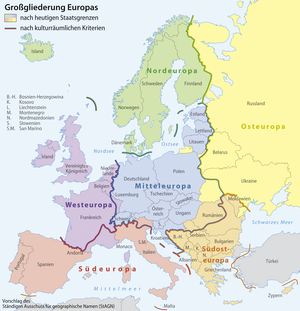
Central Europe is a conventional part of Europe , which is indicated between Western Europe and Eastern [2] [3] [4] . The question of its borders remains debatable.
Content
Central European States
The concept of Central Europe remains the subject of discussion [5] , although the countries that make up the Visegrád group are almost always de facto considered countries of Central Europe [6] . Various sources refer different countries to the countries of Central Europe, but most often the following are referred to countries of Central Europe:
- Austria
- Hungary
- Germany
- Liechtenstein
- Poland
- Slovakia
- Slovenia [7] (sometimes referred to southeastern Europe [8] )
- Czech
- Switzerland
Depending on the context, Central European countries are either Western or Eastern Europe [9] [10] [11] [12] . For example, Austria can be attributed to the Central European countries, to the Eastern European [13] and Western European [14] .
Other countries
Some scholars also include the following countries in Central Europe based on historical, geographical, and / or cultural ties:
- Croatia [15] [16] [17] [18] [19] (often referred to Southeast Europe [20] [21] )
- Romania ( Transylvania [22] [23] ) [24] [25] [26]
The Baltic countries , geographically located in Northern Europe, belong to Central Europe in the German sense of the term, that is, to Mittel-Europe . Benelux countries in most cases are attributed to Western Europe, and not Central. However, they are sometimes mentioned in connection with Central Europe due to their historical, cultural and linguistic ties.
Parts of the following states are also sometimes referred to Central Europe:
- Italy ( South Tyrol , Trieste , Trento , Gorizia , Friuli )
- Ukraine ( Transcarpathia [27] , Galicia and northern Bukovina [23] )
Central Europe Concept
Central Europe is not so much a geographical reality as a historical, in a sense, historical and ideological concept.
Friedrich Naumann put forward the concept of Mitteleuropa outlined by him in a book of the same name at the height of the First World War ( German - central Europe). In it, Central (more precisely, “Middle”) Europe was seen as a sphere of influence of Germany , expanded after its alleged victory in the war, but it also stipulated the need to build cooperation between the countries of the region, primarily economic, on a mutually beneficial basis.
In a new form, the concept of Central Europe became the subject of relatively wide debate in the 1980s . The fact that Poland, Czechoslovakia, and Hungary belonged to the sphere of influence of the USSR aroused rejection in most of the elites of these countries. From this came the concept of the need to “return to Europe” in the future, which was thus identified with Western Europe. It was within the framework of this concept that an essay by Milan Kundera about Central Europe was written, which he described as Europe "stolen", captivated by an alien East, personified by Russia / USSR.
In fact, the “legalization” of the concept of Central Europe occurred after the 1989 revolutions , after the fall from the communist regimes. It became clear that post-communist transformations in Poland, the Czech Republic and Hungary are proceeding faster than in the former USSR (with the exception of the Baltic countries ) and the former Yugoslavia . So the “big” socialist Eastern Europe of the 1940s – 1980s began to be considered as several regions, one of which was the newly emerging Central Europe.
Central Europe as Russia's Economic Partner
There are conflicting assessments and economic interpretations of the place and role of Russia in the foreign policy and foreign economic strategy of the countries of Central Europe, numerous points of view on the formation of a new regional identity of the Central European countries [28] .
The economic crisis of the post-socialist countries, caused by systemic transformation, and the disintegration processes in the post-Soviet space in the 1990s led to the dismantling of the previous mechanisms of economic cooperation and the transition from a duty-free trade regime under the CMEA to the most favored nation treatment, as a result of which the foreign economic reorientation of the countries of Central Europe adopted the nature of the unidirectional trend [29] .
The development of processes of international economic integration in Central Europe in the 1990s led to the formation in 2001 of a duty-free zone between participants in the Central European FTA , the Baltic FTA and the EU and EFTA countries . The isolation of Russia, which did not participate in these processes, contributed to a further reduction in the volume of trade and economic interaction between Russia and the countries of Central Europe, and the degradation of the commodity structure of their foreign trade turnover.
Based on the analysis of the transformation of the trade regime of the CE countries in connection with their accession to the EU and Russia to the WTO, it can be argued that the competitiveness of Russian energy exporters will deteriorate due to the fact that the EU’s requirements for diversification of energy import sources and other legislation have come into full force EU in the field of energy [29] .
See also
- Northern Europe
- Southern Europe
- Central and Eastern Europe
- Visegrád group
- European Union
- Geographic Center of Europe
Notes
- ↑ The World Factbook: Field listing - Location (link not available) . The World Factbook . Central Intelligence Agency (2009). Date of treatment May 3, 2009. Archived May 24, 2011.
- ↑ Regions, Regionalism, Eastern Europe by Steven Cassedy . New Dictionary of the History of Ideas, Charles Scribner's Sons (2005). Date of treatment January 31, 2010.
- ↑ Lecture 14: The Origins of the Cold War . Historyguide.org. Retrieved on October 29, 2011.
- ↑ Central Europe - The future of the Visegrad group , The Economist (April 14, 2005). Date of treatment March 7, 2009.
- ↑ For the Record - The Washington Post - HighBeam Research (link not available) . Highbeam.com (May 3, 1990). Date of treatment January 31, 2010. Archived June 24, 2011.
- ↑ From Visegrad to Mitteleuropa , The Economist (April 14, 2005).
- ↑ Borders in Central Europe: From Conflict to Cooperation // Geopolitics of European Union Enlargement: The Fortress Empire . - Routledge, 2007. - P. 165. - ISBN 978-1-134-30132-4 .
- ↑ Map of Europe . TheFreeDictionary.com . Date of treatment January 15, 2015.
- ↑ United Nations Statistics Division- Standard Country and Area Codes Classifications (M49) . Unstats.un.org (October 31, 2013). The appeal date is August 4, 2014.
- ↑ World Population Ageing: 1950-2050 . United Nations. Date of treatment January 15, 2015.
- ↑ Browse MT 7206 | EuroVoc . Eurovoc.europa.eu. The appeal date is August 4, 2014.
- ↑ Webra International Kft. The Puzzle of Central Europe . Visegradgroup.eu (March 18, 1999). The appeal date is August 4, 2014.
- ↑ Highlights of Eastern Europe (Vienna through Slovenia, Croatia, Hungary, Slovakia, Poland, Germany and the Czech Republic) . a-ztours.com. Date of treatment January 15, 2015. Archived on October 20, 2014.
- ↑ Mastication Monologues: Western Europe . masticationmonologues.com . Date of treatment January 15, 2015.
- ↑ Taranov P. M. Transformation of trade and investment cooperation between Russia and the countries of Central Europe: Author. dis. on the competition scientist step. Ph.D. - Rostov n / a: Growth. state Univ., 2004 .-- 26 p.
- ↑ In the Heavy Shadow of the Ukraine / Russia Crisis, page 10 . European Bank for Reconstruction and Development (September 2014). Date of treatment January 15, 2015.
- ↑ UNHCR in Central Europe . UNCHR . Archived August 26, 2013.
- ↑ Central European Green Corridors - Fast charging cross-border infrastructure for electric vehicles, connecting Austria, Slovakia, Slovenia, Germany and Croatia . Central European Green Corridors (October 2014). Archived on April 2, 2015.
- ↑ Interreg CENTRAL EUROPE Homepage . Interreg CENTRAL EUROPE .
- ↑ Andrew Geddes, Charles Lees, Andrew Taylor: “The European Union and South East Europe: The Dynamics of Europeanization and multilevel goverance” , 2013, Routledge
- ↑ Klaus Liebscher, Josef Christl, Peter Mooslechner, Doris Ritzberger-Grünwald: “European Economic Integration and South-East Europe: Challenges and Prospects” , 2005, Edward Elgar Publishing Limited
- ↑ Sven Tägil, Regions in Central Europe: The Legacy of History , C. Hurst & Co. Publishers, 1999, p. 191
- ↑ 1 2 Klaus Peter Berger, The Creeping Codification of the New Lex Mercatoria , Kluwer Law International, 2010, p. 132
- ↑ central europe romania - Google Search .
- ↑ United States. Foreign Broadcast Information Service Daily report: East Europe
- ↑ Council of Europe. Parliamentary Assembly. Official Report of Debates . - Council of Europe, 1 October 1994. - P. 1579. - ISBN 978-92-871-2516-3 .
- ↑ Transcarpathia: Perephiral Region at the "Center of Europe" . - Routledge, 2013 .-- P. 155. - ISBN 1136343237 .
- ↑ Novopashin Yu. S. Central Europe in search of a new regional identity. // International historical journal. - 2000. - No. 11.
- ↑ 1 2 Taranov P. M. Foreign Economic Relations of Russia with the Post-Socialist Countries of Central Europe // News of Higher Education Institutions. North Caucasus region. Social Sciences. 2003. - No. 3.
Links
- Alexey Miller . The theme of Central Europe: history, contemporary discourses and Russia's place in them
- Yaroslav Shimov. Central Europe: small nations in search of a "big homeland"
- Yaroslav Shimov. Central Europe: the way home
- Oskar Krejčí. "Geopolitics of the Central European Region. The view from Prague and Bratislava ” Bratislava: Veda, 2005. 494 p.
- Taranov P. M. Transformation of trade and investment cooperation between Russia and the countries of Central Europe: Author. dis. for a job. scientist step. Ph.D. - Rostov n / a: Growth. state Univ., 2004 .-- 26 p.
- Taranov P. M. Foreign Economic Relations of Russia with the Post-Socialist Countries of Central Europe // News of Higher Education Institutions. North Caucasus region. Social Sciences. 2003. - No. 3.