Vesprem ( Hungarian. Veszprém , German: Weißbrunn ) - one of the oldest cities in Hungary , the administrative center of Veszprem County . The population as of January 1, 2014 is 60,788 [1] people.
| City | |||||
| Veszprem | |||||
|---|---|---|---|---|---|
| Veszprém | |||||
     | |||||
| A country |  Hungary Hungary | ||||
| Copper | Veszprem | ||||
| The mayor | Carmel Tirat | ||||
| History and Geography | |||||
| Square | 126.9 km² | ||||
| Center height | 260 m | ||||
| Timezone | UTC + 1 , in summer UTC + 2 | ||||
| Population | |||||
| Population | 60 788 people ( 2014 ) | ||||
| Density | 486.38 people / km² | ||||
| Official language | Hungarian | ||||
| Digital identifiers | |||||
| Telephone code | (+36) 88 | ||||
| Postcode | 8200 | ||||
| veszprem.hu (Hungarian) | |||||


Content
Geography and transport
The city is located on both sides of the Shed River, about 110 kilometers southwest of Budapest and 15 kilometers from the shore of Lake Balaton . Veszprem is connected by motorways with Budapest , Szekesfehervar , Gyor and the surrounding cities. The Szekesfehervar-Veszprem- Szombathely railway passes through the city. It takes about 2 hours by train to Budapest.
History
Veszprem is one of the oldest cities in Hungary. It was founded during the reign of King St. Stephen , however, according to the chronicler of Prince Bela III , there was already a castle on the rock where the Veszprem fortress was built when the Hungarians came to this region. Probably it was the strengthening of the Franks , erected in the era of Charlemagne . Veszprem became one of the first bishopric departments of Hungary, the department was founded in 1009 . The Veszprem bishops have long been privileged to crown Hungarian queens, which is why Veszprem was called the “city of queens”. From the hands of the bishops of Veszprém, all the queens of Hungary received the crown, starting with Gisela , the wife of Saint Istvan, to Zita Bourbon-Parma , the last Queen of Hungary, the wife of Charles I of Habsburg . In 1001, the Cathedral of St. Michael was built in the city, subsequently repeatedly rebuilt.
By the 13th century, the Veszprem fortress had turned into a well-fortified stronghold on a steep and rocky hill with powerful walls. In 1241, the Mongol army was unable to take it and retreated from the city. In 1552, Veszprem was captured by the Turks, but they were quickly expelled, thanks to which more medieval monuments were preserved in the city than in many other Hungarian cities.
The growth of the city led to the fact that it occupied a large territory, spreading to the surrounding hills. It is believed that the hills on which the city is located are seven, as in Rome:
- Fortress (Várhegy),
- Jerusalem (Jeruzsálem-hegy),
- Shepherd (Gulyadomb),
- Cemetery (Temetőhegy),
- Cherhat (Cserhát),
- Calvaria (Kálvária-domb) and
- Benedictine (Benedek-hegy).
In 1706, the walls of the fortress were destroyed by Austrian soldiers.
Attractions
The main attractions of Veszprém are concentrated on Fortress Hill, in the most ancient part of the city. Among them:
- Episcopal Palace - is located in the center of the Old Town on St. Trinity Square. Built in the Baroque style in the late 70s of the XVIII century.
- St. Michael. The first cathedral on this site was built in 1001 in the Romanesque style , subsequently rebuilt many times. The cathedral took its current form after another restructuring in 1910. From the original ancient temple, only the altar and crypt were preserved. On the north side, the remains of the ancient chapel of St. George, IX century.
- Gisella Chapel. A small, very ancient chapel is located between the Episcopal Palace and the neighboring Rector's House. Despite the fact that there are no reliable sources about the connection of the chapel with the name of the famous queen, there is no doubt that it was created in the early period of the rule of the Arpad , most likely in the XI century.
- Monument to Istvan and Gisella. The monument was erected in 1938 in an unusual place, above the cliff of the fortress hill. The monument offers a magnificent view of the surroundings.
- Convent of PR. Built in the XVIII century, the Order of PR .
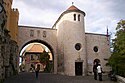
- Gates of Heroes. Built in 1936 on the site of a medieval gate. The architecture of the neo-Romanesque gate, despite its modern origin, the gate fits well into the ensemble of ancient buildings around them.
- Fire tower. The tower was built in the 15th century as a watchtower. In 1810, it was hit hard by an earthquake. Initially, it was decided to disassemble it, but then it was rebuilt into a fire tower and served for a long time in that capacity.
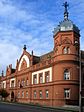
- The ensemble of the square Ovarosh ter. Ovarosh Ter Square, located at the foot of the ramparts, is surrounded by beautiful Baroque mansions, among which the town hall and the house of the Pose family stand out.
- Petofi Theater. The theater building in a beautiful park near the ramparts was built in 1908 in the Art Nouveau style . It is named after the great Hungarian poet Sandor Petofi , who has a monument near the entrance to the theater.
Twin Cities
- Kursk , Russia
- Bottrop , Germany
- Gladsax , Denmark
- Ottignies-Louvain-la-Neuve , Belgium
- Passau , Germany
- Rovaniemi , Finland
- Sfintu Gheorghe , Romania
- Tartu , Estonia
- Tirat Carmel ( Haifa District), Israel
- Saint-Michel-sur-Orge , France
- Амбamberk , Czech Republic
Literature
- Hungary. Guide. Around the World, 2007. ISBN 978-5-98652-117-6
Notes
Links
- Official website of the city (English)
- Veszprem on the site funiq.hu (Russian)
Gallery
St. Michael
Church and monastery of public relations
Fire tower
Heroes Gate
Ovaros Ter
House Pose
Monument to Istvan and Gisella
St. Trinity