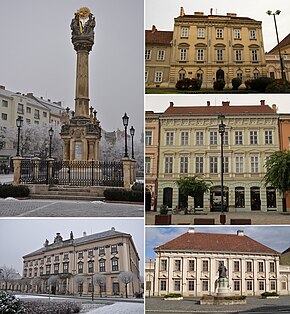
Szombathely ( Hungarian. Szombathely ['sombɒt.hɛj] , German. Steinamanger , Croatian. Sambotel , Slovenian. Sombotel , Slovak. Kamenec ) - the city in the west of Hungary , the oldest in the country. The administrative center is yours . The population is 77,566 [1] people (2014).
| City | |||||
| Szombathely | |||||
|---|---|---|---|---|---|
| Szombathely | |||||
 | |||||
| A country |  Hungary Hungary | ||||
| Copper | Your | ||||
| The mayor | Tivadar Puskas | ||||
| History and Geography | |||||
| Founded | 45 BC | ||||
| Former names | Savaria | ||||
| Area | 97.52 km² | ||||
| Center height | 216 m | ||||
| Timezone | UTC + 1 , in summer UTC + 2 | ||||
| Population | |||||
| Population | 77 566 people ( 2014 ) | ||||
| Density | 813.82 people / km² | ||||
| Official language | Hungarian * | ||||
| Digital identifiers | |||||
| Telephone code | (+36) 94 | ||||
| Postcode | 9700 | ||||
| szombathely.hu (Hungarian) | |||||


Content
- 1 Geography and transport
- 2 Etymology
- 3 History
- 4 Attractions and events
- 5 Sports
- 6 Culture
- 7 Famous Natives and City Residents
- 8 Twin Cities
- 9 notes
- 10 Links
Geography and transport
Szombathely is located in the Western Transdanubia, about 220 kilometers west of Budapest and 10 kilometers east of the border with Austria . The Budapest - Szekesfehervar -Szombathely- Graz railway passes through the city. The train journey to Budapest takes about 4 hours. The roads lead from the city south towards the E66 Szekesfehervar-Graz Autobahn and north towards Sopron and Vienna . Two small rivers flow through the city - Perint and Gyöngyös.
Etymology
The Hungarian name for the city comes from the words Hung. Szombat - Saturday and Hung. hely is the place and goes back to the famous fairs that were held in the city every Saturday. The German name is German. Steinamanger literally translates as “stones on the field” and possibly refers to the ruins of the Roman city of Savaria, and possibly alludes to the 458 earthquake that completely destroyed the city. Latin name is lat. Savaria comes from Sybaris, the Roman name for the Gyöngyös River.
History
Szombathely is the oldest city in Hungary. It was founded by the Romans in 45 BC. e. under the name Savaria and was the capital of the province of Pannonia . The city was built an imperial residence, baths and an amphitheater. The future emperor Septimius Severus led Pannonia and was proclaimed emperor in Savaria.
The heyday of the city was the period of the reign of Constantine the Great , who himself visited Savaria several times. New buildings, theaters and churches were built in the city. According to one version, Saint Martin of Tours was born here (according to another version, this happened in Pannonhalm ). During the reign of Valentinian III, the Huns conquered Pannonia. Savaria was occupied in 445. In 458, Savaria was destroyed to the ground by a powerful earthquake.
In the V - VIII centuries, the city, despite everything, remained inhabited, Slavic tribes and Avars lived here. After the defeat of the latter by Charles the Great, he came under the rule of the Franks , and at the end of the 9th century under the rule of the Moravians . In the X century, the former Pannonia was conquered by the Hungarians. In 1009, Istvan I the Holy included Szombathely in the newly organized Diocese of Gyьr . In 1242, the city was destroyed by the Mongols , but it quickly rebuilt and in 1407 received the status of a free royal city. In 1578, Szombathely became the capital of your committee .
During the Ottoman invasion, the city was besieged by the Turks twice. For the first time in 1664, the Turks were forced to retreat after the defeat that the Austrians inflicted on them near Szentgotthard . In 1683, after a defeat in the battle of Vienna, the Turks during the retreat plundered a large number of cities, but this time Szombathely saved the fortress walls.
The beginning of the 18th century was a period of disaster for the city. During the uprising of Ferenc Rakoczy, Szombathely was engaged in warring several times, in 1710 more than 2 thousand inhabitants died from the plague , and in 1716 a fire destroyed most of the city’s buildings. Disasters led to a sharp reduction in the population, which caused an influx of new colonists into Szombathely, mainly Germans. Soon the Germans began to make up the majority of the population of the city.
In 1772 a gymnasium was built, five years later Szombathely became an episcopal residence, after which it entered a period of rapid growth. Here was built a cathedral, an episcopal palace, and many new buildings. In 1809, the city was occupied by Napoleon and held by him for 110 days. In the 1849 Revolution, Szombathely supported the rebels, but there were no military operations in the vicinity of the city. In 1865, the railway came to the city, in 1885 several neighboring villages were included in the growing city.
After World War I, Hungary lost most of its territory, and Szombathely became a border town. During World War II , like most Hungarian cities, Szombathely was heavily bombed. The city was liberated on March 29, 1945 by troops of the 3rd Ukrainian Front . In the post-war period, the city was industrialized, a number of textile, machine-building and food-processing enterprises were built in it.
One of the districts of the city “YoshkarOla” is named after the twin city of Yoshkar-Ola , the capital of the Mari- related people of Hungary. In turn, in Yoshkar-Ola, one of the districts is called “Szombathely”.
Attractions and Events
- The ruins of Roman Savaria . The remains of the temple of Isis (beginning of the III century) and the early Christian basilica (IV century).
- Cathedral of the city . Built in the late 18th century in the Baroque style .
- Bishop's Palace . The rococo palace was built in the 18th century after Szombathely became the episcopal residence.
- City Hall .
- Canon House .
- Church of st. Martina . According to legend, it was placed at the place of birth of St. Martin Toursky.
- Church of st. Elizabeth .
- The synagogue .
- Museum "Savaria". Numerous Roman archaeological artifacts are presented.
- Historical festival "Savaria".
- City water tower .
Sport
The city is based football club Haladash , bronze medalist of the Hungarian championship 2008/2009.
Culture
Since 1962, the Savaria Symphony Orchestra has been based in the city.
Since 1993, one of the pioneers of the Hungarian electronic scene, the project Anima sound system, has been engaged in the work of the city.
Famous Natives and Residents
- Martin Tours
- Sandor Vöresh
- Laszlo Magyar
- Gyorgy Garich
- Rudolph Virag, father of Leopold Bloom, one of the two main characters of the novel by J. Joyce Ulysses
Twin Cities
- Ferrara ( Italy )
- Kaufbeuren ( Germany )
- Lappeenranta ( Finland )
- Ramat Gan ( Israel )
- Maribor ( Slovenia )
- Yoshkar-Ola ( Russia )