The Visn defense took place during the German invasion of Poland at the beginning of World War II and lasted 3 days. Against the 19th German army corps , which consisted of more than 42 thousand soldiers, 350 tanks and 650 guns, the Poles put up a total of 720 people, armed with 42 machine guns, 6 guns and two anti-tank guns. This battle in Polish history is otherwise called the " Polish Thermopylae " [2] .
| Visa Defense | |||
|---|---|---|---|
| Main Conflict: World War II Polish Wehrmacht Campaign (1939) | |||
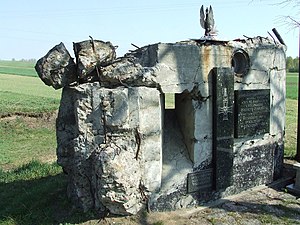 The ruins of one of the Polish bunkers in Wiesn | |||
| date | September 7 - September 10, 1939 | ||
| A place | Wiesna , near Lomza , Poland | ||
| Total | German victory | ||
| Opponents | |||
| |||
| Commanders | |||
| |||
| Forces of the parties | |||
| |||
| Losses | |||
| |||


Content
Before the battle
For a long time, the territory near Vizna was considered a strategic point for the Polish armed forces. On the south side, the area near Vizna was an advantage for the Poles at the intersection of the Narew and Bobra rivers. The 9-kilometer zone to the north, however, was poorly fortified, and its loss in the event of a conflict would open the way for the enemy from the north to Warsaw , since the Polish troops would not have had time to transfer sufficient forces from Lomza .
The fortifications around Vizna were considered a key point in the Polish defense system on the eastern border. Also, the most important Lomza- Bialystok road passed through Vizna. To protect the village in April 1939, the construction of fortifications began. The site for the construction of fortifications was carefully chosen, as many concrete bunkers were built on the hills through which Narev flowed. In the event of a “head-on hit”, the enemy would have easily reached the bunkers by crossing the bridge. By September 1, 1939, 12 bunkers were built, of which 6 were built of reinforced concrete (the weight of each dome was about 8 tons), and the remaining 6 were equipped with machine gun nests. Another 4 bunkers were under reconstruction at the time of the outbreak of war. Also, many trenches were dug in the territory, many anti-tank and anti-personnel ditches were dug. It was assumed that the dams on the Beaver and Narew rivers could be destroyed to strengthen their defenses, but in the summer of 1939 there was a severe drought in the history of Poland, and the water level was very low.
Despite the incomplete preparation for the defense, the Polish fortifications were very good in quality. The average thickness of the walls of the bunker was one and a half meters, there were also steel plates 20 cm thick, which no Wehrmacht artillery could penetrate at that time. Bunkers were located on the hills, which gave a greater radius of fire to troops inside.
The first phase of the battle
On September 1, 1939, Germany attacked Poland, starting the Second World War. The 3rd Wehrmacht Army , located in East Prussia, moved towards Warsaw, trying to attack it from the rear, fighting the task force "Narew" .
On September 2, the defense of Vizny was led by Captain Vladislav Raginis . He chose a bunker, codenamed "GG-126," which was located near Gura-Strenkova , as headquarters. The bunker was located on a hill in the very center of the Polish defense line.
The Polish forces consisted of soldiers of the 8th Infantry Battalion of the 135th Infantry Regiment, two companies of Czech Carabinieri, the 136th Engineer Company, a horse company and a positioned artillery battery [3] . Under the leadership of Raginis, there were about 700 soldiers and non-commissioned officers , as well as 20 officers who had only 6 76 mm caliber heavy weapons, 24 heavy machine guns and 18 light machine guns, as well as only 2 anti-tank guns of the 1935 model .
The Polesye cavalry brigade, preparing for the defense, was forced to retreat on the night of September 3–4 after many attacks from the flank and go to Malo-Plock. On September 3, Polish troops were attacked from the air, and their aircraft could not do anything.
On September 7, scouts from the 10th Panzer Division , led by Nikolaus von Falkenhorst , entered Vizna. Scouts from the Polish Mountain Division were defeated and retreated to the southern coast of Narew. The attempt of the Germans to break through Narew across the bridge was stopped by Polish engineers, destroying the only bridge. German patrols at dawn tried to advance to Gelchin, but were repelled with heavy losses.
On September 8, Guderian ordered to break through to Vizna to Brest. At dawn the next day, German troops invaded Vizna and joined the 10th Panzer Division, as well as the Letzen brigade. The German forces totaled 1,200 officers and 41,000 soldiers and non-commissioned officers. The army also had at least 350 tanks , 108 howitzers , 188 grenade launchers, 288 heavy machine guns and 689 machine guns. According to various sources, the balance of forces ranged from 40 to 60 German soldiers per Polish .
Battle Phase 2
In the early morning, German planes dropped many leaflets to the Poles with an offer to surrender and a promise to save their lives, warning of the futility of the resistance. However, Vladislav Raginis preferred death to surrender and refused the offer to surrender. Soon, artillery fire began. Polish guns were hastily transported to Bialystok. After preparations, the Germans attacked the northern flank of the Polish army, which was weakly fortified. Two platoons of Polish troops were attacked from three sides, but the Germans suffered huge losses. First Lieutenant Kevlich was ordered to set fire to the bridge in order to cut off the path to Bialystok. Partially, Kevlich’s troops broke through the encirclement and were able to cross to Bialystok, where they joined the troops of General Franciszek Kleiberg .
At this time, the Polish fortifications in the south were cut off. It was impossible to repel the tank attack, however, infantry could be fired from Polish bunkers. By 6 o’clock in the evening, however, the Polish forces were forced to retreat to the bunkers, leaving trenches and field fortifications. German tanks crossed the line of defense and advanced to Tykocin and Zambrow, but the German infantry suffered huge losses and did not follow the armored units.
Raginis could not get reinforcements from Lieutenant Tadeusz Tabachnitsky , although his troops were very close (30 kilometers from Osovets ). On September 8, Supreme Commander Edward Rydz-Smigly ordered the 135th Infantry Regiment to retreat to Warsaw. When the order had already reached the troops, it was too late. Polish troops on Wiesn could no longer escape from the encirclement.
The assault on the fortifications continued. Until the morning of September 10, German troops stormed the positions of the Poles around the clock. By 12 o’clock in the afternoon, German troops destroyed 10 of the 12 bunkers. Despite the large number of casualties and lost equipment, the fire did not cease and the remaining 2 bunkers continued to resist. Guderian, in order to force the Poles to cease fire, sent an ultimatum to Captain Raginis demanding a cease-fire, threatening to shoot prisoners. In response, Captain Raginis committed suicide by blowing himself up with a grenade. The remnants of the Polish troops were destroyed, but none of the captives was shot.
Consequences
After the battle, the 19th Army Corps advanced to Vysoké Mazowiecki and Zambrow , defeating the 18th Polish Infantry Division near Andrzejewo, which retreated south and fought at Brest-Litovsk .
Despite the complete destruction of the Polish battle group, the advance of the Germans was slowed down by 3 days. However, this did not prevent Germany from occupying Poland. The feat of the Polish army is now one of the symbols of Poland’s participation in the Second World War, as well as a part of modern Polish culture.
Losses
The official losses of the party are still unknown. Most likely, all Polish troops were destroyed, about 40 people were captured. According to Guderian, the German losses were estimated at 900 people. Despite only 2 anti-tank rifles at the Poles, at least 10 German tanks and a certain number of armored vehicles were destroyed.
Reflection in Culture
Swedish power metal band Sabaton has dedicated their song “ 40: 1 ” to Vizna’s defense. The song was included in their album The Art of War , the name of the song shows the ratio of German and Polish troops. The song focuses on the heroism of Polish soldiers, they are compared with the Spartans . The Minister of Defense of Poland praised this and awarded the musicians with commemorative officer dirks [4] .
See also
- Polish Post Defense in Gdansk
- Defense of westerplatte
- Helsky Spit Defense
Literature
- Kosztyła Zygmunt. Obrona odcinka "Wizna" 1939, BKD (Bitwy, Kampanie, Dowódcy) [7/76], 1976
- Kupidura P., Zahor M. Wizna, Wojskowy Przegląd Techniczny i Logistyczny, nr 3, 1999
- Stawiński Kazimierz. Bój pod Wizną. Warszawa 1964. Wydawnictwo Ministerstwa Obrony Narodowej.
- Wiktorzak A. Wizna - Polskie Termopile, Głos Weterana, nr 9, 1997
Notes
- ↑ 1 2 Heinz Guderian. Memoirs of a soldier. The beginning of the disaster
- ↑ Andrzej Krajewski. Polskie Termopile, czyli cud pod Wizną (Polish) // Polska The Times . - 2009-09-04. - P. 16-17. - ISSN 1898-3081 .
- ↑ Battle of Visa. Polish Thermopylae?
- ↑ Minister obrony narodowej docenił muzyków Sabatona (Polish) . // Gazeta Wyborcza (03/02/2013). Date of treatment July 13, 2013. Archived January 8, 2014.