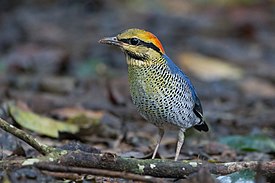
Pitovye all look alike in common warehouse and habits. Previously, they were often placed in one genus, although from 2009 to the present, this family is divided into three genera: Pitta , Erythropitta and Hydrornis . The name comes from the word “pitta” in Telugu , common in southern India, and denotes the common local name for all small birds. By the standards of passerine pitas, birds are medium in size, from 15 to 25 cm long. Dense, with a compact teardrop-shaped body, they have strong and high legs. They are characterized by very short tails and a powerful, slightly curved beak. Many of them, but not all, have brightly colored plumage [2] .
These are predominantly land birds collecting food on moist forest litter. They feed on mollusks, insects and other invertebrates. Pitovye, mostly solitary. During nesting, they lay up to six eggs in a large spherical nest, which they build in trees or in shrubs, or sometimes directly on the ground. Both male and female take part in the care of the offspring [2] . Many pitta species are migratory.
A number of pitta species are threatened with extinction. One of them, pitta Gurney , is listed in the IUCN Red List [3] , eight more have a status of “vulnerable species” [4] . The main threat to pitts is habitat degradation due to rapid deforestation.
During migration, pitts often appear in the most unexpected places, for example, in such as home gardens.
The following taxa [5] [1] are included in the family:
- Genus Pitta Vieillot , 1816 - Pitts
- Pitta anerythra Rothschild, 1901 - black-faced pitta
- Pitta angolensis vieillot, 1816 - angolan pitta
- Pitta brachyura Linnaeus, 1766 - blue - winged pitta
- Pitta elegans Temminck, 1836 - slim pitta
- Pitta iris Gould, 1842 - Rainbow Pitta
- Pitta maxima S. Muller et Schlegel, 1845 - pitta giant
- Pitta megarhyncha Schlegel, 1863 - mangrove pitta
- Pitta moluccensis Statius Muller, 1776 - moluccan pitta
- Pitta nympha Temminck et Schlegel, 1850 - pitta nymph
- Pitta reichenowi Madarasz, 1901 - green- breasted pitta
- Pitta sordida Statius Muller, 1776 - black - headed pitta
- Pitta steerii Sharpe, 1876 - Pitta Steer , Blue - bellied Pitta
- Pitta superba Rothschild et Hartert, 1914 - black - backed pitta
- Pitta versicolor Swainson, 1825 - Loud Pitta
- Genus Hydrornis Blyth , 1843
- Hydrornis phayrei (Blyth, 1862) - eared pitta [6]
- Hydrornis nipalensis (Hodgson, 1837) - Nepalese Pitta [7]
- Hydrornis soror (Ramsay RGW, 1881) - blue - lumbar pitta [8]
- Hydrornis oatesi hume , 1873 - brown- headed pitta [9]
- Hydrornis schneideri (Hartert, 1909) - Pitt Schneider [10]
- Hydrornis caeruleus (Raffles, 1822) - Great Pitta
- Hydrornis baudii (Müller, S & Schlegel, 1839) - blue - breasted pitta [11]
- Hydrornis cyaneus (Blyth, 1843) - Blue Pitta [12]
- Hydrornis elliotii (Oustalet, 1874) - striped-bellied pitta [13]
- Hydrornis guajanus (Statius Müller, 1776) - blue-tailed pitta [14]
- Hydrornis irena (Temminck, 1836) - Sumatran blue-tailed pitta [15]
- Hydrornis schwaneri (Bonaparte, 1850) - Borneo blue-tailed pitta
- Hydrornis gurneyi (Hume, 1875) - Pitta Gurney [16]
- Genus Erythropitta Bonaparte , 1854
- Erythropitta kochi (Brüggemann, 1876) - Luzon Pitta [17]
- Erythropitta erythrogaster (Temminck, 1823) - Red - bellied Pitta [18]
- Erythropitta arquata (Gould, 1871) - Red-headed Pitta [19]
- Erythropitta granatina (Temminck, 1830) - Pomegranate Pitta [20]
- Erythropitta venusta (Müller S., 1836) - Graceful Pitta [21]
- Erythropitta ussheri (Gould, 1877) - Sarawak Pitta [22]