Ginzburg skyscraper , or Ginzburg House - 12-story skyscraper , which stood [1] [2] in Kiev at the beginning of the XX century. It went down in history as “the first skyscraper of Ukraine” [3] [4] [5] . It was built in 1910-1912, was blown up by the NKVD troops on September 24, 1941 and completely destroyed in the early 1950s, when the final demolition of the foundation of the house was carried out. In the year of construction it was the highest skyscraper of the Russian Empire [6]
| Hotel | |
| Ginzburg Skyscraper | |
|---|---|
| Hmarochos Ginzburg | |
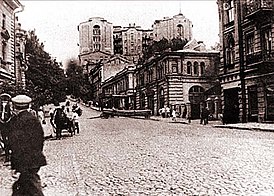 Ginzburg Skyscraper | |
| A country |  Russian empire Russian empire |
| Location | Kiev , st. Institutskaya , 4 |
| Architectural style | Modern |
| Project Author | Adolph Minkus Fedor Troupiansky |
| Construction | 1910 - 1912 |
| condition | destroyed (in 1941 ) |
Content
- 1 Construction
- 1.1 Height
- 2 History
- 2.1 Destruction
- 3 Other Ginzburg houses
- 4 References
- 5 notes
- 6 See also
- 7 records
Construction
At the place where the Ginzburg House was built, by the beginning of the 20th century there was a 4-storey house of a military engineer M.P. Fabricius .
The construction of the skyscraper began during the second construction boom, in 1910 on Institutskaya Street, on the site of houses No. 14, No. 16 and No. 18 (40-50 meters north of the current Ukraine Hotel ). The project was developed by Odessa architects - A. B. Minkus and F. A. Troupiansky.
According to the plan, the house should have an h-shape and different floors on the sides of the structure (it was determined by the location of the house on a hill) - all 11 floors were visible only from Nikolaevskaya Street.
The owner of the building was a well-known construction contractor, the first guild merchant Lev Borisovich Ginzburg , who decided to build a “profitable house” on an area of 2036 square fathoms (about 9300 m²) [7] .
In 1889, he bought a plot from Mikhail Fabrizius, and subsequently demolished the 4-storey “apartment building” (house number 18), which was located here. Leo Ginzburg was the owner of a construction company, which was engaged in the construction of the house.
The construction cost 1,500,000 rubles [8] .
12 million bricks were used. The construction was carried out in adverse geological and hydrological conditions, but using the latest technologies at that time. Ginzburg's house was built in the "modern" style (all the buildings of Khreshchatyk at the beginning of the 20th century were made in this style). In 1912, the construction of the skyscraper was completed, at the same time the opening took place. The house immediately became the most modern in Kiev, as it had the rare forged elevators of the American company Otis .
Height
Since the height of one floor of the skyscraper was 4 m, it is possible that the house had 45-55 meters in height, which was at the level of Kiev bell towers. In addition, a tower with a spire still rose above the building, giving the house another 10 meters of height. Therefore, the height with a spire could range from 60 to 70 meters and is still not precisely defined.
Residential buildings as tall as the Ginzburg skyscraper at the beginning of the 20th century existed only in the USA, Germany, Argentina and Canada.
History
The house was used as a hotel for visitors and for renting apartments; in those days, such houses were called profitable. There were 94 luxury apartments in a skyscraper, the largest of which had 11 rooms. There were about 500 rooms in total.
This building was serviced by a large number of servants, only there were more than twenty cleaners [9] .
On the ground floors of the Ginzburg house there was a shopping center (food shops were located here). The construction was crowned with a tower, from where beautiful panoramas of Kiev opened. Ginzburg's house was so famous that every cabman knew where it was. Due to the height of 50-60 meters, the building was visible even for several kilometers.
Since 1913, Prince Alexander Obolensky , the head captain , one of the adjutants of the Kiev, Podolsky and Volyn governor-general Fedor Trepov, lived in a skyscraper.
From 1915 to 1918, the Poltava second guild merchant Sergei Arshavsky , a customer and former owner of the famous Weeping Widow House, lived in the Ginzburg house.
In the fall of 1913, the famous artist Alexander Murashko on the 11th floor of the building opened the "Alexander Murashko Art Studio", in which almost 100 people studied at the same time. The owner himself, Leo Ginsburg, did not live in a skyscraper, but in a two-story house built near it.
A prose writer Vadim Okhrimenko , an avid hunter, correspondent for the newspaper Pravda and a great friend of Maxim Rylsky, also lived in the house [10] .
In 1917, expensive skyscraper apartments (for a year of living in it) cost from 1300 to 1700 rubles.
In Soviet times, the skyscraper was nationalized . It was turned into a residential building - hotel rooms were redeveloped into communal apartments . By 1928, the Ginzburg House was the tallest in the Soviet Union [11] .
The house took part in the shooting of the experimental Soviet film " A Man with a Movie Camera " in 1929, the tower and the inner courtyard of a skyscraper were shot in the film [12] .
When German troops occupied Kiev in 1941, the Ginzburg skyscraper became the underground headquarters of the Soviet intelligence officer Ivan Kudri , where he kept his weapons and valuables. The scout also used the building to transmit radiograms.
According to the memoirs of contemporaries, some pilgrims who came from other cities and headed to St. Sophia Cathedral and the Kiev Pechersk Lavra were baptized in front of a skyscraper, mistaking it for a temple [13] .
The owner of the building, Leo Ginsburg, died before his creation - in 1926 in a hospital.
Destruction
A few days before the occupation of Kiev by German troops, the engineering units of the 37th Army of the Southwestern Front, together with the NKVD units, began large-scale mining of the city. In a short time, power plants, water supply, railway lines, bridges across the Dnieper, administrative buildings and some large houses were mined. The operation was carried out in secrecy mode. So, in the cellars of the Ginzburg house, NKVD officers carried explosives in wooden boxes under the guise of moving archives. The latest Bemi radio-controlled landmines and remote explosive devices were used to detonate (the Red Army was the first to use such explosives in practice) [14] .
The chief engineer of the General Staff, Captain Khilyakin, and the head of the engineering department of the 37th Army, Colonel Alexander Goldovich coordinated the engineer work , and the direct performer of blasting in the city itself was the commander of the 11th platoon of special forces, Lieutenant Mikhail Tatarsky [15] . September 24, 1941, on the fifth day of the occupation of Kiev, at about 23:00, the Ginzburg house and several other buildings on Khreshchatyk were blown up. From the gigantic building there was only a skeleton.
In total, in the explosions of September 24–27, 16 buildings of Khreshchatyk (including the Ginzburg house) were destroyed. The explosion did not completely destroy the skyscraper - it was finally demolished in the 1950s during the "clearing" of Kiev. Interestingly, the foundation of the skyscraper began to be dismantled only at the beginning of preparation for the construction of the Moscow Hotel .
In 1954-1961, at the place where the Ginzburg House stood, the Moscow Hotel was erected (since 2001 - Ukraine).
Other Ginzburg houses
In addition to a skyscraper, Ginzburg's house was called a gorgeous six-story “apartment building” on 9 Gorodetsky Street (Kiev, Paris). In addition to the main 6 floors, the house has two more - underground and attic [16] .
The Leo Ginzburg Construction Company also built other buildings - the National Bank of Ukraine, the House of the National Philharmonic of Ukraine, the Teacher’s House, the National Art Museum of Ukraine and others.
The residential building of the People's Commissariat of Finance in Moscow , designed by M. Ya. Ginzburg and I.F. Milinis , was also called the "Ginzburg House". [17]
References in the literature
Ginzburg’s house is mentioned in the collection of short stories Front Without a Front Line , namely in the work Two Years Over the Abyss by Viktor Drozdov and Alexander Evseev . A feature film was shot on this work, where the authors acted as screenwriters:
| It was late evening. Khreshchatyk burned. Under the explosions, in the light of the glow, tormented and horrified people dragged their belongings and children to the slopes and cliffs of the Dnieper until dawn. Kudrya and Maria Ilyinichna walked along the street, pushing a baby stroller in front of them, in which lay a suitcase and some clothes - all that they managed to take with them. They still thought that in a day or two they would return to Institutskaya. When they approached the Philharmonic Hall, an explosion rang out somewhere behind. Flames soared into the sky. The Ginzburg House no longer existed ... There were no more weapons, ciphers, passports, money, addresses, products - almost all that Kudra picked up with such difficulty for work. Everything had to start all over again. |
The house is also mentioned in the book "Sputnik in the city of Kiev, 1912":
| ... the giant L. B. Ginzburg is the tallest and most extensive building in the whole city; This house has 10-12 floors and 90 apartments, comprising a total of over 500 rooms. From the balconies of the upper floors of this "skyscraper" a wide view of the Old City with its ancient churches opens; from here, you can also view in clear weather almost the entire city "bird's-eye view". |
Notes
- ↑ History (inaccessible link) . Hotel Ukraine. Date of treatment December 16, 2009. Archived July 4, 2012.
- ↑ The house that Ginzburg built . Socmart. Date of treatment December 16, 2009. Archived July 4, 2012.
- ↑ This skyscraper is indeed the first in Ukraine, because the first skyscraper in Kharkov was built in 1928 ( Gosprom ), and the first skyscraper in Lviv in 1921 (Sprecher House); in other Ukrainian cities, skyscrapers appeared much later.
- ↑ Dnieper towers . Encyclopedia Kiev. Date of treatment December 16, 2009. Archived July 4, 2012.
- ↑ Higher, higher and higher? (inaccessible link) . News in Ukraine. Date of treatment December 16, 2009. Archived on April 5, 2013.
- ↑ http://www.domindex.com.ua/article/90 Archived June 1, 2009 by Wayback Machine Checked 2010-02-25
- ↑ The house that Ginzburg built (Inaccessible link - history ) . House index. Date of appeal December 16, 2009. (unavailable link)
- ↑ write across ... - September 24, 1941. Ginzburg House
- ↑ http://www.socmart.com.ua/news/kiev/read/3716/ Retrieved 2010-03-07.
- ↑ http://www.umoloda.kiev.ua/print/84/45/6628/ Retrieved 2010-01-21.
- ↑ Previously, the Gosprom was considered the highest skyscraper of the USSR, but in reality, Ginzburg's skyscraper was erected 16 years earlier, and was almost identical in height to the Gosprom.
- ↑ http://mik-kiev.livejournal.com/44130.html?thread=718946 Retrieved 2010-03-17.
- ↑ [1] . "The first skyscraper."
- ↑ http://archunion.com.ua/history/history_008.shtml Archived copy of January 29, 2009 by Wayback Machine Checked 2010-02-24.
- ↑ Laurel: Behind the scenes of tragedy . Ukraine is young. Date of treatment December 22, 2009. Archived July 4, 2012.
- ↑ http://www.domindex.com.ua/article/344 (inaccessible link) The house that Ginzburg built. Retrieved 2009-12-17.
- ↑ http://www.sak.ru/reference/famous-buildings/famous-building4.html Checked 2010-03-23
See also
- Hotel "Ukraine" (Kiev)
- List of tallest buildings in Ukraine
- Skyscraper