Ckm wz.30 ( Polish ciężki karabin maszynowy wz.30 ; - 1930 machine gun ) - Polish easel machine gun , which is a modification of the American Browning machine gun M1917 . It was in service with the Polish army , the captured machine guns were used by the Wehrmacht .
| Ckm wz. thirty | |
|---|---|
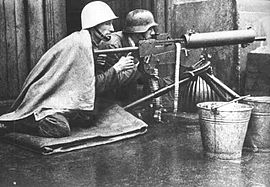 Polish rebels with a machine gun Ckm wz.30, Warsaw Uprising (1944) | |
| Type of | easel machine gun |
| A country |  Poland Poland  USA USA |
| Service History | |
| Adopted | |
| In service | Poland Germany Germany |
| Wars and conflicts | Spanish Civil War The Second World War |
| Production history | |
| Designed by | 1930 |
| Manufacturer | Państwowa Fabryka Karabinów |
| Years of production | 1930-1939 |
| Total released | 7861 |
| Specifications | |
| Weight kg | 65 (machine gun, machine tool, 4 liters of water and ammunition) |
| Length mm | 925 |
| Barrel length mm | 720 |
| Cartridge | 7.92 × 57 mm |
| Caliber mm | 7.92 |
| Work principles | recoil of the barrel with a short stroke , lever locking |
| Rate of fire rounds / min | 600 |
| starting speed bullets , m / s | 845 |
| Type of ammunition | 250 round tape |
Content
Development History
After Poland gained independence in 1918, its armed forces inherited various types of small arms, mainly from the armies of states that previously occupied its territory. Machine guns (also used in the Soviet-Polish war ) were mainly represented by the Russian 7.62 mm Maxim , the Austrian 8mm Schwarzlose , the 7.92 mm German version of the same Maxim ( MG-08 ) and the French Hotchkiss under 8 mm cartridge Lebel.
Striving for unification, the Polish General Staff in the early 1920s decided to replace all old machine gun models with a new type. [1] [2]
At first, Hotchkiss had the most supporters, but not 8 mm, but under the 7.92 mm cartridge adopted at that time as the main German. At the end of 1924 - the beginning of 1925, approximately 1000 pieces of such machine guns were ordered in France, the Ministry of Defense began negotiations to acquire a license, but according to the test results, it was decided to refuse production. In late 1927, the ministry announced a competition for a new model of machine gun.
According to its results, of the three participating samples (Browning M1917, Czech Schwarzlose-Janeček and English Vickers , Browning showed the best results. He also showed good results at the next competition, held in 1928. When finally it was decided to purchase a license for the release, it turned out that neither Colt’s design nor its European representative Fabrique Nationale were patented in Poland, which caused the decision to start with the BAR automatic rifle drawings earlier. independent release of the machine gun M1917.
By the summer of 1930, the first copies of the new weapons were ready. Released by March 1931, 200 machine guns, received the name "Ckm wz.30", were sent to military units for further testing.
The greatest design differences between the original M1917 and the Polish model concerned the following elements:
- Caliber .30-06 changed to 7.92 × 57 mm Mauser
- Barrel extended
- Changed trunk latch design
- Reduced shutter weight to make barrel replacement easier
- The ring sight is replaced by a regular
- A new type of machine was developed (wz.30), allowing anti-aircraft fire
- The handle is enlarged for easy carrying
- Added butt and scope for shooting at air targets
According to the test results, new changes were made to the design. In 1938, the trigger was replaced by a more reliable one. Also replaced and shutter. The new model of the machine gun was designated ckm wz.30a.
With the above changes, machine guns of the wz.30 / 39T modification were to be produced (under the Argentinean cartridge 7.65 × 53 mm ), intended for export to Turkey.
Machine guns were also modified (wz. 34, type WR and wz. 36 - for cavalry).
By the beginning of World War II, the Polish fortified areas in Silesia and Polesie, as well as tanks (serial Vickers E , 7TP and prototypes 9TP , 10TP , were armed with machine guns .30
Modifications
- Ckm wz. 1930A
- Ckm wz. 1930 / 39T - prototype for the Turkish army chambered for 7.65 × 53 mm
- Ckm wz. 32 - modification without a fluid cylinder.
- wz. 33, wz. 36 - aircraft machine guns
Armed
- Germany
- Poland
- Romania
- Spain (Republicans)
- Spain (francists)
- Turkey
See also
- Machine gun list
Sources
- ↑ Robert Jaryczewski, Ciężki karabin maszynowy wz.30 , < http://wojskoitechnika.cba.pl/dane/ckmwz30.html >
- ↑ Leszek Erenfeicht, CKM Browning wz.30 - Klon lepszy od oryginału (“Clone better than original”) Archived on April 16, 2013. (in Polish) Magnum-X.pl, 2008; reprint.