Kalu Rinpoche ( 1905 - May 10, 1989 ) - Tibetan Buddhist lama of the Kagyu tradition, master of meditation. One of the first Tibetan Buddhism teachers in the West .
| Kyabje Kalu Rinpoche | |
|---|---|
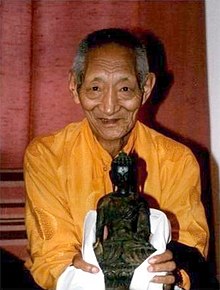 Kalu Rinpoche at Kagyu Rinchen Choiling in Montpellier , France , 1987 | |
| Religion | Buddhism |
| School | Vajrayana |
| Flow | Kagyu |
| Title | Rimpoche |
| Date of Birth | 1905 year |
| Place of Birth | Kam , eastern Tibet |
| Date of death | May 10, 1989 (84 years old) |
| Place of death | Kam , eastern Tibet |
| A country | Tibet |
Content
Biography
The early years
Kalu Rinpoche was born in East Tibet, in the Kam region. His father, a yogi and a doctor, was a direct student of three mentors, the founders of the extra- dimensional Rome movement. Among these three sages was Jamgon Kongtrul - the main creator and inspirer of this movement. Kyabje Kalu Rinpoche became one of the main spiritual successors of Jamgon Kongtrul.
At the age of thirteen, Kalu Rinpoche took monastic vows at the Pelpung Monastery, one of the main Kagyu monasteries in western Tibet. The abbot of the monastery was Tai Situpa . Very quickly, Kalu Rinpoche completed his training program and defended his doctorate (khenpo). At sixteen, Rinpoche ended up in the reclusive center of Kunzang Dechel Osal Ling, founded by Jamgon Kongtrul Lodre Taye. Here he went through the traditional three-year retreat led by Lama Norbu Tondrup. Subsequently, he received from him a complete transfer of the traditions of karma-kagyu and shangpa-kagyu . After retreat, Kalu Rinpoche continuously studied and practiced under the guidance of many lamas of different Tibetan lines and traditions.
At twenty-five, he decided to devote himself entirely to practice and for twelve years became a wandering monk, practicing solitary hermitage in the Himalayas. At thirty-seven years old, through stubborn efforts in this direction, Kalu Rinpoche became widely known as the “Master of Three-Year Retreat Meditation (Drubpon) from the Pelpung Monastery”.
At the age of forty, Kalu Rinpoche made many trips to Central Tibet, during which he passed the Five Golden Teachings to many famous lamas, revived the monasteries of the Jonang and Shangpa traditions and spread the Teaching. He later continued this activity in Kham and Western Tibet.
Tibet
In 1955, the political problems caused by the Chinese invasion of Kam forced Kalu Rinpoche to return to Central Tibet. In 1957, he went to Bhutan, having received an invitation to serve as head of several monasteries and confessor of the royal family. As the patriarch of the shangpa tradition, Kalu Rinpoche became one of the most revered spiritual mentors in the entire Tibetan tradition. In the last years of his life, he was invited by Karmapa XVI to teach prominent tulkus, holders of his line. On the advice of the Dalai Lama, he also taught geshe at monastery and tantric colleges.
India
In 1966, Kalu Rinpoche settled in Sonada ( India ), where he founded a monastery and hermitage centers, which became his main residence and center of the shangpa-kagyu tradition. In 1968, he met his first future student from the West.
Europe and America
With the blessings of the Karmapa and the Dalai Lama, Kalu Rinpoche went to the West. In 1971, he accepted an invitation from Western students and made his first trip to Europe and North America . Soon the first Dharma center in Canada was created and a meditation group formed in Paris .
During the second trip in 1974, numerous centers were created in Europe and America, for which Kalu Rinpoche entrusted the responsibility for the first group of his lamas. During the third trip in 1976-1977, he founded in France the first Western center of three-year hermitage. Fifteen lamas arrived with Kalu Rinpoche to teach the Dharma . During the trips of 1980 and 1982-1983. and in subsequent years, Kalu Rinpoche opened many Dharma centers and hermitage centers in Southeast Asia and other continents. Between 1971 and 1989, he made about ten long trips, many of which were around the world, founded about a hundred centers of Dharma and about twenty centers of three-year hermitage, which he entrusted to the care of more than thirty lamas - their students.
After the death of Kalu Rinpoche, his degenerate tulku was found, who, after passing through the traditional three-year shutter, took monastic vows and now lives the life of a layman [1] .
In Russian Culture
From the memoirs of Marina Vlady it is known about the audience that Kalu Rinpoche gave in France to her, Vladimir Vysotsky and Mikhail Shemyakin . The Buddhist parable told by Kalu Rinpoche allowed Vysotsky and Shemyakin to refrain from drinking for a long period. [2]
Bibliography
- Gemstones of various oral instructions.
- The foundation of Buddhist meditation.
- The heart of Buddhism.
- (in collection) The Bible of Buddhism. Collected works of Buddhist masters of antiquity and modernity.
- We all possess the nature of the Buddha - M .: Orientalia, 2010. - 107 p.
- The Rising Sun of Wisdom - Moscow: Orientalia, 2010 .-- 167 p.
- The Dharma of the Diamond Chariot - M .: Orientalia, 2012 .-- 216 p.
- Rainbow Heaven - M.: Orientalia, 2010 .-- 144 p.
Links
Notes
- ↑ Hooper J. Llamas found and lost again . Urton (July 18, 2015).
- ↑ Marina Vladi. Vladimir, or Interrupted flight. Soviet writer, M., 1990.