The Vendee Treaty is an alliance treaty between the Grand Duchy of Lithuania and the Livonian Order , concluded during the war of 1500-1503 and directed against the Grand Duchy of Moscow . The Union was agreed in Vilna on March 3, 1501 [1] at the meeting of the Master of the Livonian Order, Walter von Plettenberg, with the Grand Duke of Lithuania Alexander, who received it at his residence [2] . The agreement was signed on June 21, 1501 in Wenden ( Livonia ; now Cesis in Latvia ) - the residence of the Master of the Order [3] .
Content
- 1 Background of the contract
- 2 Execution of the contract
- 3 notes
- 4 Literature
Prerequisites for the contract
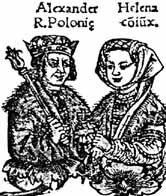
Despite the conclusion of peace in 1494, at the turn of the XV — XVI centuries, relations between the Russian state and Lithuania were growing tensions. The ground for a new war with Lithuania, which Ivan III Vasilievich began in 1500 , was the attempts of Alexander Yagellonchik to persuade the Orthodox population of the Grand Duchy of Lithuania to unite with Catholics , as well as the religious oppression of Jagellonchik against his daughter Ivan III, who had been Prince of Lithuania since 1495. legal spouse. The English historian Bane also names the desire of the Lithuanian court to convert Helen to the Roman faith among the most important causes of the Russian-Lithuanian war of 1500-1503 [4] .
The extradition of Elena Ioannovna (1476-1513) [5] to marry Jagiellonchik was one of the conditions of the Russian-Lithuanian peace treaty of 1494 . At the same time, the future husband, a Catholic, undertook to preserve his wife "Greek law", the Orthodox faith , and guaranteed that he would not force her to adopt Catholicism. However, when Elena asked Alexander to build a church for her in Vilnius Castle, Jagiellonchik refused her, referring to the old Jagailo ban on building new Orthodox churches in Lithuania. In the year of his wedding with the Russian Grand Duchess (1495), Jagiellonchik appointed Metropolitan Makarios, "the Metropolitan of Kiev completely devoted to Orthodoxy." After Makarii was killed near Mazyr in the spring of 1497 by a detachment of Crimean Tatars, Jagiellonchik appointed Iosif Bulgariaovich in his place - a champion of the adoption of the Florentine Union by the Orthodox in 1439 [6] .
The new metropolitan of Kiev elected Vilna [7] as his residence, from where in 1500 he openly informed Pope Alexander VI (1431-1503) about the alleged readiness of the Orthodox in Lithuania to accept the Florence Union [6] [8] . This reckless move of Joseph gave rise to the Catholic prelates of Lithuania and Poland to aggravate the situation. Having stated that they are against the conditions of the Union of Florence (which allowed the Orthodox to preserve their traditional rites), the Catholics essentially demanded that the Orthodox of Lithuania and Poland completely convert to Catholicism. The pressure increased and personally on Elena Ioannovna with the aim of forcing her to go to " latinism " [9] ; and in 1501 she lost. Alexander himself, according to D. Stone, saw for himself in this dynastic marriage, first of all, the opportunity to present claims, if possible, to the Moscow throne, and considered Elena herself only as a hostage to the fulfillment by Moscow of the terms of the agreement of 1494 [10] .
On July 24, 1499, Jagiellonchik and his brother, the Polish king Jan I Olbracht (1459-1501) updated the ancient Gorodelsky Union of 1413 . Having established in the new Gorodel Union that the Polish king cannot be elected without the consent of the Principality of Lithuania, and vice versa, the brothers paved the way for the subsequent combination of these posts, seeing this as a way to strengthen the "vertical of power" [11] .
In view of the increasing pressure of the Catholic Church on the Orthodox part of the population of the Polish-Lithuanian state, some of the Russian princes of the Orthodox faith who lived there began to go over to the side of Moscow "with their volosts and cities." [12] . Among them, at the beginning of 1500, Prince Simon Ivanovich Belsky took Moscow citizenship, with which his possessions, the city of Bely, to the south-west of Tver, withdrew from Moscow's control. The protest, which Jagiellonchik sent to Moscow with ambassadors, was rejected by Ivan III. Following Belsky, princes Semyon Ivanovich Starodubsky-Mozhaysky and Vasily Ivanovich Shemyachich Novgorod-Seversky expressed a similar desire to go to Moscow service. In their possession were such Russian cities as Novgorod-Seversky , Rylsk , Radogosh , Starodub , Gomel , Chernigov , Karachev , Khotiml [7] .
This meant considerable territorial and strategic losses for those who subjugated the Old Russian principalities. The transfer of Orthodox princes to the service of the sovereign of Moscow threatened punitive Polish-Lithuanian troops against both the “defectors” and Moscow. In anticipation of this outcome, Ivan III took preventive measures. In April 1500, clerk Ivan Ivanovich Teleshov and Athanasius Sheenok went to Vilna to declare war on the State of Lithuania and to accept the defected princes and lands to the Moscow state. After that, Lithuania moved its troops to defend its borders. A new Russian-Lithuanian war began [7] .
Already in its first battle - the Battle of Vedrosh on July 14, 1500 - a certain blow was dealt to the Lithuanian army. Some commanders of the Lithuanian army fell on the battlefield or were captured. On August 6 Putivl was taken; August 9 - Toropets , and then the estate of Prince S.I. Belsky - the city of Bely , which had already managed to occupy the Lithuanian troops by that time.
Lithuanian diplomats launched a broad campaign to find and attract allies to fight Moscow. Among those who eagerly responded and provided the most significant assistance to Lithuania was the master of the Livonian Order, Walter von Plettenberg . The contract was concluded at the master’s residence in the Venden Castle on June 21, 1501 .
Contract Execution
The first anti-Russian action on the part of the order in the context of the agreement concluded with Lithuania was carried out by Livonia not on the battlefield, but in the commercial Derpt , once owned by the Russians under the name Yuryev . 150 Pskov merchants were immediately arrested there, allegedly in connection with the theft. Pskov was the goal of the joint performance of Livonia and Lithuania, which was planned for July 25. However, 4 days before the signing of the treaty, on June 17, 1501, the brother of Jagiellonchik, the king of Poland, suddenly died in Torun , and the campaign plan was apparently changed [13] [14] .
The first clash of the troops of the Grand Duchy of Moscow with the troops of the Livonian Confederation took place on August 27, 1501 on the Seritsa River near Izborsk , which is in the middle of the route between Livonia and Pskov. Under the personal command of Master Walter von Plettenberg, the Livonians, well armed with modern firearms - field guns and hand- squeakers , took revenge [14] .
Inspired by the victory won by the Livonians over the Russian warriors alone, without the help of the Lithuanian warriors, Plettenberg tried to take the Izborsk fortress, and then take the fords across the Great River. However, military fortune has changed the master; Pskov repulsed his attacks, but the Lithuanians never arrived. The annoyed Plettenberg turned south, and on September 7 ravaged the city of Ostrov , where up to 4 thousand civilians died [15] , after which he hurried to Livonia, where he returned already on September 14. (Already after the departure of the Livonians, the late Lithuanian troops unsuccessfully stormed the Opochka fortress, after which they also retreated) [14] .
In the fall of 1501, Russian troops went on the offensive both on the lands of the Livonian Confederation and on Lithuania. D.V. Schenya avenged the Island by the devastation of northeastern Livonia and parts of Estonia ; with honor for the Russian soldiers ended the battle at the Gelmed castle with the Germans and the battle of Mstislavl with the Lithuanians (however, the city itself was not taken) [13] .
In the 1502 campaign, Plettenberg decided to repeat his attempt to take Pskov. Having learned that the main Russian forces were bogged down in the siege of Smolensk , the Livonian landmaster again threw his army on a campaign.
September 2, he unsuccessfully stormed Izborsk. Leaving behind the stubborn fortress in the rear, Plettenberg moved to Pskov, and already on September 6 his 25,000th army stood under the walls of this city. He only had the strength to besiege this city for 3 days, after which Plettenberg turned the army into winter apartments. This time, the Novgorod governors, princes D.V. Shchen and V.V. Shuisky, decided to pursue the retreating Livonians, and sent their regiments in pursuit [13] .
On September 13, at Smolina Lake, 12,000 Russian warriors overtook the 5,000th Livonian contingent commanded by Plettenberg himself. Perceiving the tactical regrouping of a well-trained army as flight, the Russian soldiers succumbed to euphoria and disturbed the order in the regiments. Meanwhile, the rebuilt Livonians launched a counterattack - and the battle at Lake Smolina ended in the defeat of more than twice the superior forces of the Russian army [14] .
The successes of the Russian troops on other battle fronts forced Jagiellonchik to abandon the continuation of the campaign for the next year, and on March 25, 1503, the king of Poland and the Grand Duke of Lithuania signed a six-year truce with Moscow [13] . In 1506, Alexander Jagiellonchik died, after which the Venden Treaty concluded by him lost its de facto force.
Moscow signed a separate truce with the Livonian Confederation as a party to the conflict on April 2, 1503 , guaranteeing the future inviolability of the borders of Livonia [13] . The guarantee turned out to be long-term and lasted for two generations: the next time the Russians met the Livonians on the battlefields only during the Livonian War , which began in 1558.
Notes
- ↑ Brief history of Latvia. XVI century
- ↑ Balthazar Russov . Chronicle of the Province of Livonia // Walter von Pletenberg, Forty-first Master of the Teutonic Order in Livonia, 1495–1535 = Balthasar Rüssow . Chronica der Provinz Lyfflandt. Rostock, 1578.
- ↑ Alexander Jagiellon // Brockhaus and Efron Encyclopedic Dictionary : in 86 volumes (82 volumes and 4 additional). - SPb. , 1890-1907.
- ↑ Robert Nisbet Bain. Slavonic Europe: a political history of Poland and Russia from 1447 to 1796 . - Cambridge University Press. - P. 46.
- ↑ Elena Ioannovna // Biographical Dictionary. - SPb.
- ↑ 1 2 Pozdnyakov V.S. Alexander Yagellonchik // Orthodox Encyclopedia . - M. , 2006 .-- T. 1 . - S. 541 . - ISBN 5-89572-017-X .
- ↑ 1 2 3 Borisov N.S. Ivan III . - The life of wonderful people. - M .: Young Guard, 2000. - ISBN 5-235-02372-2 .
- ↑ Kartashev, A.V. Essays on the history of the Russian Church. - M .: Nauka, 1991. - T. 1. - ISBN 5-02-008639-8 .
- ↑ Lurie, Ya. S. Elena Ivanovna, Grand Duchess of Lithuania . - Publications of the Institute of Russian Literature (Pushkin House) RAS.
- ↑ Stone, Daniel. The Polish – Lithuanian State, 1386–1795 . - University of Washington Press, 2001. - P. 33. - ISBN 0-295-98093-1 .
- ↑ Antanas Jusaitis. The history of the Lithuanian nation and its present national aspirations . - The Lithuanian Catholic Truth Society, 1918. - P. 156.
- ↑ Kazakov A.A. Moskovsko-Lithuanian struggle for the long-standing lands in the end of XV - to the cob of the XVI century // Abstract of thesis on the health of the science level of the candidate of historical sciences. - Zaporizhzhia, 1998.
- ↑ 1 2 3 4 5 Encyclopedia of the history of Russia. Russian-Lithuanian war (1500-1503) (inaccessible link)
- ↑ 1 2 3 4 Chronology of wars // Russian-Livonian-Lithuanian war 1500-1503. (inaccessible link) . Date of treatment September 24, 2010. Archived May 25, 2017.
- ↑ Pskov Chronicle. - M. , 1837. - S. 173.
Literature
- Alekseev Yu. G. Campaigns of Russian troops under Ivan III . - SPb. : Publishing House of St. Petersburg. Univ., 2007. - S. 463 + [3] separate cart. - Decree of personal names: C. 436-449. - Decree of geographical names: s. 450-459. - 1000 copies. - ISBN 5-288-04191-4 . Archived February 11, 2009 on Wayback Machine
- Volkov V.A. Wars and troops of the Moscow state (Pdf). - M .: Eksmo, 2004 ISBN 5-699-05914-8 . Date of treatment September 18, 2010. Archived May 26, 2012.
- Gudavičius E. History of Lithuania from Ancient Times to 1569 / Translation by G. I. Efremov. - M .: Batrus, 2005 .-- T. I. - ISBN 5-94953-029-2 .
- Borisov N.S. Ivan III . - The life of wonderful people. - M .: Young Guard, 2000. - ISBN 5-235-02372-2 .
- Kazakova N.A. Russian-Livonian and Russian-Hanseatic relations. The end of the XIV - the beginning of the XVI century. - L .: Science, 1975.
- Kartashev, A.V. Essays on the History of the Russian Church. - M .: Nauka, 1991. - T. 1. - S. 567. - ISBN 5-02-008639-8 .
- Razin E.A. The history of military art of the XVI-XVI centuries . - SPb. : Polygon, 1999 .-- S. 653. - ISBN 5-89173-040-5 .