
Virtual reality ( VR , English virtual reality , VR , artificial reality ) - a world created by technical means, transmitted to a person through his senses : sight, hearing, touch, and others. Virtual reality simulates both exposure and response to exposure. To create a convincing complex of sensations of reality, a computer synthesis of the properties and reactions of virtual reality is performed in real time .
Virtual reality objects usually behave close to the behavior of similar objects of material reality. The user can act on these objects in accordance with the real laws of physics (gravity, water properties, collision with objects, reflection, etc.). However, often for entertainment purposes, users of virtual worlds are allowed more than is possible in real life (for example: fly, create any objects, etc.) [1] .
Virtual reality should not be confused with augmented . Their fundamental difference is that the virtual constructs a new artificial world, and augmented reality only brings individual artificial elements to the perception of the real world.
Implementation
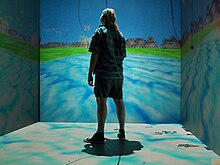
“Virtual reality” systems are devices that more fully, compared to conventional computer systems, simulate interaction with a virtual environment by affecting all five senses in a person.
Image
Currently, there are several basic types of systems that provide the formation and output of images in virtual reality systems:
Virtual Reality Helmet

Modern virtual reality helmets ( HMD-display ) are more likely glasses than a helmet, and contain one or more displays that display images for the left and right eyes, a lens system for adjusting image geometry, and a tracking system that tracks orientation devices in space. As a rule, tracking systems for virtual reality helmets are developed on the basis of gyroscopes , accelerometers and magnetometers . For systems of this type, a wide viewing angle, the accuracy of the tracking system when tracking tilts and turns of the user's head, as well as the minimum delay between detecting changes in the position of the head in space and displaying the corresponding image on the displays, are important.
MotionParallax3D Displays
This type of device includes many different devices: from some smartphones to virtual reality rooms (CAVE). Systems of this type form the illusion of a volumetric object in a user by displaying on one or several displays specially formed projections of virtual objects generated based on information about the position of the user's eyes. When changing the position of the user's eyes relative to the displays, the image on them changes accordingly. All systems of this type use the visual mechanism for perceiving a volumetric image of movement parallax (Motion Parallax). Also, for the most part, they provide stereo output using stereo displays , using stereoscopic vision . Tracking systems for MotionParallax3D displays track the coordinates of the user's eyes in space. For this, various technologies are used: optical (determining the coordinates of the user's eyes in the camera image, tracking active or passive markers), much less often - ultrasound. Often, tracking systems can include additional devices: gyroscopes , accelerometers, and magnetometers . For systems of this type, accuracy of tracking the user's position in space is important, as well as the minimum delay between detecting a change in the position of the head in space and displaying the corresponding image on the displays. Systems of this class can be performed in various forms - factors: from virtual rooms with full immersion to virtual reality screens with a size of three inches.
Virtual Retinal Monitor
Devices of this type project an image directly onto the retina. As a result, the user sees the image “hanging” in the air in front of him. Devices of this type are closer to augmented reality systems, since the images of virtual objects that the user sees are superimposed on images of real-world objects. However, under certain conditions (a dark room, a sufficiently wide retina coverage with an image, as well as in combination with a tracking system), devices of this type can be used to immerse the user in virtual reality.
There are also various hybrid options: for example, the CastAR system, in which obtaining the correct projection of the image on the plane is achieved due to the location of the projectors directly on the glasses, and stereoscopic separation due to the use of a retroreflective coating of the projected surface. But while such devices are not widespread and exist only in the form of prototypes.
At the moment, the most advanced virtual reality systems are projection systems , made in the layout of a virtual reality room (CAVE). Such a system is a room, on all walls of which a 3D stereo image is projected. The position of the user, the turns of his head are monitored by tracking systems , which allows to achieve the maximum effect of immersion. These systems are actively used for marketing, military, scientific and other purposes.
Sound
A multi-channel speaker system allows localization of the sound source , which allows the user to navigate in the virtual world with the help of hearing .
Imitation of tactile sensations
Imitation of tactile or tactile sensations has already found its application in virtual reality systems. These are the so-called feedback devices .
They are used to solve problems of virtual prototyping and ergonomic design, to create various simulators, medical simulators, remote control robots, including micro- and nano-, systems for creating virtual sculptures.
Gloves of Virtual Reality
Virtual reality gloves were created by specialists from the University of California at San Diego , using the technology of manufacturing soft robots. The author of the project is Michael Tolley, professor of mechanical engineering at the School of Engineering. Jacobs (Jacobs School of Engineering) of the above university.
Gloves allow you to feel a tactile response when interacting with objects of virtual reality, and have passed successful tests on a virtual simulator of playing the piano with a virtual keyboard. Unlike similar analogues, these gloves are made of a soft exoskeleton equipped with soft muscles designed for robots, which makes them much easier and more convenient to use. The tactile system consists of three main components:
- Leap Motion sensor (its function is to determine the position and movement of the user's hands);
- Mckibben muscles - latex cavities with braided material - which respond to movements created by the movement of the user's fingers;
- distribution board, whose task is to control the muscles themselves, which create tactile sensations.
It is planned that the gloves of virtual reality will find application not only in video games and digital entertainment, but also in surgery.
Management
In order to most accurately recreate user contact with the environment, user interfaces are used that most realistically correspond to the modeled ones: a computer steering wheel with pedals , device control sticks, a target designator in the form of a gun , etc.
For non-contact control of objects, both virtual reality gloves and tracking of hand movements carried out using cameras are used. The latter is usually implemented in a small area and does not require additional equipment from the user. [2]
Virtual reality gloves can be an integral part of a virtual reality suit , which tracks the change in the position of the whole body and also conveys tactile , temperature and vibration sensations .
The device for tracking the movements of the user can be a freely rotatable ball in which the user is placed, or can only be carried out using a virtual reality suit suspended in air or immersed in liquid. Techniques are also being developed for modeling odors . [3]
Direct connection to the nervous system
The devices described above affect the human senses , but data can be transmitted directly to the nerve endings, and even directly to the brain through brain interfaces [4] . A similar technology is used in medicine to replace lost sensory abilities [4] , but so far it is too expensive for everyday use and does not achieve the quality of data transfer acceptable for virtual reality transmission. Various physiotherapeutic devices and devices that reproduce the sensations of the real world in an altered state of consciousness (Radioson, etc.) are based on the same principle.
Application
Computer Games
Interactive computer games are based on the player’s interaction with the virtual world they create. Many of them are based on the identification of the player with the character of the game, visible or implied.
There is an established opinion that high - quality three-dimensional graphics are required for a qualitative approximation of the virtual world of the game to reality. If the virtual world of the game does not differ in graphic beauty, is sketchy, and even two-dimensional, the user can be immersed in this world due to the exciting game process (see stream ), the characteristics of which are individual for each user.
There is a whole class of simulation games of any kind of activity. Flight simulators , car simulators, various economic and sports simulators are common, the game world of which models physical laws that are important for this kind of physics , creating a model that is close to reality. Attractions of virtual reality , simulators of extreme sensations, where you do not need to risk your life or acquire special skills in order to fly on a hang glider or go downhill on skiing, are widespread.
Specially equipped simulators and a certain type of slot machines add other sensations to the output of the image and sound of a computer game / simulator, such as tilting a motorcycle or shaking a car seat. Similar professional simulators with appropriate real controls are used to train pilots .
Inconsistency of the user interface commands with the actions carried out in the game, its complexity can interfere with immersion in the game world. In order to solve this problem, not only a computer keyboard and mouse are used , but also a computer steering wheel with pedals , a target designator in the form of a gun and other game manipulators .
Training
Virtual reality is used to teach professions where the operation of real devices and mechanisms is associated with increased risk or is associated with high costs (airplane pilot, train driver, dispatcher, driver, mine rescuer, etc.).
Keiz Western Reserve University has agreed to introduce Microsoft augmented reality technology into student learning. [five]
Video
According to a survey conducted at the end of 2015, approximately 66% of respondents to the question of expectations from virtual reality indicated that they probably or definitely want to try all forms of interactive entertainment, including cinema, television or other video products [6] [ significance of fact? ]
Industry
Virtual reality technology is part of the fourth industrial revolution . It is used on assembly lines. [7]
History
Before the era of computer technology [8] , virtuality was understood as an object or state that does not really exist, but can arise under certain conditions [9] .
The concept of artificial reality was first introduced by Myron Krueger in the late 1960s . In 1964, Stanislav Lem in his book “ The Sum of Technology ” under the term “ Phantomology ” describes the tasks and essence of the answer to the question “how to create reality, which for sentient beings living in it, would not differ from normal reality, but would obey others the laws? ” The first virtual reality system appeared in 1962 , when Morton Heilig introduced the first prototype multi-sensory simulator, which he called Sensorama. The sensorama immersed the viewer in virtual reality with the help of short films, which were accompanied by smells, wind (using a hairdryer) and the noise of the megalopolis from audio recordings. In 1967, Ivan Sutherland described and constructed the first helmet, the image on which was generated using a computer. Sutherland's helmet made it possible to change images according to head movements (visual feedback).
In the 1970s , computer graphics completely replaced the videography previously used in simulators. The graphics were extremely primitive, but the important thing was that the simulators (these were flight simulators) worked in real time. The first implementation of virtual reality is considered to be the “ Aspen Movie Map ”, created at the Massachusetts Institute of Technology in 1977 . This computer program simulated a walk through the city of Aspen , Colorado , giving you the opportunity to choose between different ways to display the terrain. Summer and winter options were based on real photos.
In the mid -1980s , systems appeared in which the user could manipulate three-dimensional objects on the screen due to their response to hand movements. In 1989, Jaron Lanier introduced the now more popular term “virtual reality”. In the science fiction literature of the cyberpunk subgenre, virtual reality is a way of human communication with “cyberspace” - a kind of medium of interaction between people and machines created in computer networks.
Currently, virtual reality technologies are widely used in various fields of human activity: engineering and design, mining, military technology, construction, simulators and simulators, marketing and advertising, the entertainment industry, etc. The volume of the virtual reality technology market was estimated [ when? ] at $ 15 billion a year [10] .
Philosophical concept
Philosophy abstracts the idea of virtual reality from its technical embodiment. Virtual reality can be interpreted as the totality of objects modeled by real processes [11] , the content and form of which do not coincide with these processes. The existence of simulated objects is comparable with reality, but is considered apart from it - virtual objects exist, but not as substances of the real world. At the same time, these objects are relevant, not potential. The " virtuality " (imaginary, false appearance) of reality is established in relation to the underlying "underlying" reality. Virtual realities can be nested together. [12] At the completion of the modeling processes going on in the “main” reality, virtual reality disappears. [13]
Properties
Regardless of the implementation of virtual reality, the following properties can be distinguished in it (according to N. A. Nosov ) [14] [15] :
- generation (virtual reality is produced by another reality external to it),
- relevance (there is actual, at the time of observation, "here and now"),
- autonomy (has its own laws of being, time and space);
- interactivity (can interact with other realities, however, having independence).
According to the philosophical concept of S. S. Khoruzhiy, computer virtual reality can be characterized as a multi-mode being, that is, a being that allows many options and scenarios for the development of events [14] [16] .
Augmented Reality
Augmented reality - adding to the sensations of imaginary objects coming from the real world, usually of auxiliary inform