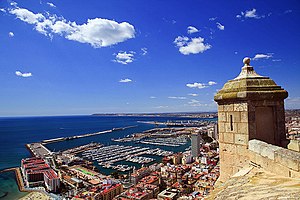
Alicante (Alacan) ( Spanish: Alicante , Cat. Alacant ) - a city in Spain as part of the autonomous community of Valencia , the center of the province of the same name. The city is located on the Mediterranean coast . In terms of population (330 thousand people), Alicante is the second in the Valencian community and 11th throughout the country.
| City | |||||||||
| Alicante, Alacan | |||||||||
|---|---|---|---|---|---|---|---|---|---|
| Spanish Alicante , cat. Alacant | |||||||||
| |||||||||
| |||||||||
| A country |  Spain Spain | ||||||||
| Autonomous community | Valencia Community | ||||||||
| Provinces | Alicante | ||||||||
| The mayor | Sonia Castedo Ramos | ||||||||
| History and Geography | |||||||||
| Based | |||||||||
| City with | 324 BC e. | ||||||||
| Square | 201.3 km² | ||||||||
| NUM height | 0 m | ||||||||
| Timezone | UTC + 1 , in summer UTC + 2 | ||||||||
| Population | |||||||||
| Population | 329 988 people ( 2017 ) | ||||||||
| Katoykonim | Alicante, Alicante [1] | ||||||||
| Official language | and | ||||||||
| Digital identifiers | |||||||||
| Telephone code | 966, 965 | ||||||||
| Postcode | 03000-03016 | ||||||||
| Car code | |||||||||
| alicante.es | |||||||||


![Flag [d]](http://upload.wikimedia.org/wikipedia/commons/thumb/2/29/Flag_of_Alicante.svg/160px-Flag_of_Alicante.svg.png)
![Coat of arms [d]](http://upload.wikimedia.org/wikipedia/commons/thumb/6/66/Escudo_de_Alicante_corona_abierta.svg/90px-Escudo_de_Alicante_corona_abierta.svg.png)
History
The fortified settlement on the site of the fishing harbor, which periodically included the ships of the ancient Greeks, was founded by the Carthaginian commander Hamilcar Barka , the father of Hannibal , in 230 BC. e. . This name (originating, in turn, from the Greek “Acre Levka” - “white peak”) was accepted by the Romans as “ ” and by the Arabs as “Al-Lacanth”, hence the modern name of the city. After the Reconquista, it belonged first to the Castilians, then to the Aragonese (hence the penetration of the Catalan language).
In the 19th century, with the laying of the railway line that connected Alicante with the central part of Spain, its importance as a large port city increased, and the development of industry began. The city grew, the city walls were demolished. During the entire Civil War of 1936-1939. the city was in the republican zone and suffered from bombing. José Antonio Primo de Rivera was shot in Alicante.
In the 1960s , Alicante became a center of tourism, accelerated growth of the city began, which continues to this day. Today, Alicante is the second largest city in the Valencian community, a major administrative center of the Costa Blanca and one of the fastest growing cities in Spain.
Population, Culture, Traditions
Population Growth
|
|
|
The population increased 2.5 times over the period 1950-1970-ies. (the economic boom in Spain, the rapid growth of tourism), since the late 1990s, immigration has contributed to the growth of the population.
Ethnic composition
In 2016, the share of foreigners in the population of Alicante was 12.6%. Representatives of 128 nationalities live in the city, of which the largest number are from Algeria (7427), Morocco (3587) and Romania (2930).
Cultures and Traditions
The main language of communication is Spanish, and the Valencian language (a variant of Catalan ) is also widely distributed and promoted by the authorities.
The day of St. John the Baptist is one of the most significant in Alicante. The official date for the celebration of St. John's Day is June 24, but in Alicante, the celebrations last for several days. In this form, the festival originated in 1928 as a competitor to the Valencian Fallas , held annually in March. The celebrations are called Hogueras de San Juan ( bonfires of St. John the Baptist ), since the culmination of the holiday on the night of June 24 is the making of bonfires on the beach, and on the night of June 25, tall and colorful figures located throughout the city are burned. And starting from June 26 at exactly midnight there is a series of launches of a grandiose fireworks on the beach.
Economics
82.4% of the population are engaged in services, primarily trade and tourism . Developed banking, education; has its own major university. 6.2% of the population are employed in industry. The basis of the economy is beach tourism, export of wine, olive oil, citrus fruits and fruits, light industry. The main industries are tobacco and food, as well as the production of cement and aluminum.
Transport
The city has an international airport , as well as a large port (it has regular connections with the Balearic Islands and Algeria ). Alicante is connected with other cities of Spain by a developed network of railways and highways.
In Alicante itself, in addition to buses, since 2003 a light rail transport system ( light metro ) has been operating, which will be significantly expanded in the future.
The main cities of the province of Alicante
Dénia , Altea , Jávea , Moraira, Benidorm , Villajoyosa , Elche , Crevillent, Vilhena, Orihuela, Torrevieja .
Attractions
Alicante is a famous tourist center of the Costa Blanca coast, a city whose architecture in a peculiar way combines elements of Greek, Roman, Moorish, Gothic styles, Baroque and Art Nouveau.
Iglesia de Santa María Church - Located near the Santa Bárbara Castle. The church of the XV - XVI centuries was built in the Gothic style on the site of a Muslim mosque , in honor of the victory over the Moors. Subsequently, the main altar and portal were rebuilt in the Baroque style . They can be seen today. In addition, the Church has beautiful paintings.
Fortress of Santa Barbara (Spanish: Castillo de Santa Bárbara). Located in the city center, on Mount Benacantil (Mount Benacantil) (166 m).
Museo de Arte del Siglo XX - Museo de la Asegurada ( Museum of XX century art) - is located in Plaza de Santa María . The museum has a very interesting collection of 20th-century paintings: works by Kandinsky , Braque , Ernst , Chagall , Picasso , Giacometti , Gris , Miro , as well as works by Spanish artists of the generation of the 50s : Alfaro , Kanogar , Mompo , Saura , Tapies , Sabel , Viola
From the church and museum, along Calle Mayor Street, which was the main shopping street of the city until the 19th century , you can go to Plaza del Ayuntamiento, where Ayuntamiento (city hall ) is located. This building is famous for the wonderful 18th-century baroque facade by the local architect Lorenzo Chapuli .
Each year, in June, the traditional festival of the summer solstice or St. John the Baptist celebrates, ending on June 24 with the lighting of numerous bonfires on the streets and squares of the city.
The Cathedral of San Nicolas de Bari is located behind Ayuntamiento , on a parallel street. It was built in 1662, dedicated to the patron saint of Alicante - San Nicolás de Bari and is considered one of the most significant historical monuments of the city. After the civil war of 1936 - 39 years, the cathedral was restored. The facade of the cathedral is a work of Juan de Herrera ( Spanish: Juán de Herrera ), the architect who designed the monastery of the famous Escorial , near Madrid . In the cathedral there is a beautiful gilded altar surrounded by openwork lattices, as well as altars in the fancy churriguera style (Spanish Baroque of the early 18th century).
The El barrio de Santa Cruz district (located next to the cathedral) is the only Moorish part of the old city that has remained almost untouched, where the Moors lived after the victory of Christians.
Museo Arqueológico Provincial (Archaeological Museum) - Palacio de la Diputación. Among the exhibits: ceramics and household items of the Moors and other peoples who left their mark in the history of Alicante.
Rambla de Méndez Núñez is the “heart” of Alicante. This street hosts all official processions and parades, religious and holiday processions. La Rambla begins in the city center, near the market, and ends on the promenade in the Paseo Marítimo and Explanada de España areas.
Paseo Marítimo - Seaside Boulevard, a favorite place for walks of citizens and tourists. Paseo Marítimo with its wonderful palm alley has many shops, restaurants, bars, cafes. The alley, paved with scarlet, beige and white marble tiles, gives the impression of an isolated calm island in the bustle of a modern city.
Monastery El Monasterio de Santa Verónica / de Santa Faz - located 5 km from the city, by the highway, in the direction of Valencia. Built in 1766 in the Renaissance style, the portal is in the Baroque style . There is also a 16th-century fortress tower. Every year in May, more than 50,000 pilgrims and roving merchants, with staffs decorated with sprigs of rosemary, come to the monastery on the feast of St. Lic (Santa Faz) to honor the canvas with the Holy Face of Jesus Christ, brought in 1489 in Alicante from Rome. Plato of St. Veronica , a piece of canvas on which the facial features of Jesus Christ are depicted; according to non-canonical sources, Saint Veronica wiped the bloody sweat from the face of Jesus with this canvas.
Notes
- ↑ Gorodetskaya I. L., Levashov E. A. Alicante // Russian names of inhabitants: Dictionary-reference. - M .: AST , 2003 .-- S. 25. - 363 p. - 5,000 copies. - ISBN 5-17-016914-0 .
Links
Literature
- Alicante / T.A. Galkina // A - Questioning. - M .: Big Russian Encyclopedia, 2005. - P. 489. - ( Big Russian Encyclopedia : [in 35 vols.] / Ch. Ed. Yu. S. Osipov ; 2004—2017, vol. 1). - ISBN 5-85270-329-X .
- Alicante // Encyclopedic Dictionary of Brockhaus and Efron : in 86 volumes (82 volumes and 4 additional). - SPb. , 1890-1907.